OpenRouter Joins Stripe, New Frontier Models, and Agentic Workflows
August brings major updates: OpenRouter's Stripe integration, 1M-context models, India's AI benchmarks, and workflow automation.

OpenRouter is joining forces with Stripe. The core experience remains unchanged: the same mission, same name, same product, and the same roadmap. Existing integrations are unaffected by the change. The transaction is subject to customary closing conditions and is expected to close in the coming weeks.
New Models and Capabilities
The frontier model landscape saw significant releases this week:
- GLM-5.3 introduces a 1M-token context window designed for extended software engineering tasks.
- Grok 4.6 expands its coding and STEM capabilities with a 500K context window.
- Gemini 3.7 Flash combines 1M context with speed optimized for agent workloads.
- DeepSeek V4 Pro reached general availability.
- Qwen3.8 Max debuted as Alibaba's new flagship model, alongside an open-weight sparse variant.
The open-weight ecosystem also saw movement. Meta released Muse Glimmer 30B, distilled from Muse Spark for consumer hardware. NVIDIA launched Nemotron 3.5 Lightning, running 3B active parameters for throughput-focused agents.
For a limited time, GPT-5.6 Sol and Gemini 3.7 Flash are available at a 50% discount on OpenRouter. The Sol discount applies to batch, flex, and priority tiers.
Cost and Analytics
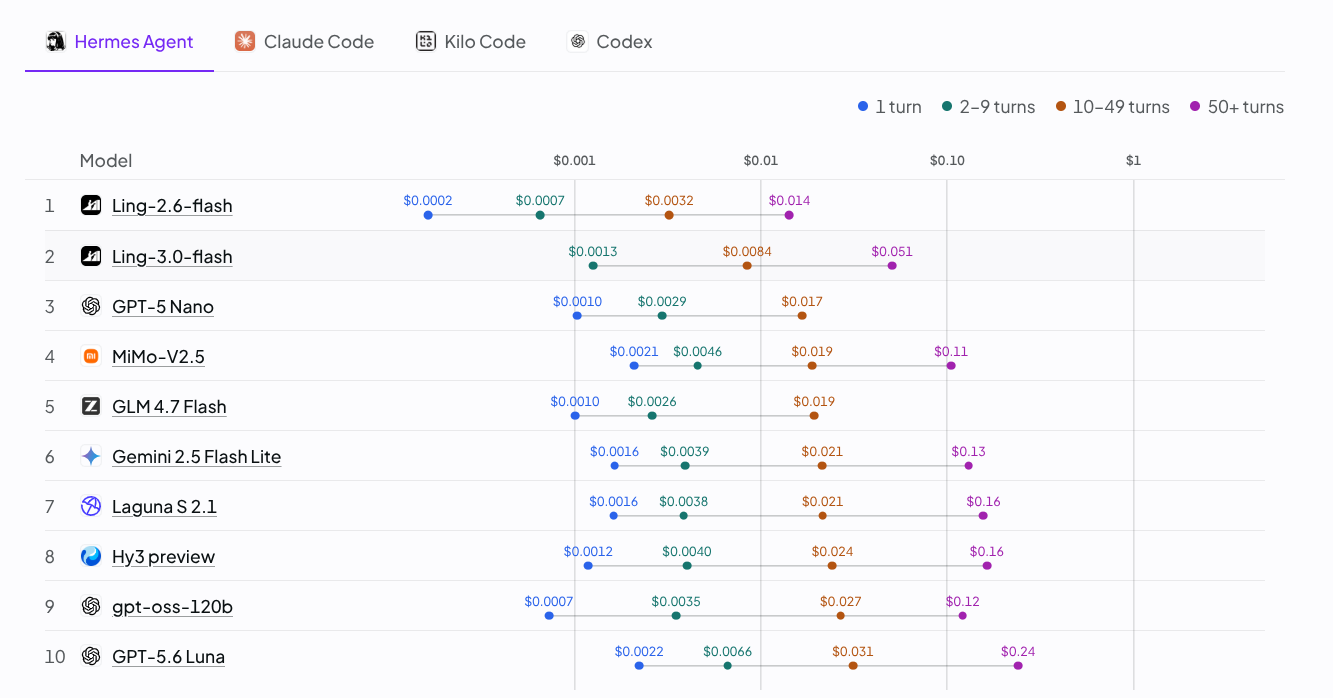
The latest agent cost data highlights a critical trend for developers running extended workflows: while single-turn costs are negligible across the board, long multi-turn agent loops reveal massive price disparities. For a 50+ turn execution (such as a complex Claude Code or Hermes Agent task), heavy models like GPT-5.6 Luna reach up to $0.24 per run. In contrast, smaller or open-weight alternatives like Ling-2.6-flash and gpt-oss-120b remain exceptionally economical, costing as little as $0.014 to $0.12 for the exact same volume of turns. This stark contrast makes dynamic model routing essential for scaling agentic applications without burning through your budget.
For evaluation, the ori CLI now runs supported coding harnesses on OpenRouter with an optimized out-of-the-box configuration. Additionally, Ori Eval allows you to benchmark models against your own custom prompts.
India Enters the AI Model Race
India has officially entered the AI model builder space, but recent data shows it is still playing catch-up with the frontier.
According to Artificial Analysis, which tracks 610 models across agentic work, coding, and reasoning benchmarks, India currently ranks eighth globally. The country's best model is Sarvam 105B, built by Bengaluru-based Sarvam AI. It scores 11.9 on the Intelligence Index, trailing significantly behind Anthropic’s Claude Opus 5 (63) and China’s Kimi K3 (60). Even non-frontier open-weight models, like OpenAI’s gpt-oss-120B (24), currently score double that of Sarvam.
Sarvam 105B is a 106-billion-parameter mixture-of-experts model with roughly 10.3 billion active parameters and a 128K context window. It was trained entirely in India through the IndiaAI Mission and released under the Apache 2.0 license.
The Cost Advantage Where Sarvam stands out is cost. At ₹29.28 per million input tokens and ₹73.2 per million output tokens, it is roughly 15 times cheaper for input and 30 times cheaper for output compared to Claude Opus 5. Similar to China's approach, India could see significant adoption of inexpensive, open-weight models even if they do not match US frontier benchmarks.
Consumer First, Builder Second OpenRouter data from Bloomberg Businessweek shows India generated around 9 trillion tokens between January and July, making it the platform’s 10th-largest market. However, 51% of that traffic went to US models and 43% to Chinese models. India remains a major consumer of AI, rather than a primary builder.
It is worth noting that current benchmarks do not evaluate models in Indian languages. Sarvam claims state-of-the-art performance across 22 Indian languages, a capability completely missed by global frontier rankings, and potentially the opening India needs to compete.
Structuring Your Agentic Workflow
The most effective AI workflows are moving away from single-prompt interactions and toward structured agent pipelines. Instead of relying on brute-force testing, the new standard is delegating specific tasks to specialized agent tools.
Here is how you can optimize your workflows using the distinct capabilities of tools like Claude Code and Hermes Agent:
- Claude Code for Autonomous Engineering: Anthropic's CLI tool operates directly in your local terminal through an agentic loop: Gather Context, Take Action, and Verify Results. Rather than just generating code, it navigates your file system, reads error logs, runs tests, and executes multi-file refactors. It also supports extensibility primitives like custom Skills, Subagents, and the Model Context Protocol (MCP). You should use Claude Code when your workflow requires deep, context-aware modifications to an existing project.
- Hermes Agent for Compounding Workflows: Hermes Agent is currently the most popular agent on OpenRouter because it shifts the paradigm from simple task-based chatbots to a "compounding agent." Developed by Nous Research, it builds its own persistent capabilities the longer you use it. It features deep cross-session memory, meaning it retains project history and user preferences instead of treating every prompt as day one. Furthermore, it autonomously writes and refines its own reusable markdown-based skills to handle repetitive tasks. It also delegates work to isolated, short-lived sub-agents to keep context windows tidy and efficient. You can use it across hundreds of model providers under an open-source MIT license.
- OpenRouter for Dynamic Orchestration: You do not need to lock your entire workflow into a single provider. Use OpenRouter to assign different parts of your pipeline to the most efficient models. You can route simple data parsing to a fast, inexpensive model, while reserving a frontier model for complex reasoning.
By matching the tool to the specific task, you can build pipelines that perform reliably on multi-step problems without constant manual intervention.
Automating Your Job Search with Career-Ops
If you are looking for a practical application of agentic workflows, Career-Ops offers an open-source example built for the job market (available on GitHub).
Career-Ops uses AI agents to streamline how you search and apply for roles. Instead of manually parsing requirements and rewriting documents for every application, the tool's agentic features automate the repetitive parts of the process. It analyzes job descriptions, matches them against your background, and structures targeted application materials. This allows you to approach the job search systematically, scaling your applications without sacrificing relevance.
Benchmarks and Usage
Web search capabilities are now graded in public. Live benchmarks evaluate web-search configurations (engine, depth, model) across four task suites, scoring them on quality, cost, and speed.
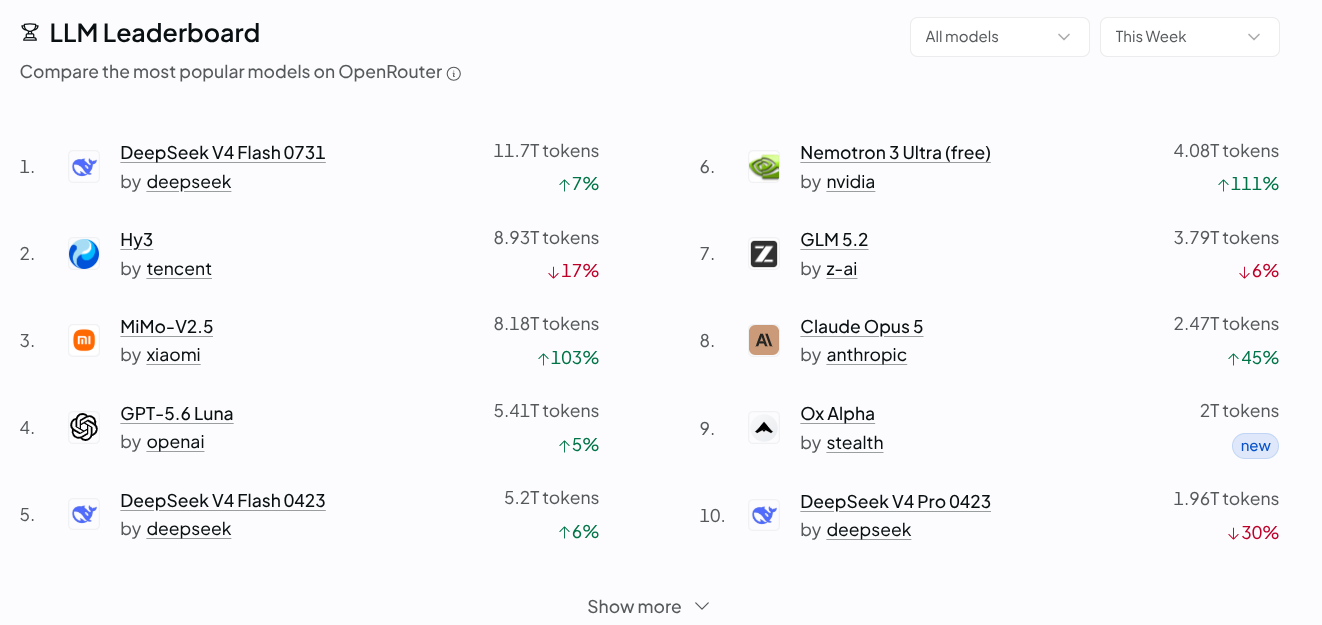
Usage trends show shifting preferences:
- DeepSeek V4 Flash is currently the most-used model on OpenRouter, processing 11.4T tokens this week.
- Claude Opus 5 usage grew 61% week-over-week.
- Gemini 3.7 Flash processed over a trillion tokens within six days of its launch.
All of these updates are live on OpenRouter now.
© Copyright, 2026, EulerFold • Maharashtra, India