
Differential Privacy: Calibrating Noise to Sensitivity in Private Data Analysis
Cynthia Dwork et al. (Microsoft Research, 2006)
Dwork, C., McSherry, F., Nissim, K., & Smith, A. (2006). Calibrating noise to sensitivity in private data analysis. In Theory of Cryptography Conference (pp. 265-284). Springer.
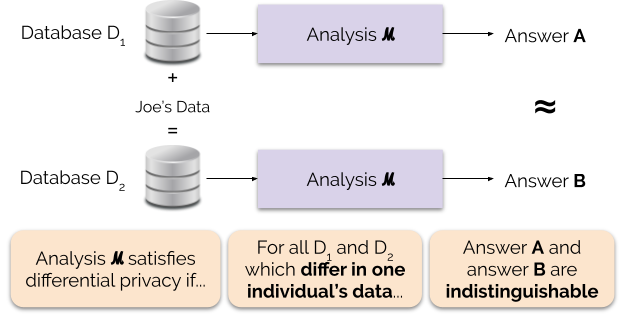
In 2006, Cynthia Dwork and colleagues introduced differential privacy, a mathematical framework for private data analysis that provides a formal guarantee of individual anonymity within large datasets. This research addresses the vulnerability of traditional "de-identification" methods - such as removing names or social security numbers - to linkage attacks, where an adversary combines disparate data sources to re-identify individuals. The researchers proved that by adding carefully calibrated noise to the output of a query, a system can ensure that the presence or absence of any single individual does not significantly alter the analytical results, establishing a rigorous foundation for privacy-preserving data science.
The Privacy Loss Budget and Epsilon-Indistinguishability
The fundamental innovation of differential privacy is the introduction of a privacy loss budget, denoted by the parameter epsilon (). Epsilon provides a formal mathematical measure of the maximum amount of information that can be leaked about any individual participant. A smaller indicates stronger privacy but lower data utility, while a larger allows for higher accuracy at the cost of reduced privacy. This methodological choice transformed privacy from a binary state into a tunable parameter that can be managed over the lifecycle of a dataset. It established the principle that "perfect" anonymity is a function of the statistical indistinguishability between a dataset containing a specific person and one that does not.
Calibrating Noise to Query Sensitivity
The technical mechanism for achieving differential privacy is the addition of random noise drawn from a specific distribution, such as the Laplace distribution, to the results of a query. The magnitude of the required noise is determined by the "sensitivity" of the query - the maximum amount that the inclusion of any single individual's record could change the final answer. For instance, a query for the "average age" of a population possesses low sensitivity, while a query for the "maximum salary" possesses high sensitivity. By anchoring the noise level to the structural properties of the question, the system masks individual contributions while preserving the global statistical trends of the group. This finding revealed that the "signal" of the population can be extracted without compromising the "privacy" of the person.
Resistance to Auxiliary Information and Linkage
Unlike traditional anonymity techniques, differential privacy is mathematically resistant to any current or future auxiliary information an adversary might possess. Because the guarantee is rooted in the inherent randomness of the response, it does not matter what other databases exist; the privacy of the individual remains protected by the controlled overlap of probability distributions. This realization proved that the only way to ensure robust privacy in a high-dimensional information environment is to ensure that the Act of data analysis is itself a stochastic process. This philosophical shift has established differential privacy as the standard for large-scale data releases by organizations including the U.S. Census Bureau and technology companies like Apple and Google.
Impact on Secure Machine Learning and Ethics
The practical significance of differential privacy is evidenced by its integration into the training of machine learning models to prevent the "memorization" of sensitive training examples. By injecting noise during the gradient descent process (DP-SGD), developers can ensure that the resulting models do not leak private user data during inference. This application proved that the scalability of data-driven systems is determined by the adoption of architectures that prioritize the systematic management of informational leakage. The work transformed the Act of data sharing into a rigorous engineering discipline, suggesting that the most effective way to protect the individual is to ensure that the truth of the whole is decoupled from the truth of the part.
Dive Deeper
Calibrating Noise to Sensitivity (Official DOI)
Springer • docs
Explore ResourceDifferential Privacy (MIT PDF)
MIT • docs
Explore ResourceDifferential Privacy Explained (Video)
Simply Explained • video
Explore ResourceDifferential Privacy Overview (Harvard)
Harvard • article
Explore Resource
Discussion
0Join the discussion
Sign in to share your thoughts and technical insights.
Loading insights...
Recommended Readings
The author of this article utilized generative AI (Google Gemini 3.1 Pro) to assist in part of the drafting and editing process.