
Special Relativity: How Einstein Rewrote Our Understanding of Time and Space
Albert Einstein (1905)
Einstein, A. (1905). Zur Elektrodynamik bewegter Körper. Annalen der physik, 4, 891-921.
In 1905, Albert Einstein published a paper addressing a fundamental contradiction between Newtonian mechanics and Maxwell’s equations of electromagnetism. The prevailing physical model assumed that light waves traveled through an stationary medium called the luminiferous ether, but experimental evidence, such as the Michelson-Morley results, failed to detect any relative motion of the Earth through such a substance. Einstein resolved this discrepancy by postulating that the speed of light in a vacuum is a universal constant, independent of the motion of the source or the observer, and that the laws of physics are identical in all inertial frames of reference.
The Relativity of Simultaneity
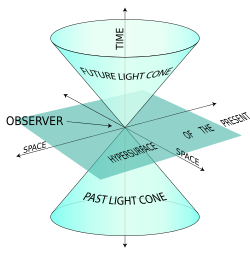
A critical conceptual shift introduced in the paper was the realization that simultaneity is not an absolute property of events. Einstein demonstrated that two events occurring at the same time for one observer may be perceived as occurring at different times by another observer in relative motion. By analyzing the perception of light signals from different frames of reference, he proved that the concept of a universal "now" is physically invalid. This finding dismantled the Newtonian assumption of an absolute time that flows at a constant rate for all observers. It revealed that time is a measurement relative to an observer's state of motion, effectively requiring the integration of space and time into a single four-dimensional manifold.
The Lorentz Transformation and Geometric Invariance
To formalize these observations, Einstein utilized the Lorentz transformation to relate the space and time coordinates of observers in relative motion. These equations show that as an object’s velocity increases, its length in the direction of motion contracts and its internal clock slows down from the perspective of a stationary observer. These effects, known as length contraction and time dilation, are necessary consequences of the constancy of the speed of light. While individual measurements of space and time vary between frames, the transformation preserves the interval between events - a four-dimensional distance that remains invariant for all observers. This revealed that the underlying geometry of spacetime remains constant even as its component dimensions adjust relative to motion.
Mass-Energy Equivalence and the Speed of Light Limit
Einstein extended the principles of special relativity to demonstrate that mass and energy are manifestations of the same physical property. As an object is accelerated, the energy added to the system increases its relativistic mass, requiring progressively more energy for further acceleration. This relationship is defined by the mass-energy equivalence formula, proving that matter contains a reservoir of potential energy proportional to its mass. This property also establishes the speed of light as the universal speed limit for any object with mass, as reaching such a velocity would require an infinite amount of energy. This finding provided a technical explanation for the deep symmetry between matter and the forces that govern its motion.
Spacetime as a Dynamic Framework
The paper transitioned physics from the study of isolated objects to the study of the geometric relationships between them. By proving that time and space are flexible and observer-dependent, the theory provided the foundation for modern particle physics and general relativity. The invariance of the speed of light became the central constant around which all other physical quantities must adjust, implying that the properties of the universe are determined by its topological structure. This leaves open the question of how the relativistic manifold of spacetime can be unified with the non-deterministic framework of quantum mechanics.
Dive Deeper
Special Relativity (English Translation)
Fourmilab • docs
Explore ResourceEinstein's 1905 Papers (Britannica)
Britannica • article
Explore Resource
Discussion
0Join the discussion
Sign in to share your thoughts and technical insights.
Loading insights...
Recommended Readings
The author of this article utilized generative AI (Google Gemini 3.1 Pro) to assist in part of the drafting and editing process.