
Karger's Min-Cut Algorithm: Solving Graph Cuts with Randomness
David Karger (1993)
Karger, D. R. (1993). Global min-cuts in RNC, and other ramifications of a simple min-cut algorithm. In Proceedings of the fourth annual ACM-SIAM Symposium on Discrete algorithms (pp. 21-30).
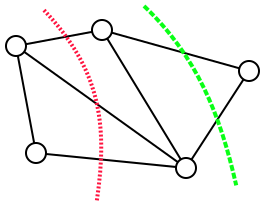
In 1993, David Karger introduced a randomized algorithm for finding the minimum cut of a connected graph using a process of edge contraction. Prior to this research, deterministic methods for identifying the global min-cut - the smallest set of edges whose removal partitions a graph - relied on complex flow-based calculations with higher computational overhead. Karger demonstrated that by repeatedly selecting edges at random and merging their endpoints, the global minimum cut can be identified with a predictable probability of success, providing a scalable framework for network partitioning and cluster analysis.
Randomized Edge Contraction and Graph Reduction
The core technical mechanism of the algorithm is the randomized contraction of edges to reduce the complexity of the graph. In each step, an edge is selected uniformly at random and its two vertices are merged into a single super-node. Any self-loops created by this process are removed, while multi-edges between the new super-node and remaining vertices are preserved. This contraction is repeated until only two vertices remain. The number of edges between these final vertices represents a candidate for the global min-cut. This finding revealed that the structural properties of a network can be derived through a sequence of local, stochastic transformations rather than global search.
Success Probability and Trial Amplification
The efficiency of Karger's algorithm is defined by its rigorous bound on the probability of finding the optimal cut in a single pass. Karger proved that for a graph with vertices, the probability that a specific min-cut survives the contraction process is at least . While this probability is small for large graphs, the failure rate can be reduced to less than by repeating the algorithm times and selecting the smallest result. This methodological choice established that computational reliability can be achieved through the strategic repetition of independent, probabilistic trials, effectively trading redundant execution for algorithmic simplicity.
Theoretical Complexity and Parallel Implementation
The computational significance of the contraction algorithm is its amenability to parallelization, reaching the class RNC (Randomized Nick's Class). Unlike traditional flow-based algorithms that are difficult to execute in parallel, the independent nature of the contraction trials allows them to be distributed across thousands of processing cores simultaneously. This finding proved that the scalability of network optimization tools depends on the transition from serial deterministic logic to parallelizable probabilistic frameworks. This has established the algorithm as a standard benchmark for measuring the performance of high-concurrency systems in big data analytics.
Applications in Image Segmentation and Clustering
The practical utility of the randomized min-cut is most evident in the fields of image processing and community detection. In these domains, the graph represents relationships between pixels or social nodes, and identifying the min-cut facilitates the isolation of discrete segments or groups. By providing a method that is both fast and structurally simple, Karger's work enabled the development of real-time segmentation tools that can operate on massive datasets without the overhead of max-flow computations. This application demonstrated that the most robust way to analyze a complex system is to identify the most efficient probabilistic paths to its structural minimums.
The Logic of Stochastic Partitioning
The success of this work demonstrated that many global optimization problems can be resolved through the persistent application of random local choices. The decision to use randomized contraction revealed that the connectivity of a network is not a monolithic property that requires exhaustive inspection, but a set of relationships that can be sampled with high confidence. This principle remains central to modern research in randomized algorithm design and graph theory. It leaves open the question of how these contraction methods can be optimized for dynamic or evolving graphs where the min-cut may shift as new data is incorporated into the system.
Dive Deeper
Global Min-Cuts in RNC (Official DOI)
ACM • docs
Explore ResourceKarger's Algorithm (Wikipedia)
Wikipedia • article
Explore ResourceRandomized Algorithms (Video Intro)
YouTube • video
Explore Resource
Discussion
0Join the discussion
Sign in to share your thoughts and technical insights.
Loading insights...
Recommended Readings
The author of this article utilized generative AI (Google Gemini 3.1 Pro) to assist in part of the drafting and editing process.