Kitaev's Toric Code: Storing Quantum Data in Geometric Shapes
Alexei Kitaev (1997)
Kitaev, A. Y. (2003). Fault-tolerant quantum computation by anyons. Annals of Physics, 303(1), 2-30.
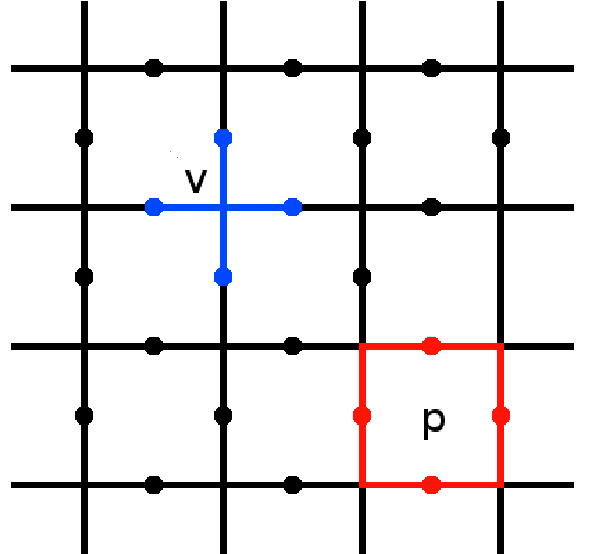
In 1997, Alexei Kitaev introduced the toric code, a model for fault-tolerant quantum memory that utilizes the global topological properties of a two-dimensional lattice to protect information from local noise. Prior to this research, quantum error correction relied on active, software-level parity checks to detect and reverse decoherence. Kitaev demonstrated that by encoding logical qubits into the degenerate ground state of a gapped Hamiltonian, information can be made intrinsically resilient to any perturbation that does not span the entire system. This finding established the field of topological quantum computing, where the robustness of a machine is a consequence of the geometry of its state space.
Topological Degeneracy on the Torus
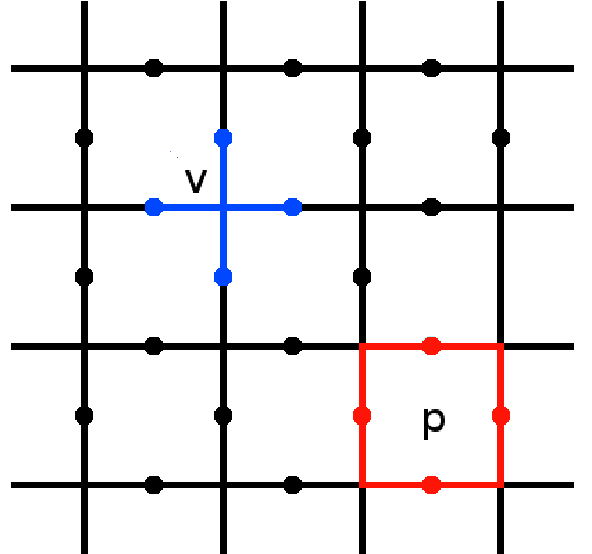
The core technical mechanism of the toric code is the definition of a stabilizer code on a square lattice with periodic boundary conditions. Qubits are positioned on the edges of the lattice, and the Hamiltonian is constructed from two types of commuting operators: vertex stars () and face plaquettes (). The ground state of the system is the subspace where all stabilizer conditions are satisfied (). On a surface with non-trivial topology, such as a torus, this ground state possesses a four-fold degeneracy that cannot be distinguished by any local measurement. This methodological choice proved that information can be stored in the global winding numbers of a lattice, ensuring that the energy required to flip a logical qubit scales with the linear dimensions of the system.
Anyonic Excitations and Braiding Statistics
Excitations in the toric code behave as anyons - quasi-particles that exist only in two dimensions and exhibit exchange statistics distinct from bosons and fermions. Violation of a vertex stabilizer creates a "charge" excitation (), while violation of a plaquette stabilizer creates a "flux" excitation (). These anyons are created in pairs at the endpoints of string operators. Moving an particle in a complete loop around an particle results in a phase shift of , a signature of abelian anyonic statistics. This finding demonstrated that the fundamental operations of a quantum computer can be executed through the physical transport and braiding of protected quasi-particles, effectively replacing fragile gate sequences with robust topological trajectories.
Error Correction as an Energy Gap
The technical significance of the toric code is its provision of passive protection against decoherence. In a gapped topological phase, local environmental interactions only create pairs of anyons that remain localized near the site of the noise. As long as these anyons do not traverse the entire manifold to annihilate with their partners, the logical state remains unchanged. This discovery transitioned the study of fault-tolerance from algorithmic overhead to the search for physical materials - such as fractional quantum Hall systems - that naturally possess these gapped ground states. It established the principle that the most reliable way to preserve a quantum state is to ensure that the logical information is decoupled from the local degrees of freedom of the hardware.
Transition to Surface Codes and Real-World Hardware
While the original toric code requires periodic boundary conditions that are difficult to implement on planar chips, its logic directly enabled the development of the Surface Code. By utilizing a 2D lattice with open boundaries and alternating measurement types, researchers created a practical framework for fault-tolerant hardware that only requires nearest-neighbor connectivity. This application remains the primary architectural blueprint for large-scale superconducting and trapped-ion processors. The work proved that the algebraic complexity of quantum error correction can be mapped onto the physical arrangement of a semiconductor or superconducting lattice, digitalizing the management of noise through structural design.
Topology as a Computational Resource
The achievement of Alexei Kitaev demonstrated that the complexity of computational systems is most accurately understood through the invariants of their underlying manifold. The decision to model memory as a topological phase revealed that the primary constraint on quantum computing was the locality of error processes. This principle remains the central theme in the development of non-abelian anyon systems, such as Majorana zero modes, which seek to implement universal computation through the braiding of even more complex quasi-particles. It leaves open the question of whether there exist higher-dimensional topological orders that can achieve similar protection with significantly lower physical overhead.
Dive Deeper
Fault-Tolerant Computation by Anyons (Official DOI)
ScienceDirect • docs
Explore ResourceKitaev Toric Code (Original arXiv)
arXiv • docs
Explore ResourceTopological Quantum Computing (Wikipedia)
Wikipedia • article
Explore ResourceIntroduction to Anyons (Video)
YouTube • video
Explore Resource
Discussion
0Join the discussion
Sign in to share your thoughts and technical insights.
Loading insights...
Recommended Readings
The author of this article utilized generative AI (Google Gemini 3.1 Pro) to assist in part of the drafting and editing process.