OS-Atlas: A Foundation Action Model for Universal Computer Use
Zheng et al. (2024)
Zheng, Y., et al. (2024). OS-ATLAS: A Foundation Action Model for Generalist GUI Agents. arXiv preprint arXiv:2410.23218.
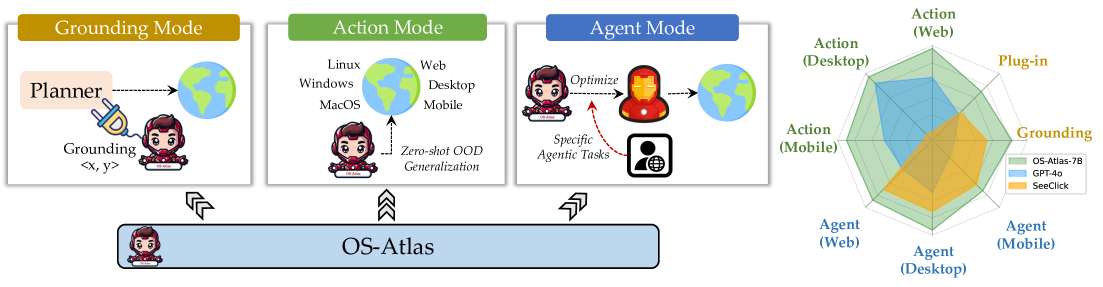
The transition from text-based LLMs to generalist GUI agents requires solving the "grounding problem" - the precise mapping of natural language intent to spatial coordinates on a visual interface. OS-Atlas addresses this not as a reasoning task, but as a foundational vision-action alignment problem. By synthesizing a corpus of 13 million elements across Windows, macOS, Linux, Android, and the Web, the researchers provided the first open-source alternative to proprietary "computer use" systems, proving that the visual grammar of interfaces is universal enough to support a foundational model.
AnyRes: Solving the Resolution Disparity

A fundamental bottleneck in GUI grounding is the pixel-density of modern displays. Standard vision transformers (ViTs) typically downsample inputs to or , which destroys the spatial features of small UI components like checkboxes or nested menu icons. OS-Atlas employs an AnyRes tiling mechanism (utilizing the InternVL-2 backbone) that dynamically segments a high-resolution screenshot into up to six individual tiles. These tiles are processed in parallel with a global downsampled thumbnail. This hierarchical vision allows the model to retain a global semantic map of the window layout through the thumbnail while maintaining the granular, high-frequency spatial features in the tiles needed for precise coordinate prediction. This "dual-track" vision is the primary reason OS-Atlas achieves high Intersection over Union (IoU) scores where standard VLMs fail, treating the screen as an information-complete medium where every pixel matters.
The Data Synthesis Toolkit (OS-Crawler)
The scarcity of high-quality GUI grounding data led the researchers to develop a multi-platform synthesis toolkit. Instead of manual labeling, the toolkit uses platform-specific accessibility APIs - pyatspi for Linux, pywinauto for Windows, ApplicationServices for macOS, and UIAutomator for Android - to programmatically extract metadata and accessibility trees. By automatically interacting with thousands of applications, the toolkit labels UI elements with their functional roles (Button, Slider, Input) and their precise bounding boxes. This automated "crawler" allowed the team to scale their pre-training data to 13 million elements, an order of magnitude larger than previous open-source datasets like ScreenSpot. This scale is what allows the model to understand that a magnifying glass icon in a Linux terminal has the same functional utility as a search bar in a macOS web browser.
Unified Action Spaces and Zero-Shot OOD
To enable cross-platform agency, OS-Atlas maps thousands of platform-specific event types into a Unified Action Space consisting of 10 fundamental actions: CLICK, TYPE, SCROLL, DRAG, HOVER, RIGHT_CLICK, DOUBLE_CLICK, KEY_COMBINATION, WAIT, and FINISH. This abstraction is critical; a "tap" on Android and a "click" on Windows are semantically identical to a user but architecturally different to a system. By standardizing these into a single "action grammar," the model is forced to learn the functional semantics of the interface rather than memorizing platform-specific shortcuts.
This architectural choice drives the model's Out-Of-Distribution (OOD) performance. In ScreenSpot and Mind2Web benchmarks, OS-Atlas demonstrated an ability to navigate software it had never seen during training, such as niche CAD tools or custom enterprise ERP systems. The researchers observed that grounding precision - the ability to hit the center of a button within a few pixels - is the primary determinant of agent success. Even if the high-level LLM planner makes the correct decision, the task fails if the action model misses the UI element. OS-Atlas effectively decouples the "eyes and hands" (grounding and action) from the "brain" (reasoning), allowing developers to plug any reasoning model (GPT-4, Llama 3) into a reliable, coordinate-perfect GUI interface.
The Web-to-Desktop Generalization Gap
A key empirical finding of the OS-Atlas research is the "Cross-Domain Failure" paradox. While pre-training on web data improves web grounding, it provides almost no gain for desktop or mobile GUI navigation. This suggests that the layout logic of a web browser - driven by DOM trees and fluid CSS layouts - is fundamentally different from the rigid, pixel-absolute layouts of desktop operating systems. For researchers, this highlights the necessity of platform-diverse pre-training. You cannot "emerge" desktop proficiency from web-scale data alone. OS-Atlas provides the first robust proof that "Computer Use" is not a singular skill but a composite of different spatial grammars. As we move toward agents that operate our entire digital lives, the OS-Atlas architecture serves as the blueprint for how we will build the "eyes" that see the digital world as a unified workspace.
Dive Deeper
OS-Atlas Project Page
GitHub • docs
Explore ResourceOS-Atlas Paper on arXiv
arXiv • article
Explore ResourceOS-Atlas GitHub Repository
GitHub • code
Explore Resource
Discussion
0Join the discussion
Sign in to share your thoughts and technical insights.
Loading insights...
Recommended Readings
The author of this article utilized generative AI (Google Gemini 3.1 Pro) to assist in part of the drafting and editing process.