
PageRank: Bringing Order to the Web Through Citation Ranking
Larry Page & Sergey Brin (1998)
Page, L., Brin, S., Motwani, R., & Winograd, T. (1998). The PageRank citation ranking: Bringing order to the web. Stanford InfoLab.
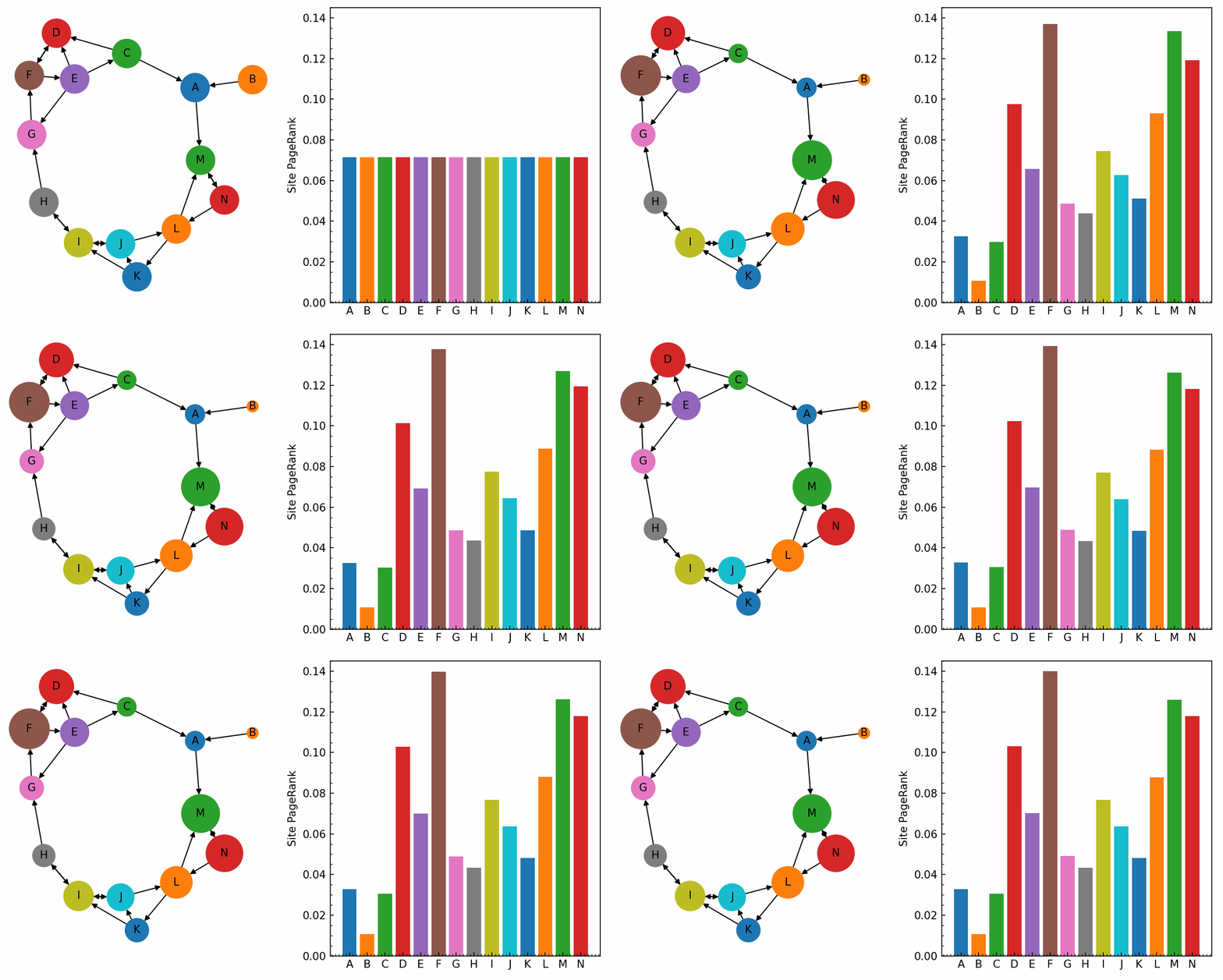
In 1998, Larry Page and Sergey Brin introduced PageRank, an algorithm for measuring the relative importance of documents within a hyperlinked network. Prior to this research, web search engines primarily utilized local keyword matching, which was susceptible to manipulation and often failed to identify the most authoritative sources. The researchers demonstrated that by treating hyperlinks as objective votes of confidence and utilizing a global, recursive ranking mechanism, the importance of a page can be determined by the collective topological structure of the web itself. This work established the mathematical foundation for decentralized information retrieval and the modern search engine.
The Recursive Definition of Authority
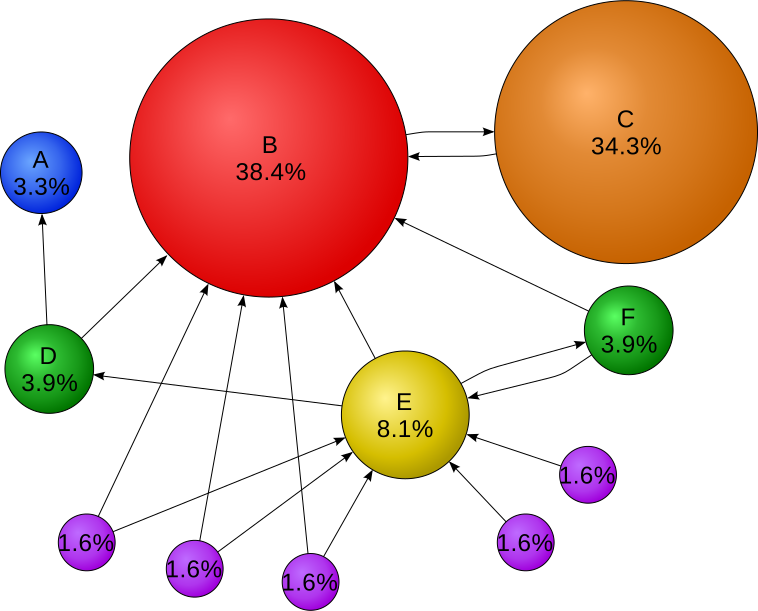
The primary technical contribution of PageRank is the recursive definition of document importance. Unlike earlier methods that treated all links with equal weight, PageRank posits that a link from a high-authority document provides more value than a link from an obscure one. For a set of documents, the rank of a page is defined as the sum of the ranks of all pages that link to it, normalized by the number of outbound links on those pages. This methodological choice transformed document ranking into an eigenvalue problem on a massive stochastic matrix, revealing that the importance of information is a structural property of its relational influence rather than an intrinsic attribute of the content itself.
The Random Surfer Model and Convergence
To ensure that the ranking algorithm converges to a stable state across a diverse and often disconnected web graph, the researchers introduced the Random Surfer Model. This model assumes that a user follows links with a probability (the damping factor, typically 0.85) and eventually "teleports" to a random page with probability . Mathematically, this adjustment ensures that the underlying Markov chain remains irreducible and aperiodic, guaranteeing the existence of a unique stationary distribution. This finding proved that the stability of a global ranking system requires a balance between following structured pathways and permitting stochastic, exploratory leaps.
Algorithmic Robustness and Manipulation Resistance
The success of PageRank was driven by its inherent resistance to the "spamming" techniques that affected keyword-based engines. Because the rank of a page is determined by the cumulative authority of its neighbors, an individual creator cannot artificially inflate their own importance without securing links from established, high-ranking sources. This application revealed that the most robust way to measure value in a decentralized network is to leverage the aggregate intelligence of millions of independent participants. It established the link as a universal unit of informational currency, digitalizing the concept of citation and peer-review for the global web.
Impact on Web Infrastructure and Organization
The practical significance of PageRank is evidenced by the rapid evolution of the World Wide Web from an unorganized collection of data to a structured, navigable ecosystem. By providing a scalable method for identifying high-quality information, the algorithm enabled the development of automated retrieval tools that could manage billions of documents with high precision. The success of this method proved that the scalability of informational systems is determined by the adoption of ranking primitives that reflect the underlying topology of human knowledge. This realization moved the field from atomized data analysis to a holistic, graph-centric view of information processing.
The Logic of Structural Signalling
The achievement of PageRank demonstrated that "authority" in a digital system can be computed objectively through the analysis of connectivity patterns. The decision to model the web as a global graph revealed that the significance of any single node is defined entirely by its relationship to the whole. This principle remains the central theme in the study of social networks, academic impact, and biological pathways, where the most important components are those that occupy critical structural positions. It leaves open the question of how these topological methods can be adapted to handle the ephemeral and highly dynamic nature of real-time communication streams where links are constantly appearing and disappearing.
Dive Deeper
The PageRank Citation Ranking (Stanford)
Stanford • docs
Explore ResourcePageRank Algorithm (Wikipedia)
Wikipedia • article
Explore ResourceLinear Algebra of PageRank (Video)
YouTube • video
Explore Resource
Discussion
0Join the discussion
Sign in to share your thoughts and technical insights.
Loading insights...
Recommended Readings
The author of this article utilized generative AI (Google Gemini 3.1 Pro) to assist in part of the drafting and editing process.