Quantum Machine Learning: Can Quantum Computers Learn Faster?
Jacob Biamonte et al. (2017)
Biamonte, J., Wittek, P., Nicola, P., Rebentrost, P., Wiebe, N., & Lloyd, S. (2017). Quantum machine learning. Nature, 549(7671), 195-202.
In 2017, Jacob Biamonte and colleagues provided a comprehensive framework for the integration of quantum computing and machine learning, identifying the specific subroutines where quantum mechanics offers the potential for exponential improvements in computational efficiency. This research addresses the scaling limits of classical data science, where the processing of high-dimensional vectors and the sampling of complex probability distributions encounter fundamental bottlenecks in time and memory. The researchers demonstrated that by mapping classical optimization and linear algebra tasks into the massive Hilbert space of a quantum processor, a system can achieve sub-linear scaling for operations that are intractable for deterministic classical machines.
Quantum Basic Linear Algebra Subprograms (Q-BLAS)
The core technical mechanism identified in the survey is the development of Quantum Basic Linear Algebra Subprograms (Q-BLAS). Many classical machine learning algorithms, including Support Vector Machines (SVMs) and Gaussian processes, rely on the inversion or eigendecomposition of large matrices. QML subroutines like the HHL algorithm for linear systems and Quantum Principal Component Analysis (Q-PCA) can execute these tasks in time, where is the dimensionality of the data. This methodological choice proved that the unique power of quantum computing in this domain is the ability to represent vectors of size using only qubits, allowing for the manipulation of entire datasets through global unitary transformations.
The Data Loading Problem and Quantum-Native Information
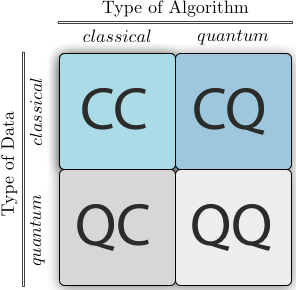
A critical challenge identified in the research is the "input/output bottleneck," where the cost of encoding classical data into a quantum state (the state preparation phase) can negate the algorithmic speedup. The researchers noted that the most efficient applications of QML involve processing quantum-native data - states generated by quantum sensors or other quantum simulators. By bypassing the requirement for classical-to-quantum conversion, these systems can perform pattern recognition directly on the wave function of the signal. This finding established that the scalability of QML is determined by the development of efficient quantum random access memory (QRAM) or the adoption of architectures that operate purely within the quantum domain.
Variational Circuits and Noise-Resilient Learning
The survey introduced variational quantum circuits as a robust framework for machine learning in the NISQ era. In this model, a quantum circuit is used as a parameterized function approximator - analogous to a classical neural network - where the gate parameters are optimized by a classical computer to minimize a cost function. Because these hybrid algorithms rely on iterative refinement rather than deep coherent logic, they exhibit a degree of resilience to the gate errors and decoherence found in current hardware. This engineering shift moved the field toward the study of "quantum kernels" and "quantum classifiers," suggesting that the first practical QML tools will likely be specialized co-processors for high-dimensional feature mapping.
Impact on Probabilistic Graphical Models and Sampling
The practical significance of QML extends to the training of probabilistic graphical models, such as Boltzmann machines. Classical sampling from these distributions is often computationally expensive, requiring Markov Chain Monte Carlo (MCMC) methods that scale poorly. Quantum computers can utilize their inherent stochastic nature to sample from complex distributions more efficiently, potentially accelerating the training of generative models. This application proved that the most effective way to extract patterns from high-entropy data is to utilize a machine that operates based on the same probabilistic principles as the information it is analyzing.
High-Dimensional Pattern Recognition as a Geometric Task
The achievement of Biamonte and his colleagues demonstrated that the complexity of pattern recognition is most accurately understood through the geometry of the information manifold. The decision to model machine learning as a series of quantum state transformations revealed that the primary constraint on classical intelligence was the one-dimensional, serial nature of bit-based logic. This principle remains the central theme in the search for "quantum advantage" in AI, influencing the design of hardware that can process high-dimensional embeddings natively. It leaves open the question of whether the statistical guarantees of classical learning theory - such as Vapnik-Chervonenkis (VC) dimension - possess direct equivalents in the non-local manifold of quantum states.
Dive Deeper
Quantum Machine Learning (Official DOI)
Nature • docs
Explore ResourceQML Survey Paper (arXiv PDF)
arXiv • docs
Explore ResourcePennyLane QML Portal (Xanadu)
Xanadu • docs
Explore ResourceQuantum Machine Learning Course (IBM)
IBM • docs
Explore Resource
Discussion
0Join the discussion
Sign in to share your thoughts and technical insights.
Loading insights...
Recommended Readings
The author of this article utilized generative AI (Google Gemini 3.1 Pro) to assist in part of the drafting and editing process.