
RFdiffusion: Generative Diffusion for Protein Design
Joseph L. Watson, David Juergens, David Baker et al. (Baker Lab, 2023)
Watson, J. L., Juergens, D., Bennett, N. R., ... & Baker, D. (2023). De novo design of protein structure and function with RFdiffusion. Nature, 620(7976), 1089-1100.
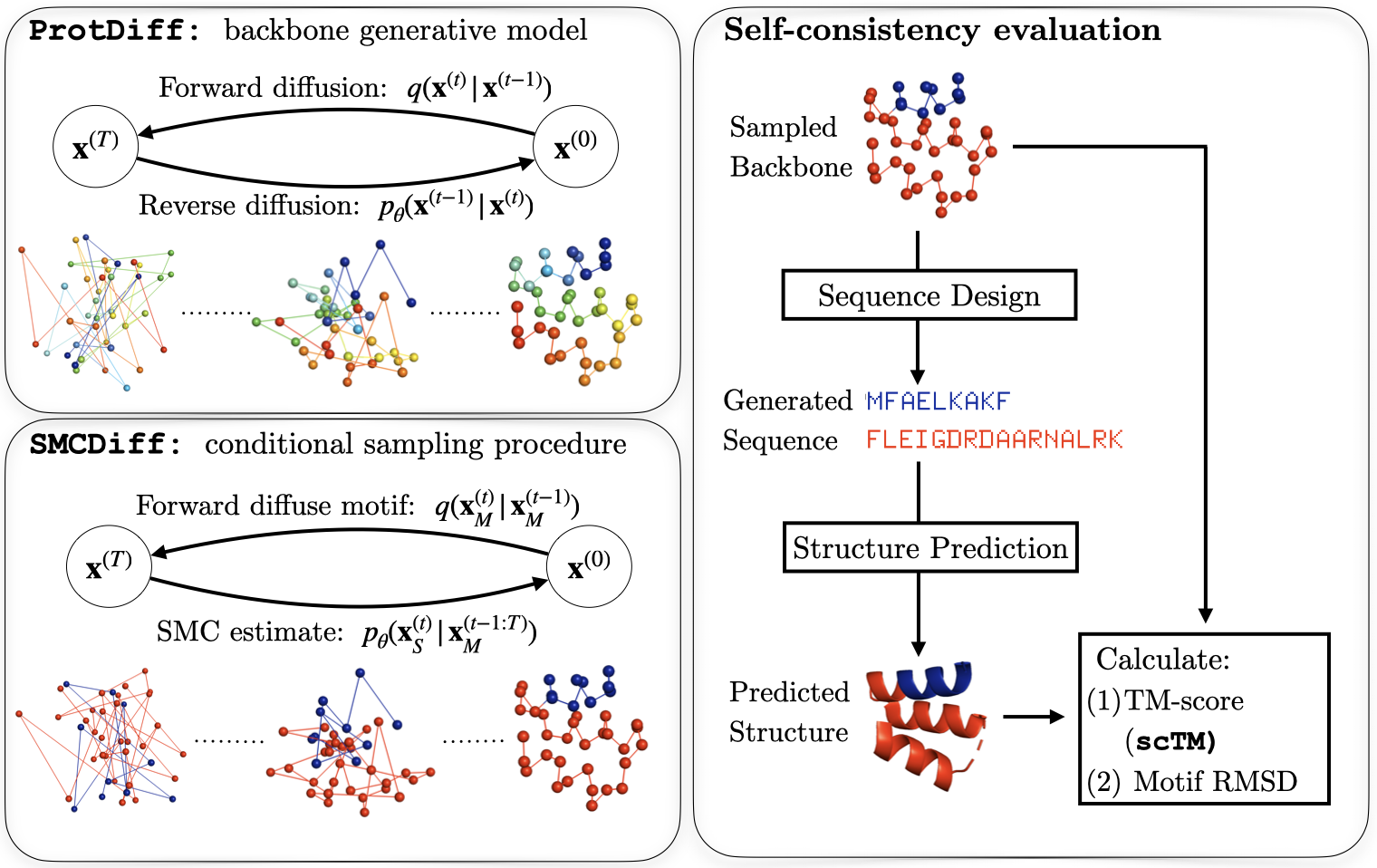
In 2023, researchers at the David Baker laboratory introduced RFdiffusion, establishing generative diffusion models as the premier methodology for de novo protein design. Prior to this breakthrough, generating functional protein backbones required stitching together fragments from known natural proteins or solving restrictive mathematical equations. RFdiffusion fine-tuned the RoseTTAFold structure prediction network as a denoising diffusion probabilistic model, generating completely new, diverse protein architectures, catalytic active sites, and picomolar-affinity therapeutic binders directly from scratch.
Limitations of Fragment Assembly and Scaffolding
Traditional protein design operated within the boundaries of known natural folds. Engineers were forced to search the Protein Data Bank for natural scaffold proteins that could tolerate grafted binding loops or catalytic residues. This approach restricted the diversity of accessible folds, frequently failed when designing binders against flat or challenging target surfaces, and required iterative rounds of laboratory directed evolution to achieve practical binding affinities. RFdiffusion sought to invert structure prediction: instead of predicting the folded state of a known sequence, it uses the learned physical rules inside neural networks to generate brand-new, fold-competent backbones from unstructured noise.
SE(3) Rigid-Body Diffusion and Guided Sampling

RFdiffusion adapts the denoising diffusion framework to 3D molecular coordinates:
- Continuous SE(3) Representation: Each amino acid is represented as a rigid body frame defined by a 3D translation in and an orientation in .
- Forward & Reverse Diffusion: In the forward process, translational coordinates diffuse via Brownian motion toward Gaussian noise, while orientations diffuse across using an isotropic Gaussian distribution. During reverse diffusion, the network starts from random 3D noise and iteratively denoises the residue frames back into a coherent protein fold.
- Denoising Trajectory: At each reverse step , the network predicts the final clean coordinates rather than an incremental noise vector, leveraging RoseTTAFold pair representations and invariant 3D coordinate update layers.
- Conditioning Mechanisms:
- Motif Scaffolding: Fixes the coordinates of essential catalytic residues or epitope-binding motifs and diffuses a brand-new supporting scaffold around them.
- Target Binder Design: Positions the target protein in space and diffuses a binder backbone directly against the target surface without requiring prior interface knowledge.
- Symmetric Assemblies: Enforces cyclic (), dihedral (), or polyhedral symmetry operators across coordinate updates, generating symmetric cages and oligomers.
Experimental Binder Validation and Benchmarks
In computational testing, structures generated by RFdiffusion achieved self-consistency scores (folding back into the target shape when evaluated by AlphaFold 2 or ESMFold) at rates 10 to 100 times greater than prior generative baselines.
The true breakthrough came in physical wet-lab validation:
- Target Engagement: The authors designed binders against critical therapeutic disease targets, including SARS-CoV-2 spike protein, cancer target PD-L1, and growth factor receptors TrkA and IL-7R.
- Picomolar Affinities: Multiple de novo binders engaged their targets with picomolar-to-nanomolar dissociation constants directly from initial computational synthesis, completely bypassing wet-lab directed evolution.
- Atomic Precision: Cryo-EM and X-ray crystallographic structures confirmed that experimental assemblies matched computational design models within 1.0 \AA\ root-mean-square deviation across backbone and interface atoms.
From Observing Nature to Programming Biology
RFdiffusion marked a pivotal turning point in biotechnology: moving from analyzing evolution to programming new functional biomolecules. By showing that structure prediction networks possess an internal representation of physical fold space that can be inverted to create viable machinery, RFdiffusion transformed protein design into an intentional generative process, accelerating the development of vaccines, targeted therapeutics, and synthetic enzymes.
Dive Deeper
De Novo Design of Protein Structure and Function (Nature)
Nature • docs
Explore ResourceRFdiffusion Official GitHub Repository
GitHub • code
Explore ResourceRFdiffusion BioRxiv Preprint
BioRxiv • article
Explore Resource
Discussion
0Join the discussion
Sign in to share your thoughts and technical insights.
Loading insights...
Recommended Readings
The author of this article utilized generative AI (Google Gemini 3.1 Pro) to assist in part of the drafting and editing process.