
Scaling AI Thought Beyond Training
Charlie Snell et al. (Google DeepMind, 2024)
Snell, C., et al. (2024). Scaling LLM Test-Time Compute Optimally. arXiv preprint arXiv:2408.03314.
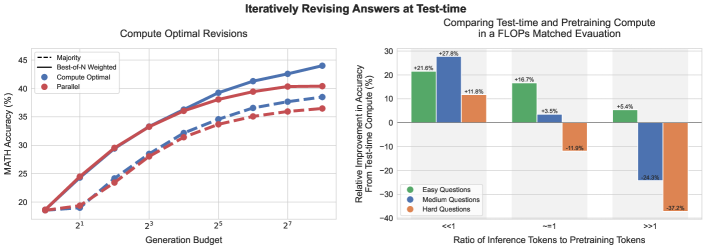
In 2024, researchers at Google DeepMind established that the performance of large language models can be significantly improved by scaling the amount of computation used during the inference phase. Traditionally, model intelligence was viewed as a fixed property determined by the scale of the pre-training phase. This research proved that for complex reasoning tasks, the "intelligence" of a smaller model can be expanded at test-time through iterative search and verifier-guided path refinement. The findings demonstrated that for a wide regime of tasks, scaling search depth is a more efficient lever for performance than scaling the raw number of parameters, provided the computational budget is allocated according to task difficulty.
Sequential Revisions and Verifier-Guided Search

The optimization of inference-time compute utilizes two primary mechanisms: sequential revisions and verifier-guided search. Sequential revisions involve fine-tuning a model to critique its own previous outputs and iteratively correct local logical errors, effectively conditioning its generation on its own history of mistakes. In parallel, verifier-guided search evaluates intermediate reasoning steps to prune incorrect paths and focus computational resources on the most promising solution trajectories. This finding revealed that for easy tasks, the model is likely "on the right track" and merely requires the local refinement of a revision cycle, whereas difficult problems necessitate the broader global exploration of a tree-search algorithm.
Process-Based Reward Models and Thought Verification
The technical engine of verifier-guided search is the Process-Based Reward Model (PRM), which provides a reward signal for every individual step of the reasoning process. Unlike traditional Outcome-Based Reward Models (ORMs) that only evaluate the final answer, a PRM identifies the exact moment a model deviates from a logical path. This granular supervision allows for "Best-of-N" sampling and "Beam Search" at the level of individual thoughts, significantly reducing the probability of a "chain-of-thought" hallucination. This engineering shift proved that the bottleneck for complex reasoning was not the model's capacity to generate an answer, but the inability to provide a high-frequency signal of correctness during the generation process itself.
Test-Time Scaling Laws and Trade-offs
The research introduced Test-Time Scaling Laws, quantifying the trade-off between pre-training compute and inference compute. Researchers found that for a fixed performance target, one can either use a massive model with minimal thinking time or a much smaller model with extended thinking time. However, this scaling is only optimal when the search budget is allocated correctly; spending too much time on easy problems or too little on hard ones leads to diminishing returns. This realization provided a new rigorous framework for AI deployment, allowing for the dynamic adjustment of a model's "compute-per-query" based on the estimated difficulty of the user's prompt.
Impact on Reasoning Frontiers and System-2 Thinking
The practical significance of optimal test-time scaling is most evident in the development of reasoning-focused architectures like the OpenAI o1 series. By training models specifically to use more time "thinking" before they respond, researchers moved the industry from a "fast-thinking" (System 1) paradigm to a "slow-thinking" (System 2) paradigm. This finding revealed that the intelligence of a model is not a fixed number of parameters, but a fluid resource that can be scaled by providing the system with a "scratchpad" and the time to use it. It suggested that for fields like mathematics, coding, and scientific research, the future of AI lies in "contemplative" architectures that prioritize search depth over immediate prediction.
Dive Deeper
Scaling LLM Test-Time Compute Optimally (Official arXiv)
arXiv • article
Explore ResourceScaling Inference Compute (Google DeepMind Blog)
Google • article
Explore ResourceLearning to Reason with LLMs (OpenAI Blog)
OpenAI • article
Explore Resource
Discussion
0Join the discussion
Sign in to share your thoughts and technical insights.
Loading insights...
Recommended Readings
The author of this article utilized generative AI (Google Gemini 3.1 Pro) to assist in part of the drafting and editing process.