
The Path to a Million-Qubit Machine
Eric Dennis et al. (Caltech/Microsoft, 2002)
Dennis, E., Kitaev, A., Landahl, A., & Preskill, J. (2002). Topological quantum memory. Journal of Mathematical Physics, 43(9), 4452-4505.
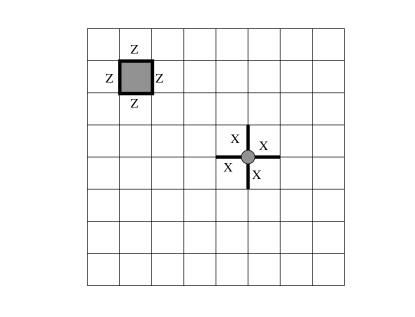
In 2002, researchers at Caltech and Microsoft introduced the surface code, a model for fault-tolerant quantum computation that preserves information within the global topological features of a planar lattice. This research resolved a primary engineering constraint of the original toric code, which required periodic boundary conditions - effectively demanding that a quantum processor be physically wrapped around a torus. The researchers demonstrated that by carefully managing the boundaries of a finite two-dimensional sheet, a system can achieve high-fidelity error correction using only nearest-neighbor interactions, providing a viable roadmap for the fabrication of large-scale quantum chips.
Planar Boundaries and Logical Degrees of Freedom
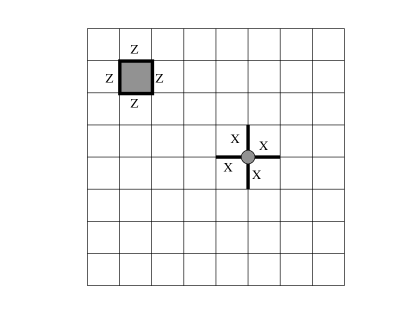
The core technical mechanism of the surface code is the introduction of two distinct boundary types: rough (plaquette) and smooth (site) edges. On a simply connected planar surface, these asymmetric boundaries allow for the encoding of logical qubits that are protected from local noise. A logical operation is represented by a chain of errors stretching between the two rough edges, while a logical operation is a chain of errors connecting the smooth edges. This methodological choice proved that topological degeneracy - the physical basis for robust memory - can be engineered into a flat manifold by utilizing its edges as structural constraints.
Local Stabilizer Measurement and Syndrome Extraction
Error detection in the surface code is performed through the continuous measurement of local stabilizer operators, each involving only four neighboring qubits. This locality is the primary figure of merit for the architecture, as it ensures that the complexity of the syndrome extraction process does not scale with the total size of the processor. When a physical qubit undergoes a bit-flip or phase-flip error, it creates a pair of "defects" or anyonic excitations at the ends of an error chain. Because the stabilizers are local and commute, these defects can be efficiently tracked over time without observing the logical state. This finding revealed that the "observer effect" in quantum mechanics can be managed by isolating the error signal from the computational information.
The 2D Accuracy Threshold and Hardware Feasibility
The technical significance of the surface code is its high accuracy threshold, proven to be nearly 1% for local depolarizing noise. Prior to this research, it was widely assumed that fault-tolerant error correction would require complex, non-local wiring to concatenate multiple levels of encoding. By demonstrating that a standard 2D lattice with nearest-neighbor gates is sufficient for universal computation, the researchers shifted the field toward a more practical engineering paradigm. This move established the principle that the most effective way to scale a quantum computer is to focus on building a large array of moderately reliable qubits rather than a small number of perfect ones.
Minimum-Weight Perfect Matching and Error Recovery
The recovery phase of the surface code involves a classical decoding algorithm - typically minimum-weight perfect matching (MWPM) - that identifies the most probable error chains based on the observed syndromes. By mapping the defects to nodes in a graph and calculating the shortest paths between them, the system can determine which correction operations will "annihilate" the anyons and return the logical state to its ground state. This synthesis of quantum physics and classical graph theory demonstrated that the reliability of a quantum memory is a function of the efficiency of its classical feedback loop. It established that a fault-tolerant system is an integrated information processor where the machine and its observer act as a coordinated unit.
The Logic of Structural Robustness
The success of the surface code demonstrated that the most robust way to store quantum information is to hide it in the non-local properties of a manifold. The decision to prioritize planar layouts revealed that the primary bottleneck in quantum hardware was the physical constraint of chip-based connectivity. This principle remains the central theme of current hardware efforts at companies like Google and IBM, which utilize surface code variants as their primary architectural blueprint. It leaves open the question of whether the high overhead of these codes - often requiring thousands of physical qubits per logical qubit - can be reduced through the use of more efficient topological constructions or 3D lattice geometries.
Dive Deeper
Topological Quantum Memory (Official Journal Record)
AIP • docs
Explore ResourceSurface Code Original Paper (arXiv)
arXiv • docs
Explore ResourceSurface Codes: Practical Error Correction (arXiv)
arXiv • article
Explore ResourceError Correction Zoo: Surface Code
Error Correction Zoo • article
Explore Resource
Discussion
0Join the discussion
Sign in to share your thoughts and technical insights.
Loading insights...
Recommended Readings
The author of this article utilized generative AI (Google Gemini 3.1 Pro) to assist in part of the drafting and editing process.