
Quantum Accuracy Threshold: The Math That Makes Fault-Tolerant Quantum Computing Possible
Panos Aliferis et al. (2005)
Aliferis, P., Gottesman, D., & Preskill, J. (2006). Quantum accuracy threshold for concatenated distance-3 codes. Quantum Information & Computation, 6(2), 97-165.
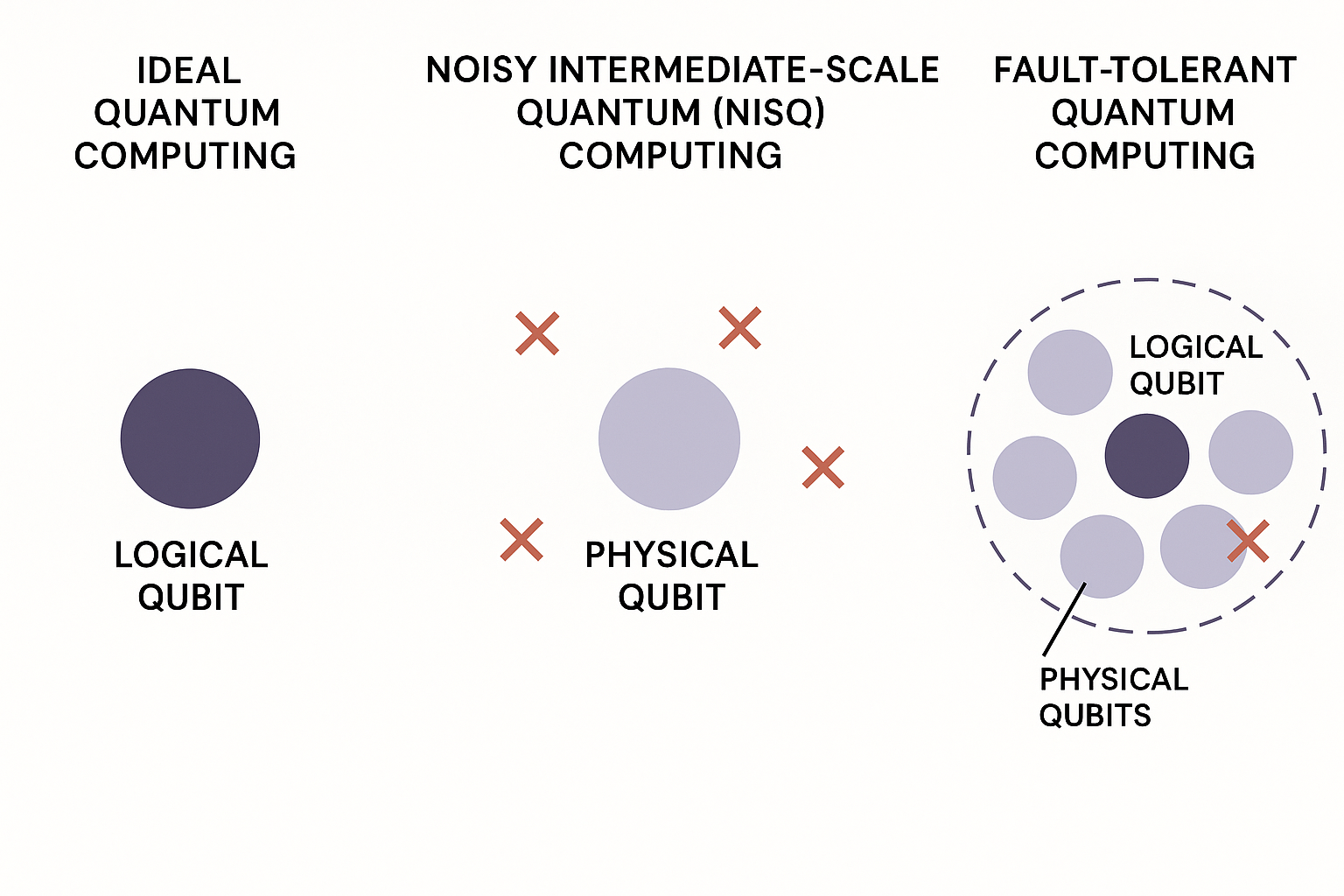
In 2005, Panos Aliferis, Daniel Gottesman, and John Preskill provided a rigorous proof that arbitrarily long quantum computations can be executed reliably if the error rate of the individual physical components is below a specific constant value. This research addressed the primary obstacle to large-scale quantum hardware: the inherent fragility of quantum states due to decoherence and imperfect gate operations. The researchers demonstrated that through the recursive application of concatenated error-correcting codes, a system can suppress errors faster than they accumulate, establishing the "accuracy threshold" as a definitive engineering target for the field.
Hierarchical Concatenation and Recursive Error Suppression
The core technical mechanism of the proof is the strategy of code concatenation. In this framework, a single logical qubit is encoded into a block of physical qubits using a base code, such as the 7-qubit Steane code. This encoded block - now acting as a single "level-1" logical qubit - is itself treated as a physical qubit and encoded into a higher-level "level-2" block. This recursive structure allows for a systematic reduction of the effective error rate at each successive level of the hierarchy. The researchers proved that for a distance-3 code, the logical error rate scales as , where is the error rate of the lower-level components. Provided is below the threshold, each level of concatenation suppresses the noise quadratically, enabling the achievement of near-perfect reliability with only a polylogarithmic increase in physical qubit resources.
Adversarial Noise Models and Mathematical Rigor
A critical technical contribution of the paper is the evaluation of the threshold under an adversarial independent stochastic noise model. Unlike earlier estimates that relied on simplified assumptions about the nature of decoherence, Aliferis et al. derived bounds that remain valid even in the presence of more complex, non-Markovian noise. They identified that for concatenated distance-3 codes, the accuracy threshold resides in the range of to depending on the specific architectural constraints and the efficiency of the syndrome measurement process. This finding established the "fidelity bottleneck" as a physical parameter that can be precisely computed, providing hardware designers with a rigorous benchmark for evaluating the maturity of diverse physical platforms.
Malicious Errors and Fault-Tolerant Gadgets
The proof relies on the construction of fault-tolerant "gadgets" - modular circuit components for performing gates, state preparation, and measurement - that prevent a single error from propagating to multiple qubits within the same code block. The researchers demonstrated that by ensuring the locality of errors throughout the entire computational graph, the logical integrity of the concatenated code remains robust. This methodological choice transformed quantum error correction from a passive storage scheme into an active framework for logical execution. It established the principle that a fault-tolerant machine is a collection of interlocking mathematical invariants that collectively resist the increase of informational entropy.
The Resource Overhead and Scaling Limits
The technical significance of the threshold theorem is its identification of the massive resource overhead required for reliable computation. While the proof establishes that scaling is theoretically possible, it also reveals that reaching the fidelities needed for practical algorithms necessitates millions of physical qubits to represent a small number of logical units. This finding created a permanent tension in the field between the need for high-precision local control and the requirement for massive hardware integration. The work proved that the scalability of quantum computers is limited not by the laws of physics, but by the efficiency with which the classical control system can manage the recursive hierarchy of error syndromes.
Fault-Tolerance as a Continuous Objective
The success of Aliferis, Gottesman, and Preskill demonstrated that the complexity of maintaining a quantum state is a manageable engineering variable. The decision to model computation as a self-correcting process revealed that the primary constraint on quantum intelligence is the rate at which error signals can be extracted and annihilated. This principle remains the central driver for current research into topological codes and low-overhead error correction, suggesting that the most robust way to calculate is to ensure that the machine is physically indistinguishable from its own correction loop. It leaves open the question of whether there exist alternative, non-concatenated architectures that can achieve significantly higher thresholds in real-world hardware.
Dive Deeper
Quantum Accuracy Threshold (Official DOI)
Rinton Press • docs
Explore ResourceThreshold Theorem Paper (arXiv)
arXiv • docs
Explore ResourceIntroduction to Quantum Error Correction (arXiv Survey)
arXiv • article
Explore ResourceSteane Code and Fault Tolerance (Wikipedia)
Wikipedia • article
Explore Resource
Discussion
0Join the discussion
Sign in to share your thoughts and technical insights.
Loading insights...
Recommended Readings
The author of this article utilized generative AI (Google Gemini 3.1 Pro) to assist in part of the drafting and editing process.