
Agentomics: Autonomous AI for Biology
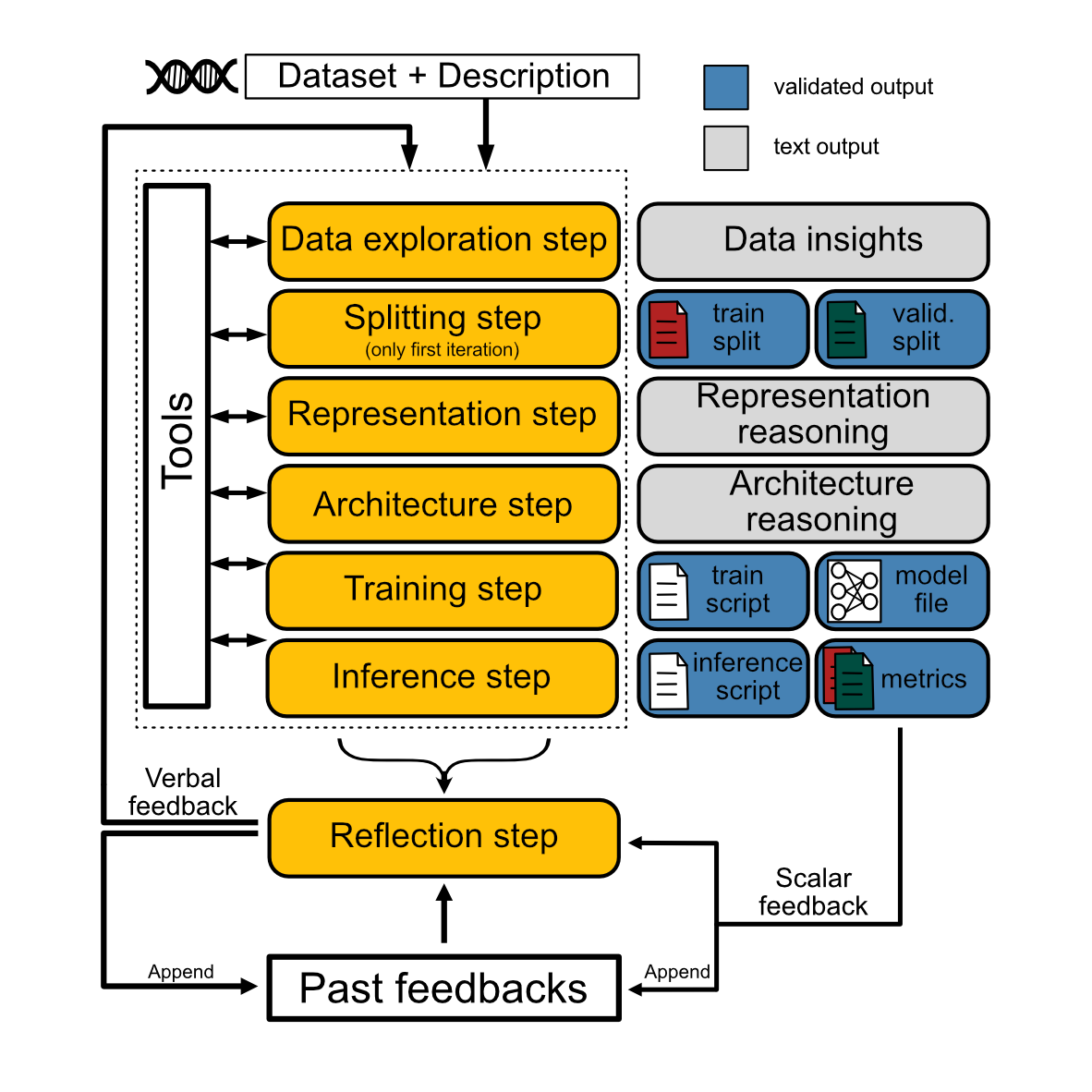
In 2025, researchers introduced Agentomics-ML, an autonomous machine learning framework designed to navigate the high-dimensional complexity and technical noise inherent in genomic and transcriptomic datasets. The application of general-purpose AI agents to biological research is frequently hindered by the "complexity bottleneck," where a lack of domain-aware constraints leads to high failure rates in automated data analysis and script production. The researchers demonstrated that by replacing open-ended agentic planning with a rigid, four-stage experimentation loop, a system can achieve state-of-the-art performance on complex biological tasks including molecular interaction modeling and clinical data analysis, establishing a robust methodology for automated biological discovery.
The Complexity Bottleneck in Biological Sequences
Genomic data is characterized by extreme dimensionality and non-linear relationships that often cause general-purpose agents to produce non-executable or biologically invalid code. Traditional agents frequently struggle with tasks such as modeling the interaction between two distinct RNA sequences or managing the batch effects prevalent in clinical cohorts. Agentomics-ML addresses these challenges by restricting the agent's search space through the use of a domain-constrained state machine. This findng revealed that the primary constraint on autonomous biological AI is not the reasoning capacity of the model, but the lack of an environment that enforces the rigorous validation and data-splitting strategies required for genuine biological insight.
Constrained Iterative Experimentation and Pydantic AI
The core technical innovation of the framework is a four-stage experimentation cycle: Data Exploration, Representation Choice, Script Production, and Training. Operating within a secure Docker environment, the agent utilizes a Bash shell and Python to interact directly with raw biological data. To ensure sequence precision and script reliability, the system implements programmatic validation using the Pydantic AI framework. The agent is required to verify the syntax and argument consistency of its code - using dummy data - before proceeding to the final training phase. This methodological choice transformed automated machine learning from a "trial and error" process into a structured engineering discipline where every step is grounded in deterministic verification.
Domain-Aware Reflection and Environment Management
The Agentomics-ML framework incorporates a "Reflect-and-Refine" logic that allows it to adapt to specific biological constraints without human intervention. After each iteration, the agent collects both scalar validation metrics and verbal self-critiques to identify issues such as overfitting or a failure to capture long-range genomic dependencies. Furthermore, the system autonomously manages its own bioinformatics environments by installing necessary tools and managing complex Conda configurations. This application proved that the scalability of AI-assisted science depends on the adoption of architectures that can manage the technical debt of the bioinformatics stack while maintaining a focus on high-level biological reasoning.
Impact on Computational Biology Productivity
The practical significance of Agentomics-ML is a reported 93.33% success rate on specialized genomic benchmarks, significantly outperforming non-specialized agents. By implementing non-random data splitting strategies based on its initial exploration, the system provides a more realistic estimation of model generalization in the presence of biological variability. This achievement established the principle that the most effective way to automate scientific research is to provide the machine with a language of interpretable biological primitives. The success of this model suggests a future where the computational biologist transitions from routine pipeline implementation to the high-level interpretation of an agent's derived insights.
Dive Deeper
Agentomics-ML Paper (Official arXiv)
arXiv • article
Explore ResourcePydantic AI Framework
Pydantic • tool
Explore ResourceConda Package Manager
Conda • tool
Explore ResourceAI for Genomics (Microsoft Research)
Microsoft • article
Explore Resource
Discussion
0Join the discussion
Sign in to share your thoughts and technical insights.
Loading insights...
Recommended Readings
The author of this article utilized generative AI (Google Gemini 3.1 Pro) to assist in part of the drafting and editing process.