
The Universal Foundation for Biological Data
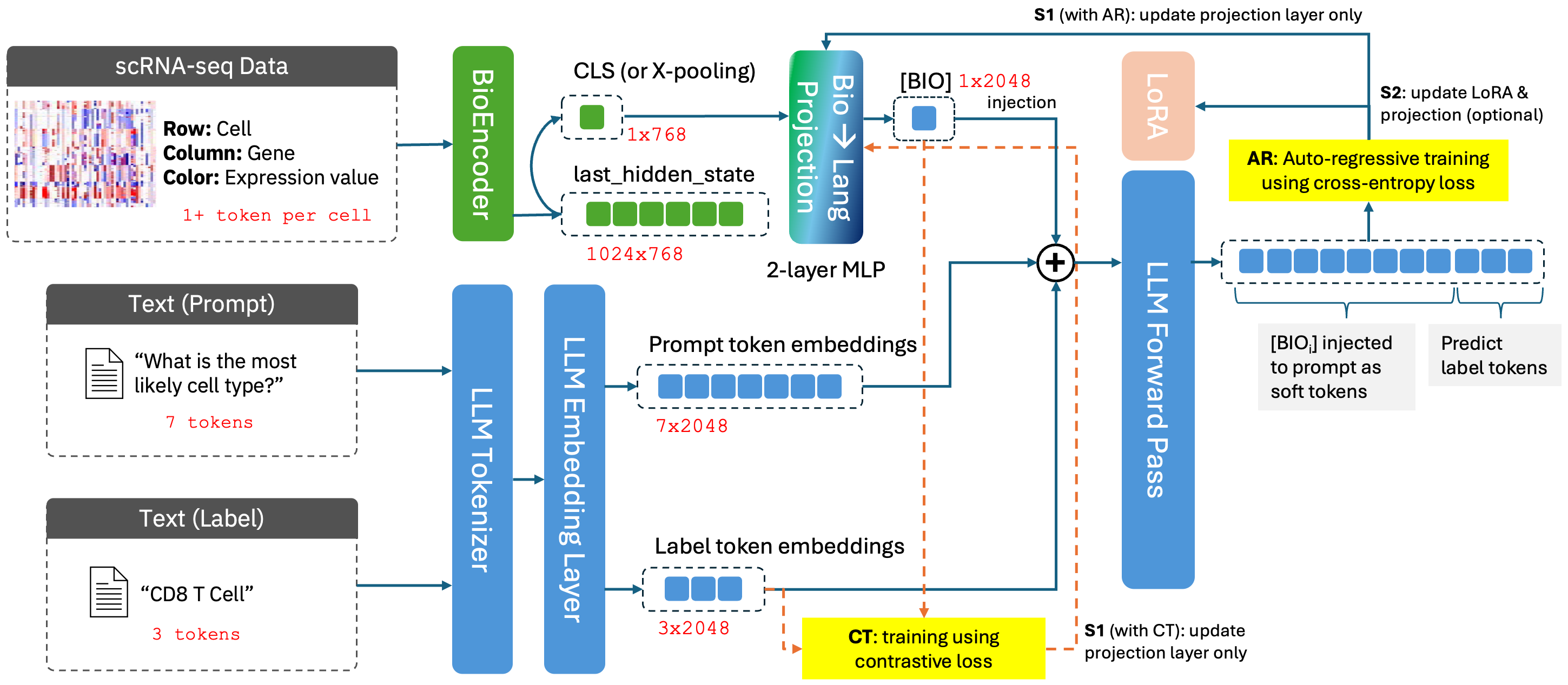
In 2025, researchers introduced BIOVERSE, a modular framework for aligning modality-specific biological foundation models (BioFMs) - such as protein or RNA sequences - into a shared generative semantic space. This research addresses the semantic isolation of biological embeddings, which typically form distinct, isolated clusters far removed from the natural language representations used by large language models (LLMs). The researchers demonstrated that by implementing a two-stage alignment process involving contrastive projection and "soft token" injection, a system can enable zero-shot reasoning directly on raw biological data as if it were a native vocabulary, established a new foundation for high-performance biological discovery on compact architectures.
Semantic Isolation and Modality Realignment

The primary technical challenge identified in the research is the "isolation bottleneck," where UMAP visualizations reveal that biological cell or protein embeddings occupy distinct manifolds inaccessible to standard text-based encoders. Traditional methods for bridging this gap rely on lossy text descriptions that strip away the high-dimensional nuances of the original data. BIOVERSE resolves this through a lightweight Multi-Layer Perceptron (MLP) projection layer that maps the output of pretrained biological encoders directly into the LLM's native token-embedding space. By utilizing a bidirectional InfoNCE contrastive loss, the framework pulls biological representations closer to their linguistic definitions, ensuring that the model captures the structural essence of biological entities rather than just their symbolic labels.
Two-Stage Alignment and Soft Token Injection
The framework utilizes a two-stage training pipeline to achieve robust multimodal integration. In the first stage, the biological encoder and LLM are frozen while the projection layer is trained to maximize representation-level similarity between biological data and text. This ensures a stable starting point for alignment without the computational expense of a full forward pass. The second stage involves multimodal instruction tuning, where the projection layer and specific low-rank adapters (LoRA) within the LLM are made trainable. During this phase, the system learns to process "soft tokens" - projected embeddings injected into placeholder positions like [BIO]. This mechanism allows the LLM to leverage its vast internal knowledge to perform complex reasoning on raw data, effectively digitalizing the Act of biological interpretation.
Zero-Shot Transfer and local Deployment Efficiency
A significant finding of the research is the achievement of state-of-the-art performance using compact backbones. A BIOVERSE configuration utilizing an 8-billion parameter backbone (e.g., IBM Granite-8B) outperformed 120-billion parameter text-only models on tasks including molecular description and protein function prediction. This efficiency is a critical requirement for clinical and genomic research, where privacy constraints often preclude the use of massive, cloud-based proprietary models. By providing high-fidelity reasoning within the memory limits of local hardware, the framework established that the scalability of biological intelligence is determined by the precision of the alignment between modalities rather than raw parameter scaling.
Impact on Clinical Discovery and Genomic Research
The practical significance of BIOVERSE is its ability to handle diverse biological modalities - including molecules encoded by ChemBERTa and proteins by ESM-2 - within a single, unified reasoning engine. By providing an interoperable interface for disparate biological domains, the framework enables researchers to automate the identification of drug-target interactions and the functional analysis of rare variants. This application proved that the most effective way to manage the complexity of biological data is to treat it as a facet of a universal information structure. It established natural language as the primary interface for directing the execution of complex experimental workflows within the digital domain.
The Logic of Universal Biological Extraction
The success of BIOVERSE demonstrated that the bottleneck in computational biology was the structural isolation of visual and sequence features from their semantic context. The decision to prioritize multimodal alignment revealed that the primary constraint on biological AI was the lack of a shared language for information processing. This principle remains the central theme in the search for "organismal foundation models" that can simulate the entire behavior of a cell from its multi-omic data. It leaves open the question of whether there exist biological concepts that are fundamentally inexpressible in language, and how these "silent" features can be integrated into a unified cognitive model for life.
Dive Deeper
BIOVERSE Technical Report (Official arXiv)
arXiv • article
Explore ResourceESM-2 Protein Foundation Model
Meta AI • model
Explore ResourcescGPT for Single-Cell RNA
Bo Wang Lab • model
Explore ResourceIBM Granite-8B Backbone
Hugging Face • model
Explore Resource
Discussion
0Join the discussion
Sign in to share your thoughts and technical insights.
Loading insights...
Recommended Readings
The author of this article utilized generative AI (Google Gemini 3.1 Pro) to assist in part of the drafting and editing process.