
The Birth of Private Communication on the Web
Whitfield Diffie & Martin Hellman (1976)
Diffie, W., & Hellman, M. (1976). New directions in cryptography. IEEE Transactions on Information Theory, 22(6), 644-654.
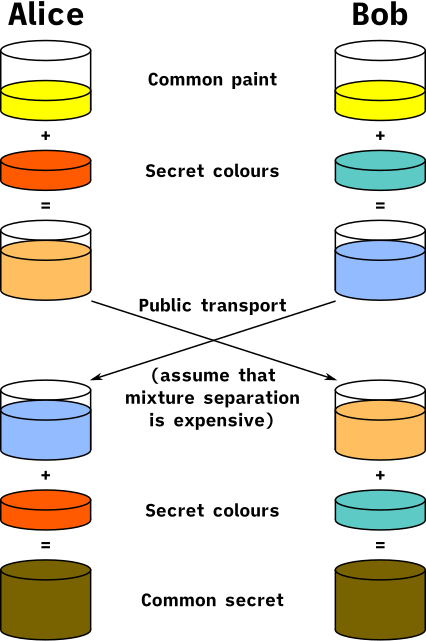
In 1976, Whitfield Diffie and Martin Hellman introduced public-key cryptography, a method for secret sharing that removes the requirement for a pre-shared physical key. This research addressed the "key distribution problem" of symmetric cryptography, where participants were required to meet or use a trusted courier before initiating secure communication. The researchers proved that by utilizing the computational hardness of the discrete logarithm problem, two parties can establish a shared secret across an insecure channel without any prior interaction. This discovery effectively decoupled the security of a communication from the physical security of the initial key transfer, established the mathematical foundation for the modern secure internet.
The Public Key Paradigm and Trapdoor Functions
The conceptual breakthrough of the research was the formalization of asymmetric encryption using trapdoor one-way functions. These are transformations that are computationally efficient to execute in one direction but exponentially difficult to reverse without specific secret information. Diffie and Hellman envisioned a system where each user possesses a pair of keys: a public key for encryption and a private key for decryption. This methodological choice transformed cryptography from a physical lock-and-key mechanism into an information-theoretic primitive. It revealed that the most effective way to secure a decentralized network is to move the source of trust from the isolation of the channel to the mathematical complexity of the algorithm.
The Discrete Logarithm Problem as a Security Engine
The technical engine of the Diffie-Hellman protocol is the discrete logarithm problem in a finite field. The protocol relies on the property that while modular exponentiation is trivial to compute, reversing the process to find the exponent is infeasible for sufficiently large primes. In the scheme, participants agree on a prime and a generator . Each chooses a private secret () and computes a public value (). By exchanging these values and applying their own secrets, both arrive at the same shared secret . An eavesdropper, observing only the public values, is faced with the task of solving the discrete logarithm, which remains the primary computational barrier protecting global digital communication.
Digital Signatures and the Logic of Authentication
Beyond secret sharing, the researchers theorized the concept of digital signatures as a mathematical counterpart to physical authentication. They argued that a "trapdoor" function allows a sender to prove their identity by performing a computation that only the holder of the private key could execute. This shift from secrecy to authenticity was as significant as the encryption itself, providing a way to verify the origin and integrity of data in an environment where physical signatures are impossible. This abstraction allowed for the development of digital certificates and the Web of Trust, digitalizing the concept of identity for the global network.
Impact on Network Security and TLS
The practical significance of Diffie-Hellman is evidenced by its role as the foundational protocol for nearly every secure transaction on the web. The principles identified in the paper enabled the development of SSL/TLS, which protects the integrity of financial transfers, private messaging, and state-level communications. This application proved that the scalability of a secure infrastructure is determined by the adoption of cryptographic primitives that are both mathematically robust and decentralized. The success of this method transitioned cryptography from a tool of military intelligence into a fundamental public utility for civil society.
Quantum Vulnerability and the Post-Quantum Era
Despite its foundational status, the Diffie-Hellman protocol is known to be vulnerable to future large-scale quantum computers. Specifically, Shor’s algorithm can resolve the discrete logarithm problem in polynomial time, rendering standard DH exchanges transparent to a quantum-capable adversary. This realization has driven the current transition toward post-quantum cryptography, where researchers seek new one-way functions based on lattice problems that do not exhibit the periodic properties exploitable by quantum Fourier transforms. The legacy of Diffie-Hellman remains its demonstration that the deepest problems in number theory are the primary prerequisites for the protection of fundamental human rights in the digital age.
Dive Deeper
New Directions in Cryptography (Official Paper)
Stanford • docs
Explore ResourcePublic Key Cryptography Explained (Video)
Computerphile • video
Explore ResourceOfficial Journal Record (DOI)
ACM • docs
Explore ResourceDiffie-Hellman Visualization (Interactive)
GitHub • interactive
Explore Resource
Discussion
0Join the discussion
Sign in to share your thoughts and technical insights.
Loading insights...
Recommended Readings
The author of this article utilized generative AI (Google Gemini 3.1 Pro) to assist in part of the drafting and editing process.