
Why the Internet is a Scale-Free World
Albert-László Barabási & Réka Albert (1999)
Barabási, A. L., & Albert, R. (1999). Emergence of scaling in random networks. Science, 286(5439), 509-512.
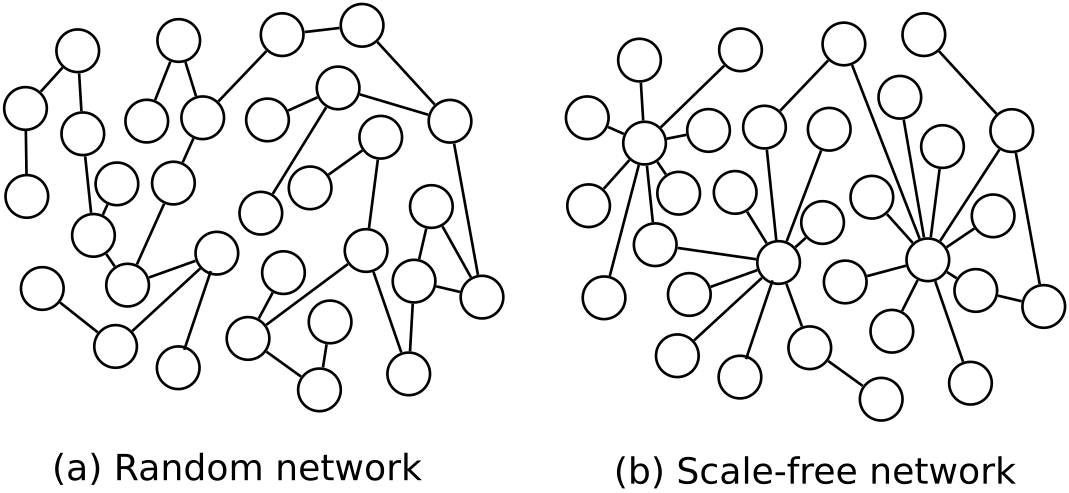
In 1999, Albert-László Barabási and Réka Albert identified a universal structural property of large-scale networks termed scale-free topology. Prior to this research, network models - such as the Erdős–Rényi random graph - assumed that connections are distributed approximately uniformly, resulting in a Poisson degree distribution where most nodes possess a similar number of links. The researchers demonstrated that real-world systems, including the World Wide Web and citation networks, follow a power-law distribution where a small number of "hubs" possess a disproportionately high degree of connectivity. This finding revealed that the architecture of complex systems is determined by the dynamic mechanisms of growth and preferential attachment.
Growth and Preferential Attachment Mechanisms
The Barabási–Albert (BA) model identifies two necessary conditions for the emergence of scale-free properties: continuous growth and preferential attachment. Unlike static graph models, the BA framework assumes that the network expands through the iterative addition of new vertices. The preferential attachment rule posits that the probability of a new node connecting to an existing node is proportional to the current degree of that node: . This "rich-get-richer" effect ensures that well-connected nodes acquire new links at a higher rate than obscure ones, leading to a stationary state characterized by a power-law degree distribution . This methodological choice proved that structural inequality is an inherent consequence of network expansion under local competition for connectivity.
The Power-Law Distribution and Scale-Invariance
A defining feature of scale-free networks is their scale-invariance, meaning the ratio of highly connected hubs to poorly connected nodes remains constant as the network grows. In a random graph, the degree distribution has a characteristic scale defined by the average degree; nodes significantly larger than the average are statistically impossible. In contrast, the power-law tail of a scale-free network allows for the existence of hubs that are several orders of magnitude larger than the mean. This finding demonstrated that the "typical" node does not exist in many real-world systems, requiring a shift in statistical analysis from mean-based metrics to the study of extreme values and heavy-tailed distributions.
Robustness to Random Failure and Vulnerability to Attack
The existence of hubs provides scale-free networks with a specific set of reliability characteristics. The researchers proved that these systems are remarkably robust to random node failures, as the vast majority of nodes are poorly connected and their removal does not significantly affect the network's global connectivity. However, this same structure creates a critical vulnerability to targeted attacks. The removal of a small fraction of the most highly connected hubs leads to the rapid fragmentation of the system into isolated components. This finding established a fundamental trade-off in the design of resilient infrastructures, revealing that the efficiency of centralized hubs is balanced by the structural risk they introduce to the entire system.
Impact on Epidemiological and Information Cascades
The practical significance of the scale-free model is evident in the fields of public health and digital communication. By proving that hubs act as super-spreaders, the research provided a mathematical explanation for why certain infections or information "cascades" can persist even when the average transmission rate is low. In an environment where the epidemic threshold is zero due to hub connectivity, the most effective strategy for control is the targeted immunization or moderation of high-degree nodes. This application demonstrated that the dynamics of spread - whether biological or informational - are governed by the topological arrangement of the environment rather than the properties of the individual agents.
Topology as a Consequence of Growth
The achievement of Barabási and Albert demonstrated that the structure of a complex system is a record of its own developmental history. The decision to model networks as growing entities revealed that the emergence of hubs is not an accident of human behavior, but a mathematical necessity for systems that value established reliability. This principle remains the central theme in the study of social networks, economic markets, and the evolution of the internet. It leaves open the question of how these power-law systems adapt when the cost of maintaining a connection becomes a limiting factor, or if there exist fundamental physical boundaries that eventually force a transition back toward more uniform, scale-dependent architectures.
Dive Deeper
Emergence of Scaling in Random Networks (Official DOI)
Science • docs
Explore ResourceBarabási Lab: Stable PDF
Barabási Lab • docs
Explore ResourceScale-Free Networks (Wikipedia)
Wikipedia • article
Explore ResourcePreferential Attachment Visualization (Video)
Outlier • video
Explore Resource
Discussion
0Join the discussion
Sign in to share your thoughts and technical insights.
Loading insights...
Recommended Readings
The author of this article utilized generative AI (Google Gemini 3.1 Pro) to assist in part of the drafting and editing process.