
AI-Assisted Precision Medicine
Cong Wang et al. (2024)
Wang, C., et al. (2024). CRISPR-GPT: An LLM-based agent for automated design and reasoning in genome editing. arXiv preprint arXiv:2404.18021.
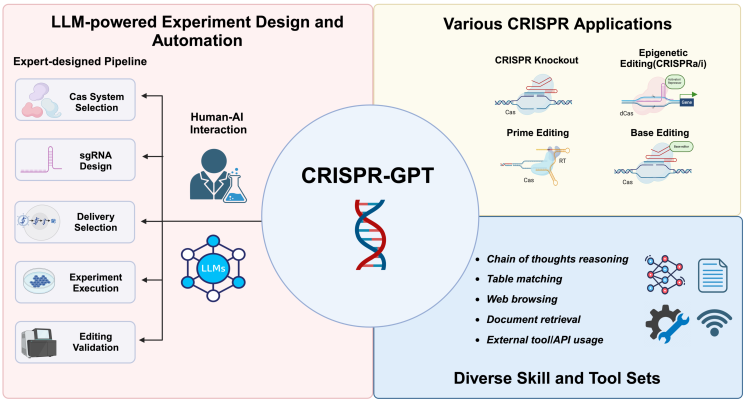
In 2024, researchers introduced CRISPR-GPT, an automated system for genome editing that decouples high-level biological reasoning from the precise generation of genomic sequences. This research addresses a fundamental limitation in the application of large language models (LLMs) to biology: the stochastic nature of token prediction, which often results in the hallucination of guide RNA (gRNA) or primer sequences that do not exist in nature. The researchers demonstrated that by utilizing a modular architecture governed by state machines and deterministic tool integration, a system can automate the design of complex CRISPR experiments while maintaining the precision required for physical wet-lab implementation.
Stochastic Design and the Hallucination Bottleneck
The primary constraint on standard LLMs in genomic engineering is the "precision gap" between linguistic plausibility and biological reality. While models like GPT-4 can design sophisticated experimental protocols, their internal weights lack the resolution to generate exact DNA sequences without error. A single incorrect nucleotide in a gRNA sequence can negate an entire experiment or cause dangerous off-target effects. CRISPR-GPT resolves this by treating the LLM as a logical orchestrator rather than a sequence generator. This finding revealed that the most effective way to utilize artificial intelligence in high-stakes scientific domains is to ensure that the "deciding" phase of reasoning is strictly separated from the "producing" phase of data generation.
State Machines and Deterministic Tool Integration
The core technical innovation of CRISPR-GPT is a task-execution engine implemented as a state machine. The system decomposes a high-level biological objective - such as a gene knockout - into a sequence of twenty-two distinct, dependent tasks. The state machine enforces a rigorous logical flow; for instance, the agent cannot proceed to gRNA design until the specific CRISPR system (e.g., Cas9, Cas12, or Prime Editing) and the delivery method have been finalized. To ensure sequence precision, the system's Tool Provider module interfaces directly with validated biological databases and computational libraries like CRISPRPick and Primer3. This retrieval-augmented approach ensures that every sequence output is literature-backed and verified, established a new standard for grounding agentic AI in the deterministic reality of genomic data.
End-to-End Experimental Automation and Safety
CRISPR-GPT provides a unified interface for the entire lifecycle of a genome editing experiment, from the initial hypothesis to the design of validation primers for next-generation sequencing. The system incorporates two operational modes: Meta Mode, which provides standardized pipelines for common tasks like activation or interference, and Auto Mode, which allows for the dynamic generation of custom task chains. A critical engineering detail is the integration of structural logic gates for ethics and security. These gates identify potentially restricted human targets and implement privacy filters to prevent the leakage of sensitive genomic information. This move effectively digitalized the Act of experimental design, transforming it from a manual, multi-tool coordination task into a streamlined algorithmic process.
Impact on Synthetic Biology and Lab Productivity
The practical significance of CRISPR-GPT is a reported 93.33% success rate on complex biological tasks that frequently cause general-purpose AI agents to fail. By providing a domain-constrained interface that manages its own bioinformatics environments (via Conda and Docker), the framework reduces the technical overhead for researchers. This achievement established the principle that the scalability of AI-assisted science depends on the adoption of architectures that prioritize domain-aware constraints over open-ended flexibility. The success of this model suggests that the future of biotechnology will be driven by agentic systems that can "write" DNA by coordinating with a suite of specialized, deterministic tools rather than relying on generative intuition alone.
Dive Deeper
CRISPR-GPT: Automated Genome Editing (Official arXiv)
arXiv • article
Explore ResourceCRISPRPick: gRNA Design Database
Broad Institute • tool
Explore ResourcePrimer3 Sequence Analysis
Primer3 • tool
Explore ResourceAI for Biology (Microsoft Research)
Microsoft • article
Explore Resource
Discussion
0Join the discussion
Sign in to share your thoughts and technical insights.
Loading insights...
Recommended Readings
The author of this article utilized generative AI (Google Gemini 3.1 Pro) to assist in part of the drafting and editing process.