GraphCast: Skillful Medium-Range Global Weather Forecasting with Graph AI
Remi Lam et al. (Google DeepMind, 2023)
Lam, R., Sanchez-Gonzalez, A., Willson, C., et al. (2023). Learning skillful medium-range global weather forecasting. Science, 382(6677), ado3910.
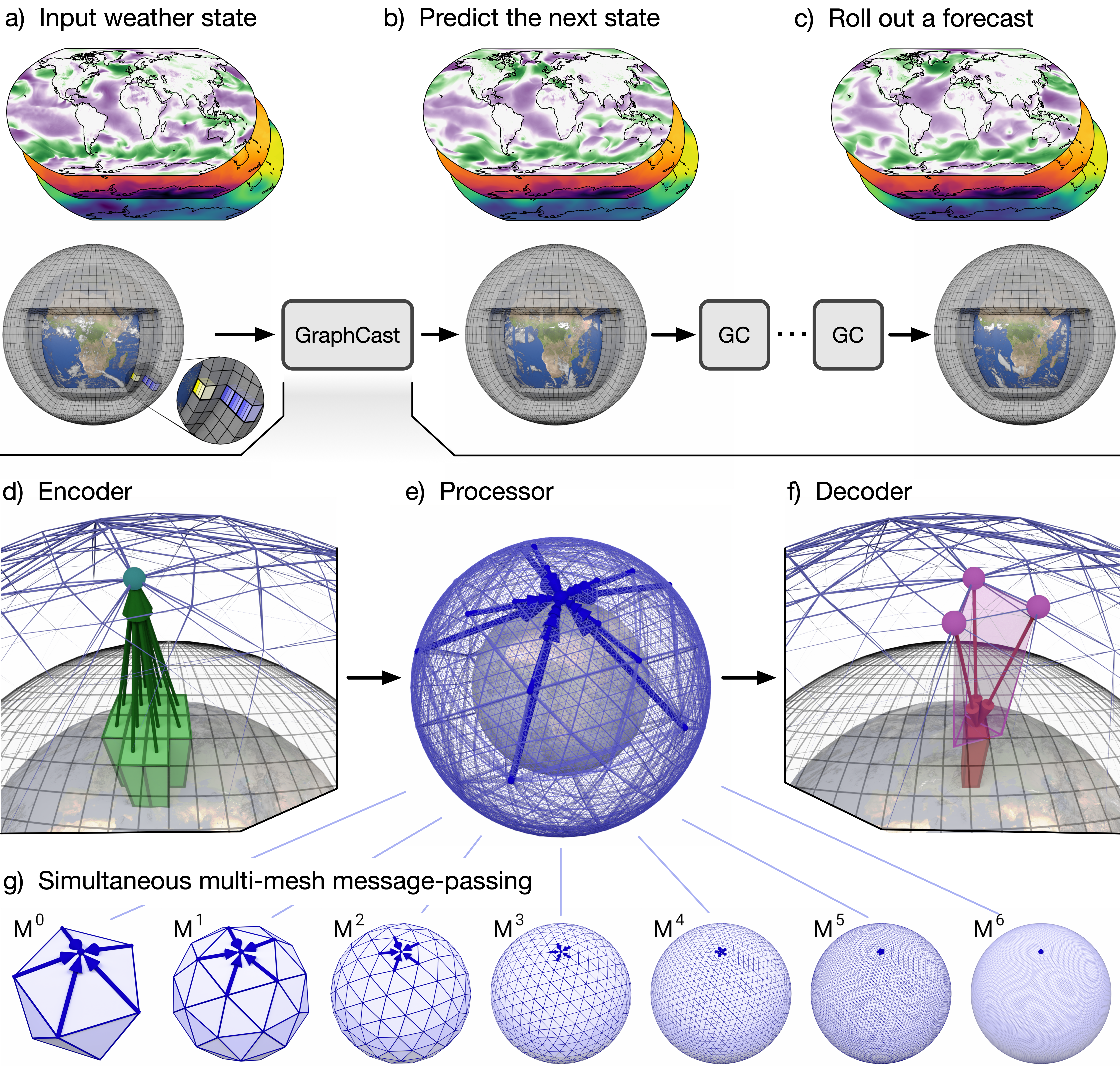
In 2023, researchers at Google DeepMind introduced GraphCast, a data-driven weather forecasting system that replaces traditional numerical physical simulations with a global graph neural network. For decades, global weather forecasting relied on Numerical Weather Prediction (NWP), which solve the complex partial differential equations of fluid dynamics over a grid of billions of points - a process requiring massive supercomputing clusters and hours of execution time. The researchers demonstrated that by treating the atmosphere as a global message-passing graph and training on four decades of historical data, a system can produce 10-day forecasts in under a minute with superior accuracy to the world's most advanced physics-based models.
Message-Passing in Global Atmospheric Graphs
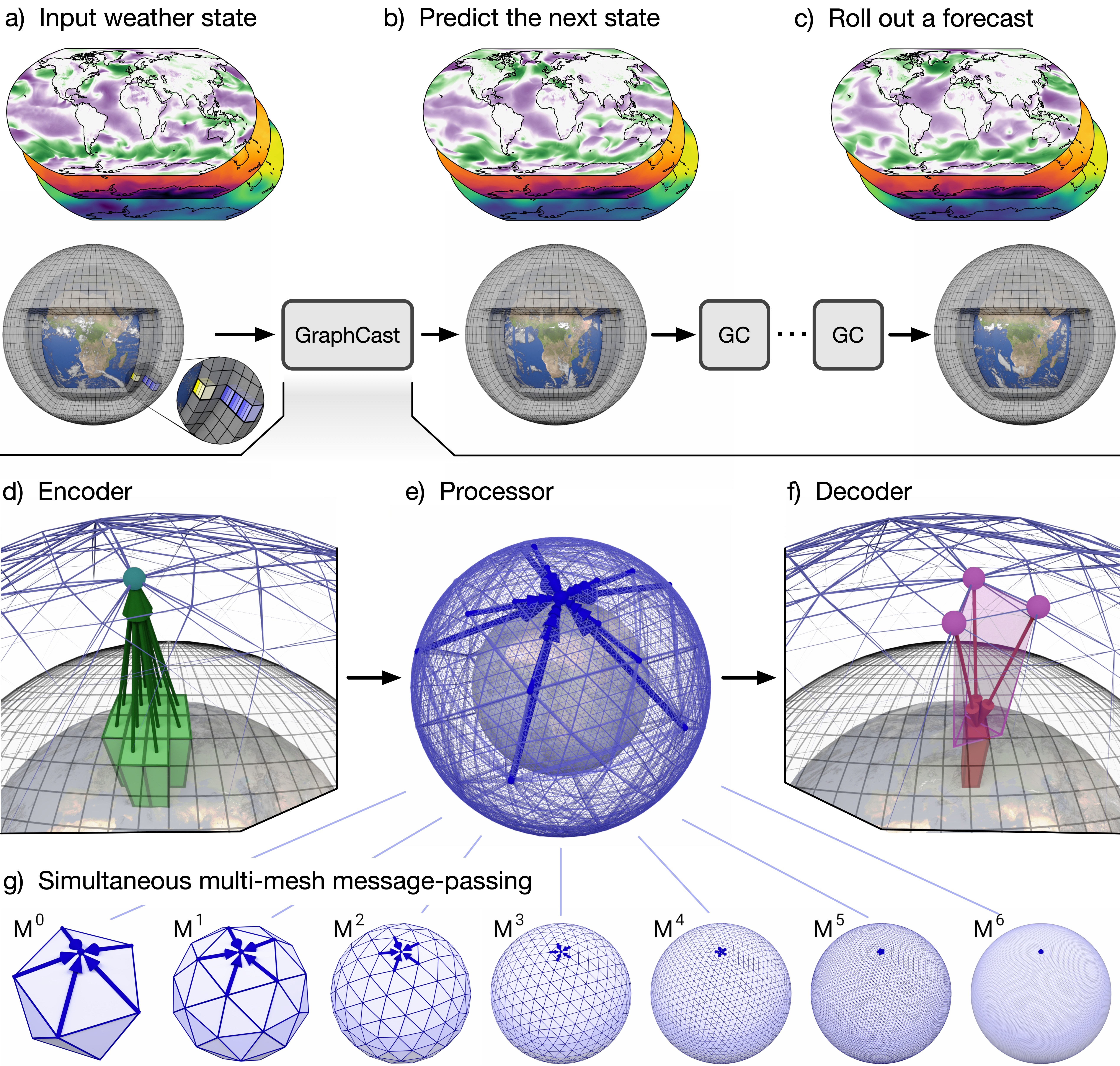
The primary technical innovation of GraphCast is the representation of the Earth's atmosphere as an encoder-processor-decoder graph neural network (GNN). The model maps the state of the atmosphere from a standard latitude-longitude grid onto a high-dimensional multi-mesh graph. In the processor stage, the system executes 16 layers of learned message-passing, allowing information to propagate across the entire globe and capture both local weather patterns and long-range teleconnections. This methodological choice proved that the fundamental rules of meteorology - such as the conservation of mass and energy - can be learned directly from the statistical history of the planet's data, establishing a new foundation for the simulation of high-dimensional physical systems.
Multi-Mesh Discretization and Spatial Stability
To achieve high-resolution forecasting without the mathematical instabilities of traditional grids, GraphCast utilizes a multi-mesh derived from a refined icosahedron. Standard lat-long grids suffer from a "pole problem" where grid points cluster together at the top and bottom of the sphere, creating computational waste and numerical artifacts. The icosahedral multi-mesh ensures that its nodes are distributed almost uniformly across the Earth's surface, providing a spatially homogeneous representation for the GNN to navigate. This engineering shift established the principle that the "shape" of the data representation is as critical for physical modeling as the algorithm itself, effectively digitalizing the geometry of the Earth for efficient parallel processing.
Efficiency and the Data-Driven Forecasting Paradigm
The practical significance of GraphCast is its massive leap in computational efficiency. While traditional supercomputing models like HRES require thousands of cores and over an hour to produce a 10-day forecast, GraphCast achieves the same result in less than 60 seconds on a single TPU. By training on the ERA5 reanalysis dataset from the European Centre for Medium-Range Weather Forecasts (ECMWF), the model learned to "shortcut" the iterative calculations of fluid dynamics. This finding revealed that the bottleneck in weather prediction was not a lack of physical understanding, but the inefficiency of the classical simulation paradigm. It proved that large-scale physical modeling is increasingly a problem of high-performance data processing rather than raw numerical integration.
Impact on Extreme Weather Prediction
The technical significance of the research was validated by its performance on extreme weather events, including the tracking of tropical cyclones and the prediction of severe heatwaves. GraphCast consistently outperformed the industry-standard NWP models on over 90% of global variables across all pressure levels. By providing accurate, real-time forecasts with minimal energy consumption, the technology enables faster early-warning systems for disaster management and climate adaptation. This application established graph-based learning as the primary engine for the next generation of environmental monitoring, suggesting that the most robust way to understand the planet is to treat it as a giant, learnable information system.
Dive Deeper
GraphCast: Medium-Range Global Weather (Official Science)
Science • docs
Explore ResourceDeepMind GraphCast Blog
DeepMind • article
Explore ResourceGraphCast Paper (arXiv Preprint)
arXiv • article
Explore ResourceGitHub: GraphCast Implementation
GitHub • code
Explore Resource
Discussion
0Join the discussion
Sign in to share your thoughts and technical insights.
Loading insights...
Recommended Readings
The author of this article utilized generative AI (Google Gemini 3.1 Pro) to assist in part of the drafting and editing process.