
DeepBind: Convolutional Discovery of Biological Motifs
Babak Alipanahi, Andrew Delong, Matthew T. Weirauch, Brendan J. Frey (2015)
Alipanahi, B., Delong, A., Weirauch, M. T., & Frey, B. J. (2015). Predicting the sequence specificities of DNA- and RNA-binding proteins by deep learning. Nature Biotechnology, 33(8), 931-938.
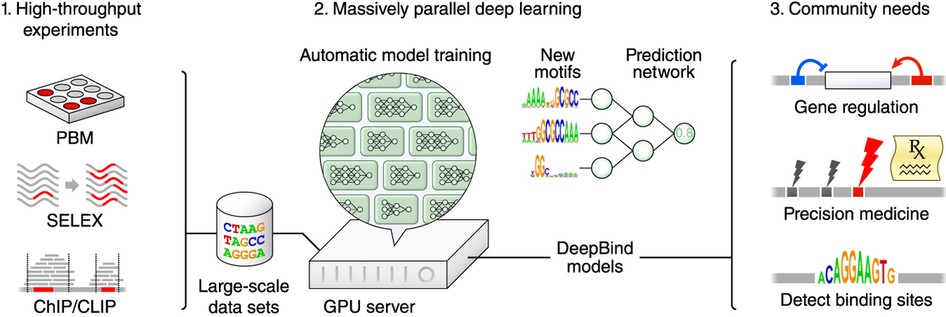
In 2015, researchers introduced DeepBind, demonstrating that deep convolutional neural networks can learn the binding preferences of DNA- and RNA-binding proteins directly from raw nucleotide sequences. Prior to this work, computational biology modeled transcription factor affinities using Position Weight Matrices (PWMs) or engineered k-mer tables. These traditional models assumed that nucleotide positions contribute independently to binding, failing to capture complex interactions, spatial spacing, and secondary structure. DeepBind proved that convolutional filters naturally parameterize Position Weight Matrices while nonlinear layers learn combinatorial binding rules without manual feature engineering.
Beyond Independent Nucleotide Assumptions
Transcription factors and RNA-binding proteins regulate cellular machinery by attaching to specific sequence patterns. Position Weight Matrices simplify this process by assigning an independent score to each base at each position within a fixed window. However, biological binding often involves cooperative protein interactions, variable spacing, and local sequence context that violate this independence assumption. Classical machine learning alternatives, such as support vector machines, required labor-intensive manual crafting of k-mer features. DeepBind addressed this challenge by treating raw nucleotide strings as input matrices, allowing a gradient-trained network to extract relevant sequence features autonomously.
1D Convolutions and Global Max Pooling
The DeepBind architecture processes one-hot encoded nucleotide sequences through three sequential stages:
- 1D Convolutional Filtering: Sequences of length are encoded as binary matrices. A bank of learnable 1D convolutional filters scans along the sequence. Each filter computes an affinity score over a local window of 10 to 24 nucleotides, acting mathematically as an unnormalized energy scoring matrix.
- Rectification: A Rectified Linear Unit (ReLU) ensures that only positive affinities contribute to downstream signals, mirroring the physical threshold required for molecular binding.
- Global Max Pooling: The network takes the maximum activation of each filter across the entire sequence length. This operation introduces translation invariance, reflecting the biological reality that a transcription factor can bind anywhere along a promoter or enhancer region regardless of its exact coordinate.
Pooled activations pass through fully connected layers that combine individual motif detections into a final predicted binding affinity score.
Generalization Across In Vitro and In Vivo Assays
DeepBind was evaluated across hundreds of transcription factor and RNA-binding protein datasets derived from protein binding microarrays (PBM), SELEX, RNAcompete, and ChIP-seq experiments. Across these benchmarks, it surpassed dozens of existing motif discovery tools in Area Under the ROC Curve (AUC) and Pearson correlation metrics. Models trained on in vitro SELEX assays generalized to in vivo ChIP-seq peaks across the genome, successfully navigating cellular noise. The researchers also validated clinical utility by scoring non-coding single-nucleotide variants, correctly predicting lost binding affinities in disease-linked mutations within the ALAS2 intron and LDLR promoter.
Biological Interpretable Filters
A key contribution of DeepBind was showing that convolutional filters can be interpreted biologically. By feeding test sequences back through trained filters and measuring positional activations, the authors generated sequence logos that matched canonical biological motifs documented in literature. DeepBind established the foundational design pattern - 1D convolutions coupled with spatial pooling - that paved the way for subsequent genomic models, proving that neural networks can decode regulatory instructions directly from linear genetic sequences.
Dive Deeper
Predicting Sequence Specificities by Deep Learning (Nature Biotechnology)
Nature • docs
Explore ResourceDeepBind Official Web Portal
University of Toronto • docs
Explore ResourceDeepBind on Kipoi Model Zoo
Kipoi • code
Explore Resource
Discussion
0Join the discussion
Sign in to share your thoughts and technical insights.
Loading insights...
Recommended Readings
The author of this article utilized generative AI (Google Gemini 3.1 Pro) to assist in part of the drafting and editing process.