
DoRA: Weight-Decomposed Low-Rank Adaptation
Shih-Yang Liu et al. (2024)
Liu, S. Y., Yen, C. Y., Nag, N., ... & Cheng, K. T. (2024). DoRA: Weight-Decomposed Low-Rank Adaptation. arXiv preprint arXiv:2402.09353.
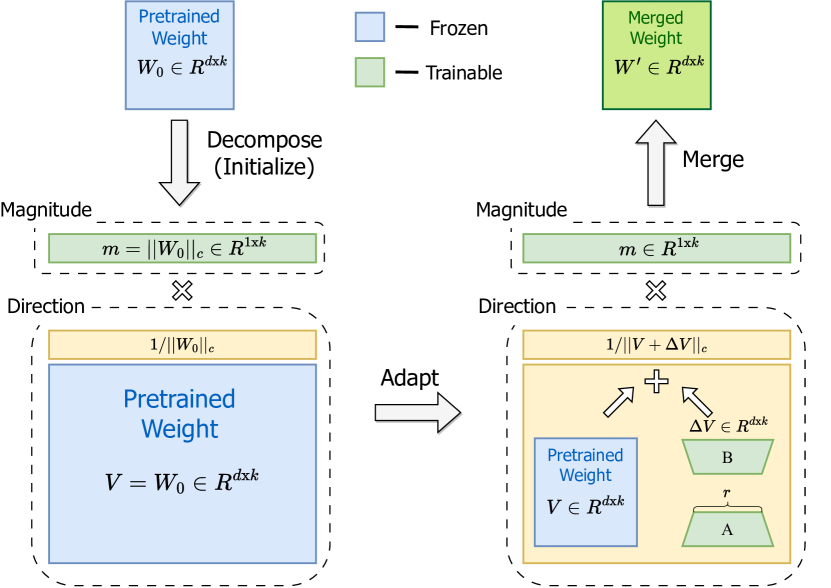
In 2024, researchers introduced Weight-Decomposed Low-Rank Adaptation (DoRA), a fine-tuning method that resolves the performance gap between sparse updates and full-parameter optimization. While standard Low-Rank Adaptation (LoRA) significantly reduces the computational barrier for adapting massive models, it is limited by a rigid coupling between the magnitude and direction of weight updates. The researchers demonstrated that by reparameterizing the pre-trained weight matrix into decoupled components, a model can independently learn directional shifts and magnitude scaling. This methodological choice allows the model to mirror the behavioral patterns of full-parameter fine-tuning, achieving superior learning stability and accuracy without introducing any additional inference latency.
Weight Decomposition and Directional Decoupling

The core technical innovation of DoRA is the decomposition of a weight matrix into a magnitude vector and a directional matrix . In standard LoRA, any significant change in the orientation of a weight vector is typically accompanied by a proportional increase in its magnitude. DoRA addresses this by applying the low-rank update specifically to the directional component while allowing the magnitude to be learned independently. Mathematically, the update is represented as , where is the low-rank update. This decoupling allows the gradient to be conditioned more effectively, as directional shifts no longer force an unintended growth in weight magnitude, enabling more nuanced adjustments during the adaptation phase.
Learning Behavior and Structural Alignment
Empirical analysis of DoRA's learning trajectories shows a striking similarity to full fine-tuning (FT), characterized by a complex and often negative correlation between magnitude and direction updates. In contrast, standard LoRA consistently exhibits a positive correlation, restricting its ability to execute precise directional shifts. By aligning its update pattern with that of full parameter optimization, DoRA achieves superior performance across diverse reasoning and visual instruction tasks. This finding revealed that the bottleneck in sparse adaptation was not the absolute number of parameters being updated, but the structural constraints on how those parameters were permitted to move through the optimization landscape.
Latency-Free Deployment and Scaling
The technical significance of DoRA is its ability to provide these performance gains with zero additional cost during the inference phase. Like LoRA, the learned low-rank updates can be pre-computed and merged directly into the base model's weights before deployment. This ensures that the adapted model maintains the exact same architecture and processing speed as the original. The success of this method proved that the scalability of model adaptation is determined by the adoption of reparameterization techniques that prioritize structural flexibility over simple parameter sparsity. It established the principle that the most efficient way to steer a massive network is to identify and manipulate its fundamental geometric dimensions.
The Logic of Independent Weight Scaling
The achievement of DoRA demonstrated that many "efficient" adaptation methods possess hidden constraints that limit their expressive power. The decision to prioritize independent magnitude and direction scaling revealed that the primary constraint on sparse learning was the coupling of these distinct geometric properties. This principle remains the central theme in the search for next-generation adaptation frameworks, influencing the design of more sophisticated weight-decomposition strategies. It leaves open the question of whether other fundamental neural components - such as normalization layers or attention heads - can be further decomposed to reveal similar hidden dimensions of optimization efficiency.
Dive Deeper
DoRA Paper on arXiv (Preprint)
arXiv • article
Explore ResourceOfficial DoRA GitHub Repository
GitHub • code
Explore ResourceNVIDIA Developer Blog: DoRA
NVIDIA • article
Explore ResourceParameter-Efficient Fine-Tuning Guide (Hugging Face)
Hugging Face • docs
Explore Resource
Discussion
0Join the discussion
Sign in to share your thoughts and technical insights.
Loading insights...
Recommended Readings
The author of this article utilized generative AI (Google Gemini 3.1 Pro) to assist in part of the drafting and editing process.