
Training AI Without the Headache of RLHF
Rafael Rafailov et al. (Stanford University, 2023)
Rafailov, R., Sharma, A., Mitchell, E., Ermon, S., Manning, C. D., & Finn, C. (2023). Direct preference optimization: Your language model is secretly a reward model. arXiv preprint arXiv:2305.18290.
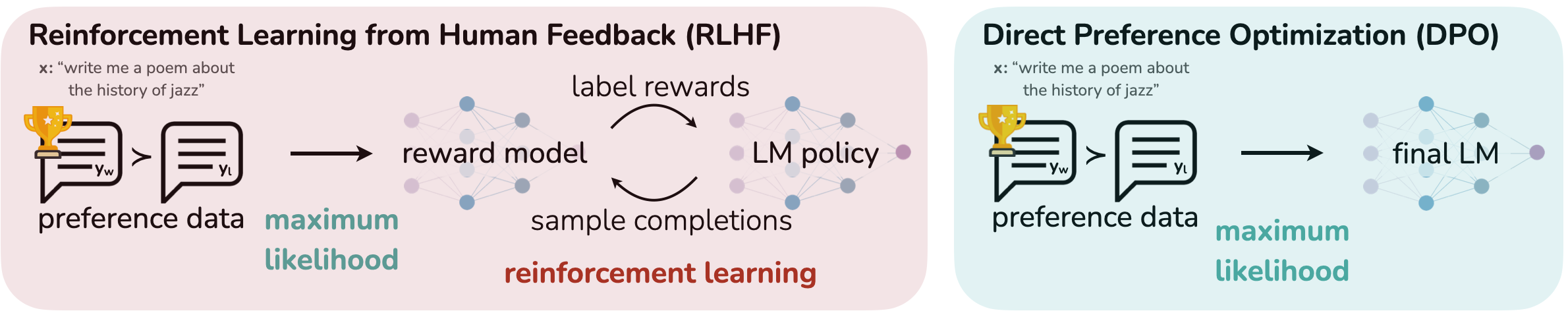
In 2023, researchers at Stanford University introduced Direct Preference Optimization (DPO), a method for aligning large language models with human preferences that eliminates the requirement for explicit reward modeling and reinforcement learning. Traditionally, alignment relied on the Reinforcement Learning from Human Feedback (RLHF) pipeline, a complex and often unstable process involving multiple neural networks and high-variance gradients. The researchers proved that the optimal policy for a given preference distribution can be derived in closed form, allowing for a stable supervised objective that directly maximizes the likelihood of preferred completions while minimizing that of rejected ones.
The Implicit Reward and Closed-Form Solution
The fundamental innovation of DPO is the realization that any optimal policy in the preference learning framework implicitly defines its own reward function. By rearranging the closed-form solution to the KL-constrained reinforcement learning objective, the researchers demonstrated that the latent reward of a completion can be expressed entirely in terms of the log-ratio between the current policy and a reference model. This discovery allows the difference in rewards - which drives the Bradley-Terry preference model - to be calculated directly from the language model’s own probabilities. This shift transformed alignment from a multi-stage reinforcement learning problem into a simple binary classification task, effectively removing the need for a separate reward model.
Stability and Computational Efficiency
The technical significance of the DPO framework is its superior stability and reduced computational overhead compared to standard RLHF methods like Proximal Policy Optimization (PPO). Because DPO is a supervised objective trained on offline datasets, it does not require the high-frequency sampling and active inference that make reinforcement learning fragile. The gradient of the DPO loss function naturally weights updates based on the model’s current confidence; if the model already assigns a high implicit reward to the preferred completion, the update is small, whereas if it is "wrong," the update is large and focused. This finding established that the most robust way to align a machine is to treat preference as an inherent property of the model's linguistic register.
Breaking the Complexity of RL-Based Alignment
The success of DPO was driven by its ability to match or exceed the performance of PPO-aligned models across tasks like summarization and dialogue while being significantly easier to implement. The elimination of the "Reward Model" and "Critic Model" reduced the memory and compute requirements for alignment by over 50%, enabling more researchers and organizations to perform high-quality preference tuning. This application revealed that the complexity of previous alignment techniques was a byproduct of treating the reward as an external signal rather than an internal property of the policy. It established the principle that high-quality, human-centric behavior is an accessible property of a well-formed training objective.
The Shift to Offline Preference Optimization
The practical significance of DPO is most evident in its rapid adoption by the open-source AI community and the development of subsequent methods like IPO and KTO. By providing a stable and scalable method for steering models, DPO enabled a wave of specialized "instruct" and "chat" versions of foundation models. This realization remains the central theme of current alignment research, suggesting that the steering of complex autonomous systems requires the identification of mathematical invariants that link the system’s output to human intent. It leaves open the question of whether these offline methods can fully capture the "exploration" benefits of reinforcement learning in truly open-ended or creative tasks.
Dive Deeper
Direct Preference Optimization (Official arXiv)
arXiv • article
Explore ResourceDPO Explanation (Hugging Face Blog)
Hugging Face • article
Explore ResourceTRL: Transformer Reinforcement Learning Library
GitHub • code
Explore ResourceEric Mitchell: Explaining DPO (Video)
YouTube • video
Explore Resource
Discussion
0Join the discussion
Sign in to share your thoughts and technical insights.
Loading insights...
Recommended Readings
The author of this article utilized generative AI (Google Gemini 3.1 Pro) to assist in part of the drafting and editing process.