
Floyd-Warshall Algorithm: All-Pairs Shortest Paths
Robert Floyd (1962)
Floyd, R. W. (1962). Algorithm 97: Shortest path. Communications of the ACM, 5(6), 345.
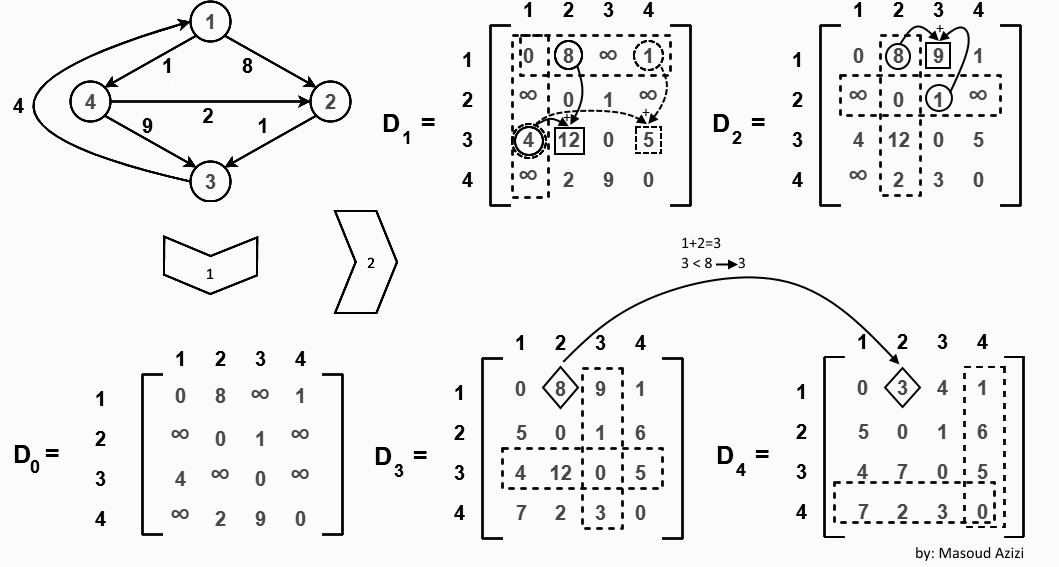
In 1962, Robert Floyd published a method for determining the shortest paths between all pairs of nodes in a weighted graph through a unified iterative process. This algorithm, which evolved from earlier work by Stephen Warshall on transitive closure, utilizes a triply-nested loop to systematically evaluate whether a path between two nodes can be improved by passing through an intermediate vertex. By treating the entire network as a dense matrix, the algorithm identifies the optimal connectivity of a graph in time, providing a fundamental example of dynamic programming applied to global network analysis.
The Logic of Systematic Path Refinement
The technical engine of the Floyd-Warshall algorithm is its method of considering every vertex in the graph as a potential bridge for every pair of vertices . For each triple , the algorithm compares the current estimated distance between and with the sum of the distances from to and from to . If the path through is shorter, the distance matrix is updated with the new value. This process ensures that after iterations of the outermost loop, the matrix contains the shortest path between all pairs of nodes using only the first vertices as intermediate points. This method proved that global network properties can be derived through the repeated application of a simple, three-node logical refinement.
Structural Equivalence to Transitive Closure
The algorithm's structure is identical to the method used by Stephen Warshall for determining the transitive closure, or reachability, of a graph. While Warshall used Boolean logic to identify if any path exists between nodes, Floyd generalized the approach to handle numerical edge weights and identify the optimal path. This historical convergence revealed that determining reachability and finding shortest paths are structurally equivalent problems governed by the same closure property in discrete mathematics. Both tasks rely on building global relationships from a series of local, interconnected observations, effectively treating pathfinding as a problem of logical induction across a matrix.
Performance Characteristics in Dense Graphs
When evaluating the efficiency of all-pairs shortest path (APSP) calculations, the Floyd-Warshall algorithm is optimized for dense graphs where the number of edges approaches the square of the number of vertices (). While executing Dijkstra’s algorithm from every node as a source may be faster in sparse networks, Floyd’s approach is superior in dense environments due to its low constant factor and predictable memory access patterns. Unlike single-source algorithms that require complex priority queue management, Floyd-Warshall performs basic arithmetic on a contiguous block of memory, making it highly compatible with modern CPU cache architectures and parallel processing environments.
Hardware Affinity and Parallel Execution
The mathematical simplicity of the triple-nested loop makes the Floyd-Warshall algorithm highly parallelizable on modern high-performance computing hardware. Implementations often use blocking strategies, where the distance matrix is divided into smaller tiles that fit within a processor's L1 or L2 cache. Because each update in a given iteration is independent of others in the same pass, the calculations can be distributed across thousands of cores in a GPU or multi-core CPU. This hardware affinity has established the algorithm as a standard benchmark for measuring the throughput of specialized networking and data processing hardware, demonstrating that algorithmic simplicity can lead to significant gains in physical execution speed.
Matrix Refinement as a Universal Logic
The success of this algorithm demonstrated that the global connectivity of a complex system can be accurately captured through a sequence of systematic refinements to a dense representation. The choice to model the problem as a matrix transformation revealed that the difficulty of network analysis is primarily a function of the number of nodes rather than the specific arrangement of edges. This principle remains the central theme of tasks such as calculating the diameter of social networks or identifying critical hubs in physical infrastructure. It leaves open the question of how these dense matrix methods can be adapted to massive, sparse datasets where the memory cost of a square matrix becomes prohibitive.
Dive Deeper
Algorithm 97: Shortest Path (ACM)
ACM • docs
Explore ResourceFloyd-Warshall Visualization
PyPup • article
Explore ResourceTransitive Closure and Pathfinding (Wikipedia)
Wikipedia • article
Explore Resource
Discussion
0Join the discussion
Sign in to share your thoughts and technical insights.
Loading insights...
Recommended Readings
The author of this article utilized generative AI (Google Gemini 3.1 Pro) to assist in part of the drafting and editing process.