
Dijkstra’s Logic: Navigating the Shortest Path
Edsger Dijkstra (1959)
Dijkstra, E. W. (1959). A note on two problems in connexion with graphs. Numerische mathematik, 1(1), 269-271.
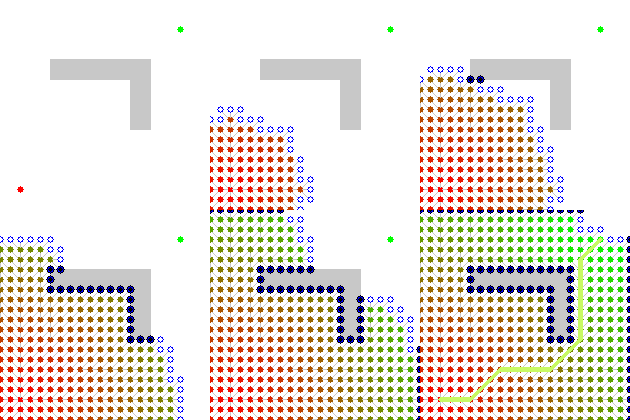
In 1959, Edsger Dijkstra published a paper describing iterative methods for solving two fundamental problems in graph theory: the determination of the shortest path between two nodes and the construction of a minimum spanning tree. Dijkstra demonstrated that these problems, which appear to require an exhaustive search of all possible paths, can be resolved through a greedy approach that maintains local optimality at each step. This work established the principle that computational efficiency is a direct result of identifying the underlying logical structure of a network.
The Shortest Path Algorithm and Edge Relaxation
Dijkstra’s shortest path algorithm identifies the path of minimum total length between a source node and all other nodes in a graph with non-negative edge weights. The algorithm operates through a process of edge relaxation, where it maintains a set of settled nodes with known shortest distances and a set of unsettled nodes with tentative estimates. By consistently selecting the unsettled node with the smallest tentative distance and evaluating its outgoing edges, the algorithm ensures that the shortest path to each vertex is discovered in a single pass. This finding proved that global optimality in pathfinding can be achieved through a sequence of local decisions, effectively converting a global search into a coordinated optimization task.
The Constraints of the Greedy Choice Property
The reliability of Dijkstra's algorithm depends on the greedy choice property, which assumes that a locally optimal selection will necessarily contribute to a globally optimal solution. This property remains valid only when the edge weights in the graph are non-negative. If a network contains negative weights, a later edge could reduce the total cost of a previously rejected path, causing the greedy assumption to fail. Dijkstra’s methodological decision to restrict the algorithm to non-negative weights enabled a significant reduction in computational complexity, initially scaling at and later optimized to with advanced data structures. This proved that the efficiency of a process is often dictated by the specific constraints applied to the problem space.
Priority Queues and Information Retrieval Efficiency
The practical implementation of Dijkstra’s algorithm relies on the efficient selection of the next node for exploration. The integration of a priority queue - a data structure that consistently provides the element with the lowest numerical value - allows the algorithm to identify the nearest unsettled node without scanning the entire set. This synthesis of algorithmic logic and data structures demonstrated that the speed of a computational process is determined not only by the number of steps taken but by the efficiency of information retrieval at each step. This principle is a central feature of modern network routing, where systems must determine optimal paths for data packets in real-time across the internet.
Minimum Spanning Trees and Connectivity
The second contribution of the 1959 paper was an algorithm for constructing a minimum spanning tree, which identifies the set of edges that connects all nodes in a graph with the minimum possible total weight. Dijkstra's method, functionally similar to Prim's algorithm, builds the tree by starting from an arbitrary vertex and iteratively adding the nearest neighbor that is not yet part of the set. This approach revealed that maintaining global connectivity in a network is most efficiently achieved by prioritizing the least expensive local connections. This finding serves as a foundational principle for the design of physical infrastructures, such as electrical grids and communication networks, where the objective is to ensure connectivity with minimal resource expenditure.
The Logical Invariant of Optimality
Dijkstra’s research proved that many network-based problems possess an optimal sub-structure, where the shortest path between two distant points is composed of the shortest paths between intermediate points. The significance of his algorithms lies in their ability to exploit this property to avoid redundant calculations. By identifying the correct iterative logic that maintains an invariant of optimality, these methods demonstrated that complex search problems can be reduced to repeatable mathematical rules. This leaves open the question of whether similar logic can be applied to NP-hard problems, or if there is an inherent threshold where local optimization no longer leads to global certainty.
Dive Deeper
A Note on Two Problems in Connexion with Graphs (PDF)
CWI Archive • docs
Explore ResourceDijkstra's Algorithm Visualizer
USFCA • article
Explore ResourceDijkstra's Original Paper (Springer)
Springer • article
Explore Resource
Discussion
0Join the discussion
Sign in to share your thoughts and technical insights.
Loading insights...
Recommended Readings
The author of this article utilized generative AI (Google Gemini 3.1 Pro) to assist in part of the drafting and editing process.