
Bellman's Routing Algorithm: How the Internet Finds the Fastest Path
Richard Bellman (1958)
Bellman, R. (1958). On a routing problem. Quarterly of applied mathematics, 16(1), 87-90.
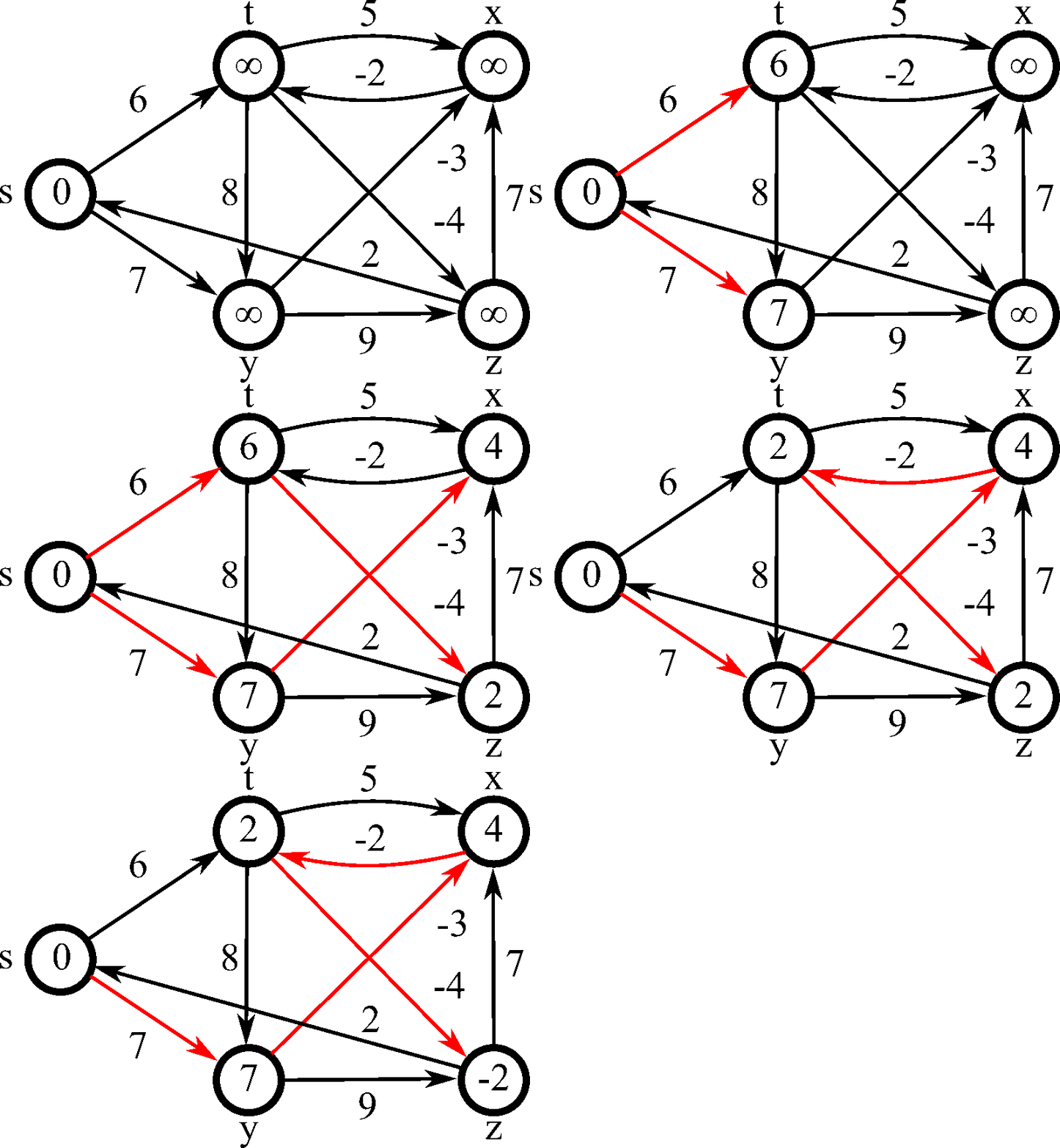
In 1958, Richard Bellman introduced a method for identifying the shortest path in a network that systematically addresses the limitations of greedy search algorithms. The paper established the Principle of Optimality, which posits that an optimal path between two points is composed of sub-paths that are themselves optimal. By applying an iterative relaxation technique to every edge in a graph, Bellman demonstrated that the global shortest path can be determined through a series of local, recursive calculations. This approach provided the mathematical foundation for dynamic programming and decentralized network routing.
The Logic of Edge Relaxation and Iteration
The technical mechanism of the Bellman-Ford algorithm relies on the repeated relaxation of edges to refine the distance estimates to each node in a graph. For a network containing vertices, the algorithm executes iterations, where each iteration involves checking every edge and updating the distance to if a shorter path is available through . This iterative process ensures that by the final pass, the shortest path to every reachable vertex has been calculated, regardless of the order in which the edges were processed. This method proved that global optimization can be achieved by maintaining a consistent invariant of local optimality across the system's components.
Resilience to Negative Edge Weights
A primary technical advantage of the Bellman-Ford algorithm is its ability to correctly process graphs containing negative edge weights. Greedy algorithms, such as Dijkstra’s, fail in these scenarios because they assume that the cost of a path only increases as it is traversed. Bellman’s iterative approach bypasses this constraint by allowing distance estimates to decrease over successive passes, accommodating paths where the total cost is reduced by specific edges. This resilience proved that the efficiency of an algorithm is often determined by the specific constraints of the problem space, such as the non-negativity of weights.
Negative Cycle Detection and Instability
The algorithm includes a mechanism for detecting negative cycles - pathways that can be traversed indefinitely to reduce the total cost toward negative infinity. By performing a -th iteration, the system can identify if any distance can still be reduced; if so, a negative cycle must be present. This finding revealed that routing logic is not only about path optimization but also about identifying structural instabilities within a network. This capability has been applied to automated financial systems to detect arbitrage opportunities, where a negative cycle in a currency exchange graph represents a sequence of trades yielding a risk-free profit.
Decentralized Routing and the Distance-Vector Protocol
Bellman’s research provided the blueprint for decentralized distance-vector routing protocols, such as the Routing Information Protocol (RIP). In these systems, each router maintains a vector of estimated distances to all other networks and periodically exchanges this information with its immediate neighbors. By applying the Bellman-Ford relaxation step to the received data, a global routing map emerges from purely local interactions. This distributed logic proved that a network can maintain structural awareness without a central authority, although it also introduced specific failure modes like the count-to-infinity problem, where invalid routing information can propagate through the system following a link failure.
The Foundation of Dynamic Programming and Efficiency
The development of this algorithm demonstrated that many complex optimization problems possess an overlapping sub-problem structure that can be exploited through memoization and iterative updates. The decision to model routing as a dynamic programming task revealed that the time complexity of pathfinding is a function of the total number of edges and vertices, scaling at . This realization remains the central theme of modern network analysis, suggesting that the most robust way to manage a complex system is to ensure that every component maintains a locally optimal view of its immediate environment.
Dive Deeper
On a Routing Problem (Official DOI)
AMS • docs
Explore ResourceJSTOR Stable Record
JSTOR • docs
Explore ResourceDynamic Programming (Wikipedia)
Wikipedia • article
Explore Resource
Discussion
0Join the discussion
Sign in to share your thoughts and technical insights.
Loading insights...
Recommended Readings
The author of this article utilized generative AI (Google Gemini 3.1 Pro) to assist in part of the drafting and editing process.