
Watson-Crick Double Helix: Molecular Structure of Deoxyribose Nucleic Acid
Watson & Crick (1953)
Watson, J. D., & Crick, F. H. (1953). Molecular structure of nucleic acids: a structure for deoxyribose nucleic acid. nature, 171(4356), 737-738.
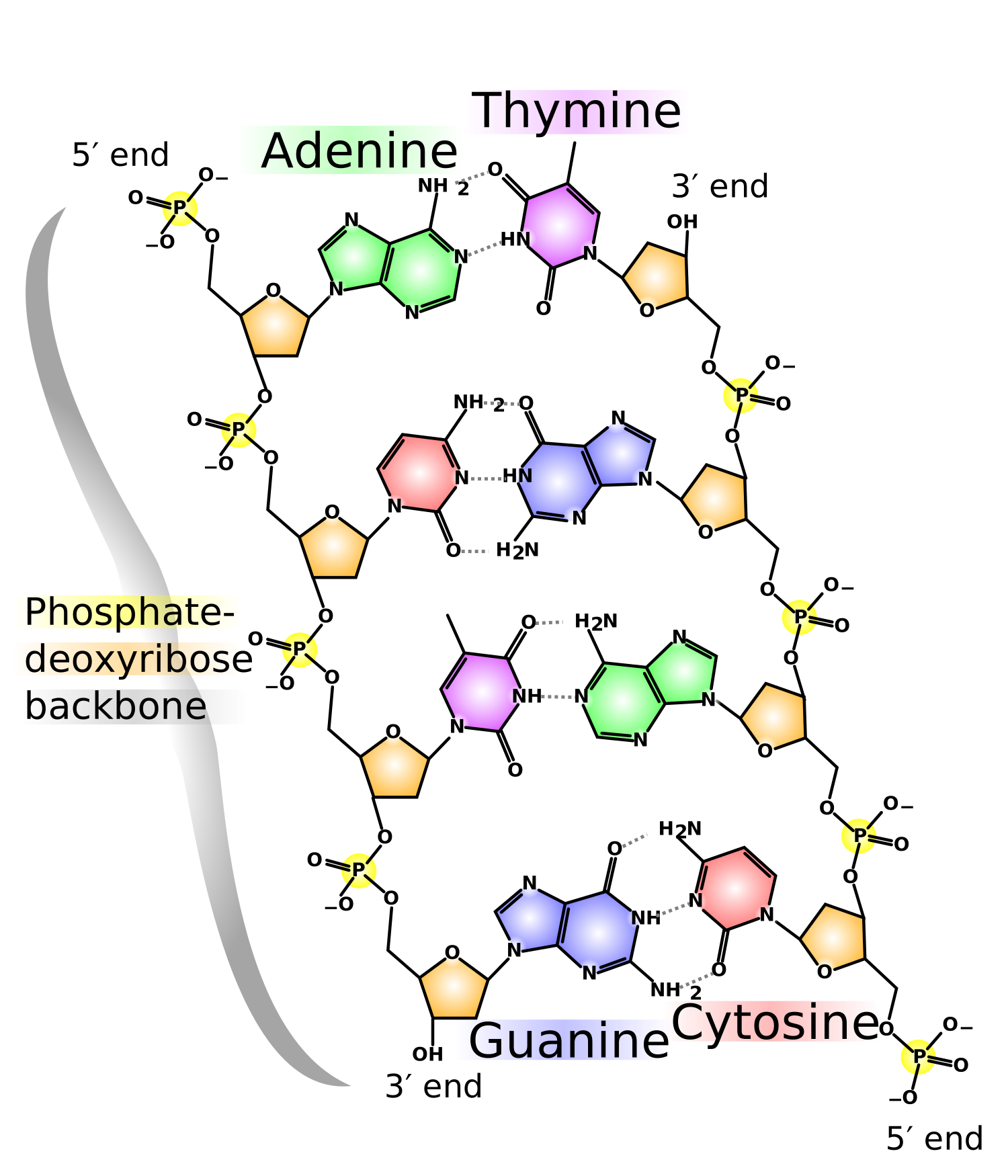
In 1953, James Watson and Francis Crick proposed a double-helical structure for deoxyribonucleic acid (DNA), identifying the physical architecture that allows for the storage and replication of genetic information. Prior to this discovery, while DNA was recognized as the primary carrier of heredity, its molecular arrangement remained unknown. The proposed model provided a geometric explanation for how biological instructions are encoded within a chemical structure, shifting the study of life from descriptive biology to the analysis of molecular logic and stereochemical constraints.
Antiparallel Geometry and the Phosphate Backbone
The technical feasibility of the double helix model relied on reconciling the chemical components of DNA with the laws of stereochemistry. The researchers identified that the molecule consists of two long nucleotide chains composed of deoxyribose sugar and phosphate groups. By evaluating bond angles and molecular distances, they determined that these backbones must be arranged in an antiparallel configuration, running in opposite directions. This arrangement places the negatively charged phosphate groups on the exterior of the molecule, where they interact with the aqueous environment, while the nitrogenous bases are shielded in the hydrophobic interior. This finding demonstrated that the stability of the genetic material is a function of a specific geometric architecture that protects the integrity of the code.
X-Ray Diffraction and Structural Boundary Conditions
The conceptual derivation of the model was supported by X-ray diffraction data, most notably the diffraction patterns obtained by Rosalind Franklin and Raymond Gosling. The characteristic X-shaped pattern provided the clinical evidence for a helical structure and established specific physical dimensions, including a diameter of 20 Angstroms and a vertical repeat every 34 Angstroms. These measurements acted as rigid boundary conditions for the model-building process. Any viable structure had to conform to these precise spatial constraints, transforming the search for the molecular basis of heredity into a problem of physical coordination and geometric fit.
Tautomeric Forms and the Specificity of Base Pairing
The most critical technical challenge was identifying the configuration of the nitrogenous bases - adenine, thymine, guanine, and cytosine - at the center of the helix. Earlier structural attempts had failed by assuming the bases existed in the enol tautomeric form. Following insights regarding the keto form, Watson and Crick identified the specific hydrogen-bonding patterns that allow for stable pairing. They discovered that adenine pairs exclusively with thymine, and guanine pairs with cytosine, ensuring that the diameter of the helix remains constant regardless of the sequence. This finding revealed that the grammar of the genetic code is dictated by the precise chemical fit of these base pairs, ensuring a uniform and repeatable structure for all genomic data.
Structural Justification for Chargaff's Rules
The base-pairing mechanism provided a physical justification for the empirical regularities known as Chargaff’s Rules, which noted that the quantities of adenine and thymine, and guanine and cytosine, are always equal in a given sample of DNA. The double helix model proved that these ratios are not merely statistical observations but are structural requirements of the molecule’s geometry. One type of base physically necessitates the presence of its complement to maintain the helix's integrity. This observation transformed a biological regularity into a structural law, implying that the informational content of life is intrinsically tied to its molecular shape.
The Mechanism of Semi-Conservative Replication
The structure of the double helix suggested an immediate mechanism for its own replication. Because each base can only pair with its specific complement, a single strand of DNA contains the complete information necessary to reconstruct its partner. The researchers noted that if the two strands are separated, each can serve as a template for the synthesis of a new, identical copy. This provided the first physical explanation for the high-fidelity transfer of traits across generations, demonstrating that heredity is essentially a molecular information transfer process.
The Logic of the Molecular Alphabet
The identification of the double helix established that biological complexity is encoded in a linear sequence of chemical units. This effectively digitalized the study of life, proving that an organism’s developmental instructions are written in a four-letter molecular alphabet. The success of this model integrated the fields of biology and information theory, suggesting that the fundamental processes of life are governed by geometric logic and the management of informational entropy. This leaves open the question of how this linear code is translated into the three-dimensional functional reality of a living system.
Dive Deeper
Molecular Structure of Nucleic Acids (NIH Archive)
NIH • docs
Explore ResourceNature Journal Record
Nature • article
Explore ResourceDNA Structure Animation
HHMI BioInteractive • video
Explore Resource
Discussion
0Join the discussion
Sign in to share your thoughts and technical insights.
Loading insights...
Recommended Readings
The author of this article utilized generative AI (Google Gemini 3.1 Pro) to assist in part of the drafting and editing process.