
The Game Theory Behind Every Conflict and Cooperation
John Nash (1950)
Nash, J. (1950). Equilibrium points in n-person games. Proceedings of the National Academy of Sciences, 36(1), 48-49.
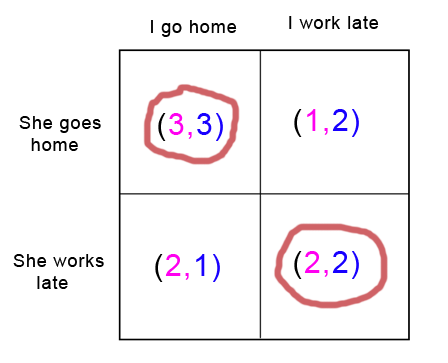
In 1950, John Nash provided a mathematical proof for the existence of equilibrium points in strategic interactions involving multiple participants. Prior to this work, game theory research was primarily restricted to zero-sum games between two players. Nash generalized these models to include any finite number of players with any set of payoffs, demonstrating that there is always at least one configuration of strategies where no individual player can improve their outcome by changing their own strategy alone. This finding established the mathematical basis for analyzing decentralized systems where order emerges from the independent decisions of rational agents.
Mathematical Existence via Fixed-Point Theorems
Nash's technical contribution relied on the application of fixed-point theorems to model human and biological behavior. He used Kakutani’s fixed-point theorem to prove that every finite game possesses at least one equilibrium point. By representing the set of all possible strategies as a compact, convex subset of Euclidean space, he defined a best-response correspondence that maps each player's choice to the strategies that maximize their utility relative to others. The proof demonstrated that this correspondence must have a fixed point, proving that a state of mutual best-response is a mathematical necessity in finite strategic environments. This shift integrated game theory into the field of topology, providing a rigorous foundation for the study of social and economic stability.
The Logic of Mixed Strategies
To ensure that the strategy space remained continuous and convex - a requirement for the fixed-point proof - Nash introduced the concept of mixed strategies. In a mixed strategy, a player does not select a single action but instead chooses a probability distribution over all available actions. This approach demonstrated that in competitive scenarios, the optimal behavior often requires a calculated degree of unpredictability to prevent exploitation by opponents. By allowing for randomized choices, Nash proved that stability can be maintained even when no single "pure" strategy is optimal, revealing that the most resilient state in a system is often a controlled balance of probabilities.
Best-Response Correspondence and System Stability
The mechanism of the Nash Equilibrium is driven by the best-response correspondence, which identifies the mapping from the strategy profiles of all other participants to the set of actions that yield the highest payoff for an individual. An equilibrium point is reached when every participant's strategy is a member of their own best-response set. This abstraction defines the equilibrium as a state of mutual exhaustion where no participant has a profitable deviation. It suggested that stability in complex systems is not a result of cooperation or collective agreement, but rather a state where individual participants are strategically constrained by the choices of those around them.
Non-Cooperative Models and Decentralized Order
Nash’s framework provided a formal methodology for analyzing non-cooperative games, where participants cannot make binding agreements. By moving beyond the restrictive two-person models of earlier researchers, Nash proved that stable outcomes can emerge in decentralized systems without the intervention of a central authority. This finding has been applied to diverse fields including international relations, market competition, and evolutionary biology, suggesting that the behavior of a system is an emergent property of its underlying rules and payoffs. It effectively treated social interaction as a structural logic determined by the alignment of individual incentives.
The Gap Between Individual Rationality and Social Optimality
The analysis of equilibrium points revealed that a stable state is not necessarily the most beneficial outcome for the group. Nash demonstrated that individual rationality can lead to Pareto-inefficient states, where every participant would achieve a better result if they could coordinate their actions. This tension is illustrated in models such as the Prisoner’s Dilemma, where the equilibrium point involves mutual betrayal despite a shared preference for cooperation. This observation provided the foundation for the field of mechanism design, raising the technical question of how to modify the rules of a game to ensure that individual best-responses align with the collective welfare.
The Framework of Strategic Persistence
The proof of equilibrium points provides a universal language for describing persistence in systems of interacting agents. It serves as a tool for evaluating the stability of market structures, biological niches, and geopolitical alliances. By demonstrating that stability is a mathematical requirement in finite games, the work provided a method for understanding why specific behaviors persist in a society even when they appear sub-optimal. This leaves open the question of how these equilibrium models adapt to truly large-scale or open-ended systems where the number of participants and available strategies is in constant flux.
Dive Deeper
Equilibrium Points in N-Person Games (PDF)
NIH PubMed Central • docs
Explore ResourceOfficial Journal Record (DOI)
PNAS • docs
Explore ResourceGame Theory Introduction (Stanford)
Stanford Encyclopedia • article
Explore ResourceThe Nash Equilibrium (Video)
Yale Courses • video
Explore Resource
Discussion
0Join the discussion
Sign in to share your thoughts and technical insights.
Loading insights...
Recommended Readings
The author of this article utilized generative AI (Google Gemini 3.1 Pro) to assist in part of the drafting and editing process.