
Alan Turing’s Quest for Thinking Machines
Alan Turing (1950)
Turing, A. M. (1950). Computing machinery and intelligence. Mind, 59(236), 433-460.
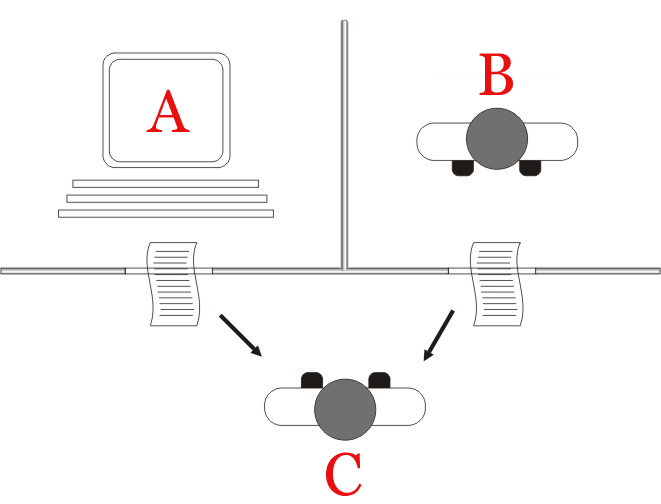
In 1950, Alan Turing proposed replacing the abstract question of whether machines can think with an empirical benchmark termed the imitation game. He argued that the concept of thinking is too poorly defined for rigorous analysis and instead focused on the observable behavior of information processing systems. If a digital computer can engage in a text-based conversation such that a human evaluator cannot reliably distinguish its responses from those of a human, the machine is considered to have achieved a functional equivalence to human intelligence.
The Universal Machine and Discrete States
The technical justification for Turing's test is the concept of the universal machine, which posits that a digital computer is a discrete-state system that moves between definite configurations through logical transitions. Turing proved that such a machine can mimic the behavior of any other discrete-state system if provided with sufficient memory and computational speed. This finding demonstrated that human reasoning, if it can be represented as a finite set of logical operations, can be replicated by a machine without the need for biological components. It suggested that the software of the mind is independent of the hardware of the brain, a principle that remains a foundational assumption of computational theory.
Logical and Mathematical Constraints
Turing addressed the mathematical objection to machine intelligence, which often cites Gödel’s incompleteness theorem to argue that there are logical truths a machine cannot prove but a human can perceive. He countered by observing that human intelligence is not defined by mathematical perfection or absolute consistency. He argued that the existence of unprovable statements within a formal system does not preclude a machine from navigating uncertainty or performing complex reasoning comparable to that of a human. Intelligence is presented not as an exhaustive logical solver, but as an adaptive process capable of error and correction.
The Operationalist View of Consciousness
The argument from consciousness claims that a machine cannot truly experience feelings or be aware of its own cognitive processes. Turing responded with an operationalist perspective, noting that the only way to confirm another entity's consciousness is to be that entity. Since human social and legal systems grant the status of intelligence to other people based on their external behavior, Turing argued that the same standard must be applied to machines. If a system can generate a sophisticated argument or compose poetry that is indistinguishable from human output, the internal subjective experience becomes a secondary, non-empirical concern for the purposes of engineering.
Lady Lovelace’s Objection and Algorithmic Autonomy
Lady Lovelace’s objection states that a machine has no capacity to originate anything and can only follow pre-defined instructions. Turing challenged this by suggesting that machines can produce results that surprise their designers through the complex interaction of simple rules. By incorporating elements of learning or stochastic processes, a system can develop behaviors that were not explicitly programmed. This observation proved that originality in a system is a function of complexity rather than a unique biological trait, allowing for the development of autonomous algorithmic agents.
The Child Machine and Learning Systems
Turing’s most significant technical insight for the development of artificial intelligence was the proposal of the child machine. He argued that instead of attempting to program an adult-level intelligence directly, researchers should create a simpler system designed for learning and then subject it to a process of education through feedback. This engineering choice demonstrated that complex intelligence is most effectively achieved through iterative growth and adaptation rather than top-down logical design. This vision of a system that refines its own rules through reinforcement anticipated the development of neural networks and machine learning by several decades.
The Transformation of Intelligence
The paper predicted that by the end of the twentieth century, the common understanding of intelligence would have shifted to the point where the phrase "thinking machines" would be used without contradiction. This was an observation on the cultural and linguistic integration of technology rather than a specific hardware milestone. The imitation game remains a central, if debated, metric for evaluate AI capability, raising the question of whether the distinction between human and artificial cognition is a fundamental difference in kind or merely a difference in the complexity of the underlying discrete-state transitions.
Dive Deeper
Computing Machinery and Intelligence (PDF)
UMBC • docs
Explore ResourceOfficial Journal Record (DOI)
Oxford Mind • docs
Explore ResourceThe Imitation Game (Video)
Computerphile • video
Explore Resource
Discussion
0Join the discussion
Sign in to share your thoughts and technical insights.
Loading insights...
Recommended Readings
The author of this article utilized generative AI (Google Gemini 3.1 Pro) to assist in part of the drafting and editing process.