
Reinventing the Priority Queue
Michael Fredman & Robert Tarjan (1987)
Fredman, M. L., & Tarjan, R. E. (1987). Fibonacci heaps and their uses in improved network optimization algorithms. Journal of the ACM (JACM), 34(3), 596-615.
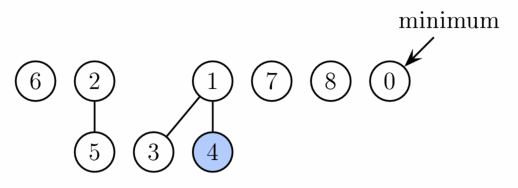
In 1987, Michael Fredman and Robert Tarjan introduced a data structure termed the Fibonacci heap, which utilizes an amortized analysis framework to optimize priority queue operations. Prior to this research, standard heap implementations such as binary or binomial heaps required logarithmic time for both extracting the minimum element and decreasing the value of a key. Fredman and Tarjan demonstrated that by adopting a strategy of structural laziness, the cost of decreasing a key can be reduced to constant amortized time, enabling a significant improvement in the theoretical complexity of foundational network optimization algorithms.
Structural Laziness and Deferred Reorganization
The primary technical innovation of the Fibonacci heap is the systematic delay of tree reorganization until it is strictly necessary. Unlike standard heaps that maintain a rigid structure after every operation, a Fibonacci heap permits a collection of many small, heap-ordered trees to exist simultaneously. Significant structural changes, such as consolidating trees of equal rank, are only performed during the delete-min operation. This methodological choice allows operations that do not require global knowledge - specifically insert and decrease-key - to be executed in amortized time. This finding proved that the efficiency of data management can be increased by front-loading only essential updates and batching maintenance overhead.
Amortized Complexity in Network Optimization
The achievement of constant amortized time for the decrease-key operation resolved a primary bottleneck in graph-based search and connectivity problems. By integrating Fibonacci heaps into Dijkstra’s shortest path algorithm and Prim’s minimum spanning tree algorithm, the researchers reduced the total time complexity to , where represents edges and represents vertices. This result demonstrated that the performance of global network algorithms is a function of the data structure used to track local priorities. It established that the computational cost of managing a network's connections can be effectively decoupled from the cost of managing its individual components.
Marking Mechanisms and Rank Constraints
To maintain the efficiency of the structure over a long sequence of operations, Fibonacci heaps utilize a marking system to manage cascading cuts. When a child node is removed from its parent during a decrease-key operation, the parent is marked; if the parent loses a second child, it is also cut and moved to the root list. This mechanism ensures that the trees in the heap maintain a size that is exponential in their rank, providing a bound on the maximum rank of any node. This structural constraint is derived from the Fibonacci sequence, giving the data structure its name and ensuring that the number of trees remains small enough to be consolidated efficiently during extraction phases.
The Logic of Amortized Analysis as a Design Tool
The development of Fibonacci heaps demonstrated that the complexity of digital systems is most accurately evaluated through amortized analysis - calculating the total cost of a sequence of operations rather than the individual cost of a single step. The engineering choice to use a flexible, lazy structure revealed that temporary imbalances in a system can be tolerated if they lead to lower cumulative overhead. This principle remains central to the design of modern data structures used in operating system schedulers, database indices, and high-performance routing hardware. It proved that the most robust way to manage dynamic sets of information is to ensure that every local operation contributes to the eventual refinement of the entire system.
Dive Deeper
Fibonacci Heaps and Improved Network Optimization (Official DOI)
ACM • docs
Explore ResourceFredman-Tarjan Fibonacci Heaps (Princeton Archive)
Princeton • docs
Explore ResourceFibonacci Heap Visualization
USFCA • article
Explore Resource
Discussion
0Join the discussion
Sign in to share your thoughts and technical insights.
Loading insights...
Recommended Readings
The author of this article utilized generative AI (Google Gemini 3.1 Pro) to assist in part of the drafting and editing process.