
Locality-Sensitive Hashing: Approximate Nearest Neighbors in High Dimensions
Piotr Indyk & Rajeev Motwani (1998)
Indyk, P., & Motwani, R. (1998). Approximate nearest neighbors: towards removing the curse of dimensionality. In Proceedings of the thirtieth annual ACM symposium on Theory of computing (pp. 604-613).
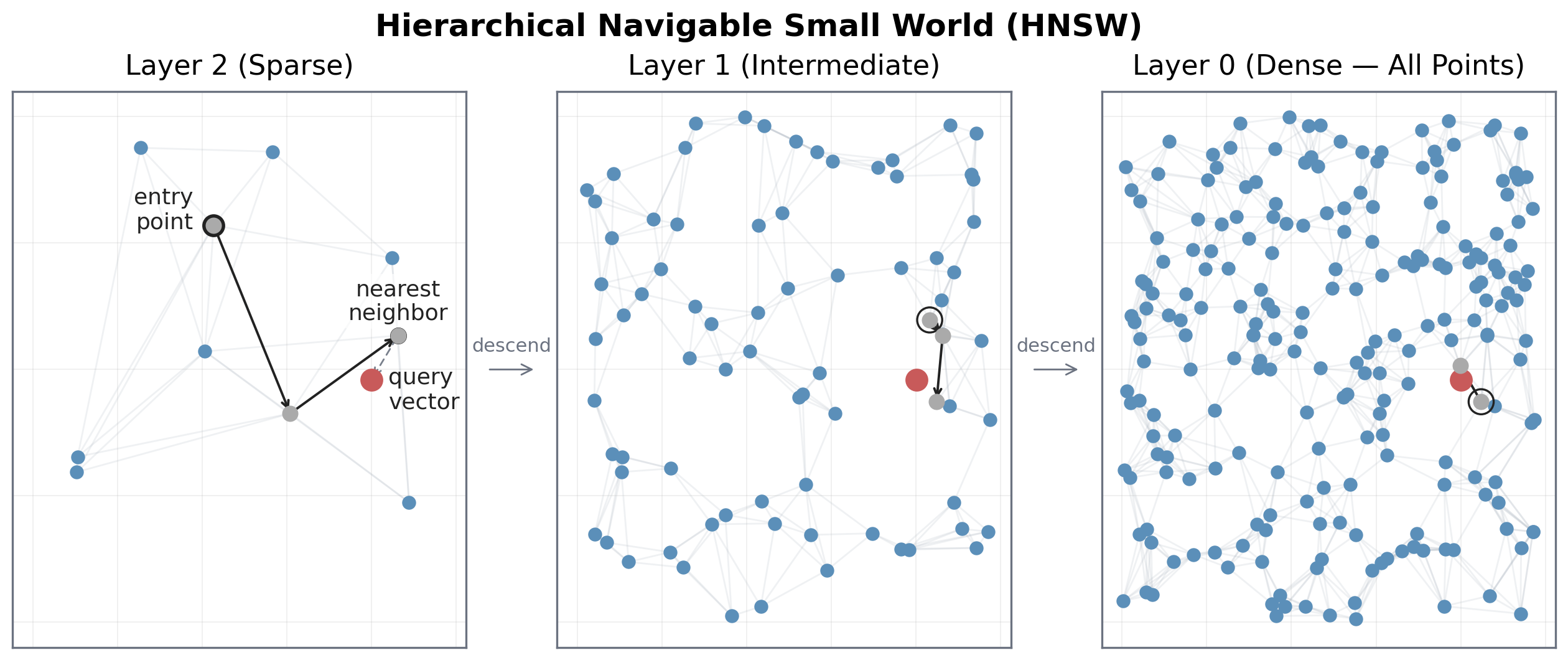
In 1998, Piotr Indyk and Rajeev Motwani introduced a method for similarity search in high-dimensional spaces that addresses the computational bottleneck known as the curse of dimensionality. Traditional search algorithms exhibit exponential performance degradation as the number of features in a dataset increases, rendering exact nearest-neighbor searches impractical for large-scale applications. The researchers demonstrated that by accepting a controlled degree of approximation, locality-sensitive hashing (LSH) can achieve sublinear query time, establishing a fundamental framework for modern vector retrieval and recommendation systems.
Collision Probabilities and Metric Proximity
The primary technical contribution of the paper is the definition of a family of hash functions characterized by their sensitivity to local geometric relationships. In contrast to cryptographic hash functions designed to minimize collisions between similar inputs, LSH functions are constructed such that the probability of two points being mapped to the same hash bucket is directly proportional to their proximity within a metric space. For any two points and , the hashing mechanism ensures that the collision probability is high when the distance between them is small and decreases as the distance increases. This allows for the indexing of data based on its underlying similarity structure rather than its absolute coordinate values.
Algorithmic Sublinearity and Dimensionality Reduction
The technical significance of LSH lies in its ability to execute nearest-neighbor queries in time, where and represents the total number of points in the dataset. By concatenating multiple hash functions to amplify the disparity between collision probabilities and utilizing multiple independent hash tables to ensure high recall, Indyk and Motwani provided the first method for high-dimensional search that does not scale exponentially with the number of dimensions. This finding revealed that the complexity of geometric search is primarily a function of the requirement for exact results; by relaxing this constraint, efficient retrieval becomes possible across complex feature spaces.
Probabilistic Bucketing as a Search Strategy
The success of LSH demonstrated that the efficiency of retrieval systems can be optimized by aligning the indexing mechanism with the similarity properties of the data. The engineering choice to use randomized bucketing revealed that identifying the approximate neighborhood of a data point is computationally more feasible than determining its exact geometric position. This principle remains the central theme of modern vector databases used for large-scale machine learning and natural language processing, where retrieval from datasets containing billions of high-dimensional embeddings must be performed with minimal latency.
Applications in Large-Scale Retrieval Systems
LSH has become a foundational tool for managing high-dimensional data in diverse fields ranging from duplicate detection in web search to the identification of similar protein structures in bioinformatics. By providing a scalable method for approximating proximity, the algorithm enabled the development of systems that can process massive information streams in real-time. This application proved that the scalability of a retrieval system depends on the transition from exact geometric calculations to probabilistic state refinements. It leaves open the question of how these hashing families can be optimized for non-Euclidean distance metrics or for data that resides on complex, low-dimensional manifolds within high-dimensional space.
Dive Deeper
Approximate Nearest Neighbors (Stanford PDF)
Stanford • docs
Explore ResourceLocality-Sensitive Hashing (Wikipedia)
Wikipedia • article
Explore ResourceOfficial ACM DOI Link
ACM • docs
Explore Resource
Discussion
0Join the discussion
Sign in to share your thoughts and technical insights.
Loading insights...
Recommended Readings
The author of this article utilized generative AI (Google Gemini 3.1 Pro) to assist in part of the drafting and editing process.