
The Magic of Cuckoo Hashing
Rasmus Pagh & Flemming Rodler (2004)
Pagh, R., & Rodler, F. F. (2004). Cuckoo hashing. Journal of Algorithms, 51(2), 122-144.
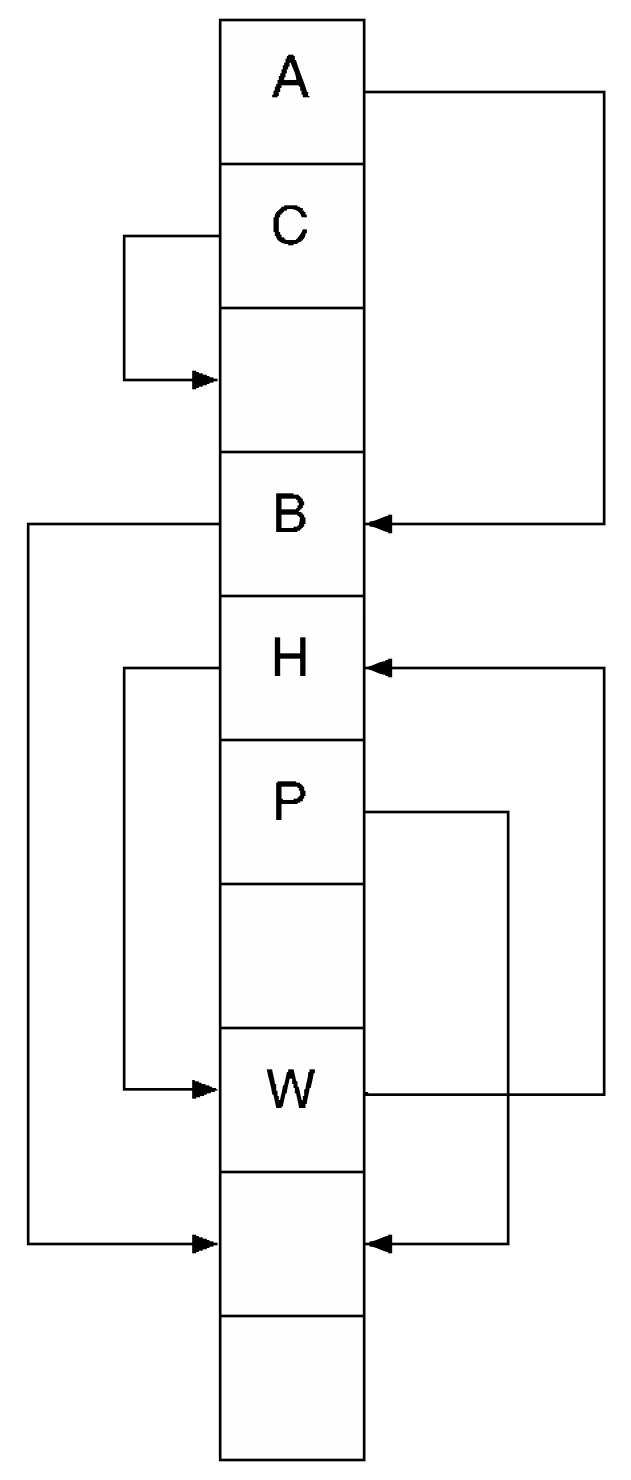
In 2004, Rasmus Pagh and Flemming Rodler introduced a dictionary data structure characterized by a worst-case constant lookup time. Prior to this research, standard hashing methods such as chaining or linear probing exhibited variable lookup performance that could degrade significantly under high load or adversarial conditions. Pagh and Rodler demonstrated that by restricting each key to a maximum of two potential locations within the table and utilizing a displacement mechanism for insertions, a system can guarantee lookup complexity independent of the dataset size.
The Displacement and Kicking Mechanism
The primary technical innovation of the data structure is the displacement logic that facilitates sets of alternative locations for each key. Cuckoo hashing utilizes two independent hash functions, and , to map a key to two specific slots in separate tables, and . When a new key is inserted, it attempts to occupy its first assigned slot; if that slot is currently inhabited by key , the new key displaces , which then moves to its own alternative location in the other table. This sequence of local displacements continues until all keys are successfully positioned or a cycle is detected. This mechanism ensures that a retrieval operation never requires more than two memory inspections, providing a deterministic bound on lookup latency.
Load Factors and the Cuckoo Threshold
The efficiency and stability of Cuckoo Hashing are determined by the load factor, defined as the ratio of stored keys to total available slots. The researchers proved that for a standard two-hash configuration, the expected time for an insertion is provided the load factor remains below a critical threshold of approximately 50%. As the table approaches this threshold, the probability of forming a cycle - where a chain of displacements returns to a previously visited slot - increases exponentially. The detection of such a cycle necessitates a global rehash of the data structure using a new set of hash functions. This finding revealed that the richness of the hashing space is the primary constraint on the system's ability to maintain deterministic performance.
Hardware-Aware Optimization and SIMD Parallelism
Modern implementations of Cuckoo Hashing often adapt the original algorithm to exploit specific processor architectures. By utilizing blocked structures, where each hash bucket contains multiple contiguous slots (e.g., 4 or 8), systems can achieve load factors exceeding 90% while maintaining constant-time performance. This multi-slot architecture allows a CPU to fetch an entire bucket into a single cache line and execute comparisons across all slots simultaneously using SIMD (Single Instruction, Multiple Data) instructions. This engineering shift demonstrated that the primary bottleneck in modern dictionary performance is the number of distinct memory accesses rather than the number of hash calculations.
Worst-Case Guarantees and Probabilistic Set Membership
Building on the principles of deterministic placement, the logic of Cuckoo Hashing has been extended to probabilistic data structures such as Cuckoo Filters. These filters store compact fingerprints of items within a cuckoo-hashed array to provide high-speed membership testing. Unlike traditional Bloom filters, Cuckoo Filters support the efficient deletion of items and achieve superior space utilization in many practical scenarios. This application proved that the principles of local displacement and restricted placement provide a robust framework for managing both exact and approximate information retrieval.
Determinism as a Structural Design Tool
The success of Cuckoo Hashing demonstrated that the complexity of data retrieval can be minimized by strictly limiting the number of possible states an item can inhabit. The decision to restrict each key to exactly two locations revealed that high-speed retrieval is possible without the need for complex global reordering or variable-length collision chains. This principle remains the central theme in the design of high-performance network caches, hardware look-up tables, and real-time database indices. It leaves open the question of how these deterministic methods can be scaled to support extremely high-concurrency environments where multi-threaded displacements may lead to complex race conditions.
Dive Deeper
Cuckoo Hashing (Official DOI)
ScienceDirect • docs
Explore ResourceCuckoo Hashing Original Paper (PDF)
IT Copenhagen • docs
Explore ResourceCuckoo Hashing Visualization
PyPup • article
Explore Resource
Discussion
0Join the discussion
Sign in to share your thoughts and technical insights.
Loading insights...
Recommended Readings
The author of this article utilized generative AI (Google Gemini 3.1 Pro) to assist in part of the drafting and editing process.