
Grover's Algorithm: A Fast Quantum Mechanical Algorithm for Database Search
Lov Grover (1996)
Grover, L. K. (1996). A fast quantum mechanical algorithm for database search. In Proceedings of the twenty-eighth annual ACM symposium on Theory of computing (pp. 212-219).
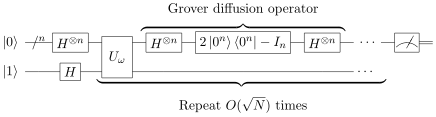
In 1996, Lov Grover introduced a quantum algorithm for searching unstructured datasets that achieves a quadratic speedup over the best possible classical methods. The research addresses the computational bottleneck of the exhaustive search problem, where a target item must be identified within a collection of unsorted elements. While a classical machine requires queries to ensure detection, Grover demonstrated that by manipulating the probability amplitudes of a quantum system through iterative rotations, the target can be identified with high probability in steps.
Quantum Superposition and Global State Initialization
The algorithm begins by preparing a quantum register in a uniform superposition of all possible basis states. This is achieved by applying a Hadamard transform to an initial zero state, resulting in a configuration where every item in the search space has an equal probability amplitude of . Mathematically, the state is represented as . This initialization ensures that the computational process operates on the entire database simultaneously, rather than inspecting individual elements sequentially. This methodological choice established that the efficiency of quantum search is derived from the ability to represent a global view of uncertainty as a coherent wave function.
The Oracle and Selective Phase Inversion
The core technical mechanism for identifying the target is the Oracle operator (), which acts as a recognition function for the desired state . When the Oracle encounters the target state, it shifts its phase by radians, effectively inverting the sign of its amplitude from positive to negative while leaving all other states unchanged. This operation distinguishes the target from the background without increasing its observational probability. This finding revealed that the identification of information in a quantum system is a two-stage process: first, the marking of the target through phase manipulation, followed by the constructive amplification of its presence within the Hilbert space.
Inversion About the Average and Amplitude Amplification
Following the Oracle step, the algorithm applies the Diffusion operator (), which performs an inversion about the average amplitude of the system. For each state, the operator calculates the mean amplitude across the entire superposition and reflects the individual amplitudes about this value. Because the target state possesses a negative amplitude due to the Oracle's inversion, this reflection causes its amplitude to grow significantly in the positive direction while slightly diminishing the amplitudes of the non-target states. Geometrically, each Grover iteration rotates the system’s state vector toward the target axis. This process demonstrated that probability can be redistributed across a high-dimensional space through the systematic management of constructive and destructive interference.
Quadratic Scaling and Algorithmic Optimality
By repeating the Oracle and Diffusion cycle approximately times, the state vector is aligned with the target state with near-certainty. The achievement of complexity established a theoretical limit for unstructured search, as it has been proven that no quantum algorithm can resolve the problem more efficiently. This quadratic speedup has significant implications for any task solvable by brute-force search, including the cracking of symmetric cryptographic keys (e.g., AES-128) and the resolution of complex optimization problems. It proved that quantum mechanics allows for a more efficient exploration of discrete spaces by treating information as a signed vector rather than a scalar probability.
Search as a Geometric Rotation
The success of Grover's algorithm demonstrated that the act of searching can be reframed as a problem of geometric navigation within a complex vector space. The decision to manipulate amplitudes rather than individual bits revealed that the bottleneck in classical search is the inability to exploit the global structural relationships of the dataset. This principle remains the central theme in the study of quantum walk-based search and the development of specialized hardware for combinatorial optimization. It leaves open the question of how these rotation-based methods can be adapted to structured databases where partial information about the target's location is already available to the algorithm.
Dive Deeper
A Fast Quantum Mechanical Algorithm (Official DOI)
ACM • docs
Explore ResourceGrover's Original Paper (arXiv PDF)
arXiv • docs
Explore ResourceGrover's Algorithm (Wikipedia)
Wikipedia • article
Explore ResourceSearch Algorithms on Qiskit (IBM)
IBM • docs
Explore Resource
Discussion
0Join the discussion
Sign in to share your thoughts and technical insights.
Loading insights...
Recommended Readings
The author of this article utilized generative AI (Google Gemini 3.1 Pro) to assist in part of the drafting and editing process.