
The First Blueprint for a Real Quantum Computer
J. Ignacio Cirac & Peter Zoller (1995)
Cirac, J. I., & Zoller, P. (1995). Quantum computations with cold trapped ions. Physical Review Letters, 74(20), 4091-4094.
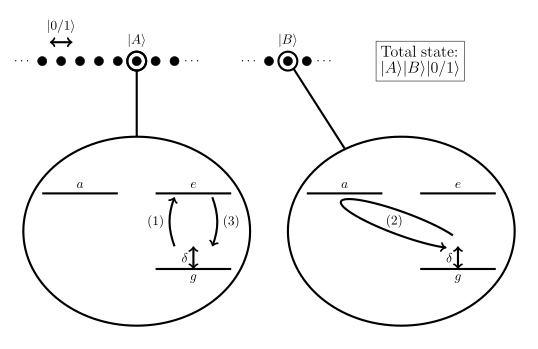
In 1995, J. Ignacio Cirac and Peter Zoller proposed a physical architecture for a scalable quantum computer using a string of laser-cooled ions confined in an electromagnetic trap. This research addressed the primary requirement for quantum hardware: the identification of a system that combines long-lived qubit states with a controllable mechanism for executing multi-qubit logical gates. The researchers demonstrated that the collective vibrational motion of the ions acts as a shared data bus, allowing for the coherent transfer of information between distant qubits through directed laser interactions.
Energy Levels and Qubit Representation
The Cirac-Zoller architecture utilizes the internal electronic energy levels of individual ions to represent the computational basis states and . Because these states are derived from fundamental atomic transitions, they exhibit exceptionally long coherence times, frequently exceeding several minutes. This stability represents a significant technical advantage over synthetic qubit platforms, such as superconducting circuits, which are more susceptible to environmental noise. This finding established that the use of identical, naturally occurring atoms provides a robust foundation for maintaining the integrity of quantum information over the durations required for complex algorithmic execution.
Phonons as a Quantum Data Bus
The primary technical contribution of the paper is the utilization of the ions' collective motional modes as a medium for multi-qubit interactions. Due to their shared electrical repulsion, a string of ions in a trap behaves as a coupled oscillator system where the vibrations are quantized into particles of motion termed phonons. By utilizing laser cooling to reach the motional ground state (), a single phonon can be selectively excited to carry information between any two ions in the trap. This "all-to-all" connectivity within a single trap allows for the execution of gates between non-adjacent qubits without the need for redundant swap operations, effectively maximizing the computational efficiency of the hardware.
The Laser-Driven CNOT Mechanism
The implementation of the Controlled-NOT (CNOT) gate is achieved through a multi-step sequence of laser pulses. The state of the control ion is first mapped onto the collective vibrational mode; if the ion is in state , it emits a phonon into the shared bus. A subsequent pulse on the target ion's "red sideband" induces a phase shift only if the shared phonon is detected. Finally, the vibrational mode is mapped back to the control ion to restore the motional ground state. This mechanism proved that the fundamental forces of atomic interaction - the Coulomb force and the quantization of motion - can be harnessed as the "wires" of a quantum processor, providing a formal methodology for translating abstract logic into physical state transitions.
Scaling via Modular Traps and Interconnects
While the original proposal focused on a single chain of ions, the researchers identified the potential for scaling through the integration of multiple trap zones. Modern evolutions of this architecture, such as the Quantum Charge-Coupled Device (QCCD), allow ions to be physically transported between distinct interaction and storage regions. This engineering shift demonstrated that the scalability of ion-trap systems is a function of the precision with which individual atoms can be manipulated and moved within a complex electromagnetic landscape. It established a roadmap for the development of modular quantum processors where the limits of computation are determined by the fidelity of atomic transport and laser-induced gates.
Atomic Precision as a Computational Foundation
The achievement of Cirac and Zoller demonstrated that the laws of quantum optics provide a rigorous framework for universal computation. The decision to model qubits as trapped ions revealed that the most effective way to build a quantum computer is to utilize the inherent symmetries and stability of the physical world. This principle remains the central theme for leading quantum hardware companies, including Quantinuum and IonQ, which seek to implement the DiVincenzo criteria through the systematic management of atomic states. It leaves open the question of how these high-precision systems can be scaled to support the millions of qubits required for fault-tolerant error correction in the presence of inevitable technical noise.
Dive Deeper
Trapped Ion Quantum Computations (Official DOI)
APS • docs
Explore ResourceCirac-Zoller Paper (Stable PDF)
University of Warsaw • docs
Explore ResourceIon Trap Computing (Wikipedia)
Wikipedia • article
Explore ResourceQuantinuum H-Series Architecture
Quantinuum • docs
Explore Resource
Discussion
0Join the discussion
Sign in to share your thoughts and technical insights.
Loading insights...
Recommended Readings
The author of this article utilized generative AI (Google Gemini 3.1 Pro) to assist in part of the drafting and editing process.