
Shor's Error Correction: A Scheme for Reducing Decoherence in Quantum Memory
Peter Shor (1995)
Shor, P. W. (1995). Scheme for reducing decoherence in quantum computer memory. Physical Review A, 52(4), R2493-R2496.
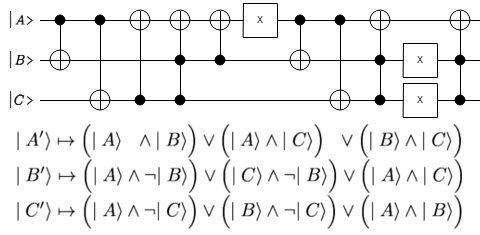
In 1995, Peter Shor demonstrated that quantum information can be protected from environmental decoherence through the use of redundant entanglement, resolving a theoretical crisis that threatened the feasibility of quantum computation. Prior to this research, it was widely believed that the no-cloning theorem - which prevents the creation of identical copies of an unknown quantum state - made traditional error correction impossible. Shor proved that while a state cannot be copied, its logical content can be distributed across a larger block of physical qubits such that local errors can be detected and reversed without collapsing the underlying superposition.
The 9-Qubit Code and Hierarchical Redundancy
The primary technical contribution of the paper is the 9-qubit error-correcting code, which provides protection against both bit-flip and phase-flip errors. The scheme encodes one logical qubit into a state of nine physical qubits organized in a hierarchical structure: three blocks of three qubits each. The inner code uses entanglement to identify and correct bit-flips () within each block. The outer code utilizes a change of basis - transforming the logical state into the Hadamard basis - to protect against phase-flips (). This methodological choice proved that quantum robustness is an emergent property of non-local information distribution rather than individual qubit stability.
Syndrome Measurement and Wavefunction Preservation
A critical technical requirement for the scheme is the extraction of error signals, termed syndromes, without observing the content of the logical qubit. Shor utilized auxiliary qubits and parity-check circuits to identify the specific nature and location of an error. Because these measurements only reveal whether the physical qubits are in a specific entangled configuration, they do not provide information about the logical state itself, thus avoiding the "observer effect" that would otherwise collapse the wavefunction. This finding revealed that a quantum memory can be actively maintained through continuous, non-destructive monitoring of its structural invariants.
The Quantum Threshold and Fault-Tolerance
The development of the 9-qubit code established the theoretical foundation for the Quantum Threshold Theorem. This theorem posits that if the error rate of individual quantum gates is below a specific numerical threshold, a machine can perform arbitrarily long computations by recursively applying error-correcting codes. This abstraction transformed quantum computing from a problem of absolute isolation into a problem of error management. It established that the objective of hardware design is to reach the fault-tolerant regime where the rate of active correction exceeds the rate of environmental interference, enabling the scaling of quantum circuits to a size suitable for practical algorithms.
Impact on Hardware Design and Topological Codes
The practical significance of Shor’s error correction framework is evidenced by the development of subsequent, more efficient architectures such as the Surface Code and other topological representations. By proving that information can be made resilient against the inherent noise of the physical world, the research provided a rigorous roadmap for the construction of large-scale quantum processors. This application established entanglement as a functional tool for engineering reliability, moving the field away from the search for "perfect" qubits toward the design of robust, error-aware systems.
Error Management as a Physical Constant
The success of this work demonstrated that the integrity of information in a quantum system is a function of its topological complexity. The decision to distribute logical states across multiple physical nodes revealed that the primary constraint on quantum intelligence was the local nature of decoherence. This principle remains the central theme of quantum computer architecture, suggesting that the most effective way to preserve a state is to ensure that no single environmental interaction contains enough information to reconstruct the original signal. It leaves open the question of how these high-overhead codes can be optimized for the physical constraints of real-world superconducting or trapped-ion systems.
Dive Deeper
Shor's Error Correction (Official DOI)
APS • docs
Explore ResourcePublic Access Paper (PDF)
University of Miami • docs
Explore ResourceIntroduction to Quantum Error Correction (Video)
QuTech • video
Explore ResourceFault-Tolerant Quantum Computing (Wikipedia)
Wikipedia • article
Explore Resource
Discussion
0Join the discussion
Sign in to share your thoughts and technical insights.
Loading insights...
Recommended Readings
The author of this article utilized generative AI (Google Gemini 3.1 Pro) to assist in part of the drafting and editing process.