Richard Feynman’s Vision for Quantum Computers
Richard Feynman (1982)
Feynman, R. P. (1982). Simulating physics with computers. International Journal of Theoretical Physics, 21(6/7), 467-488.
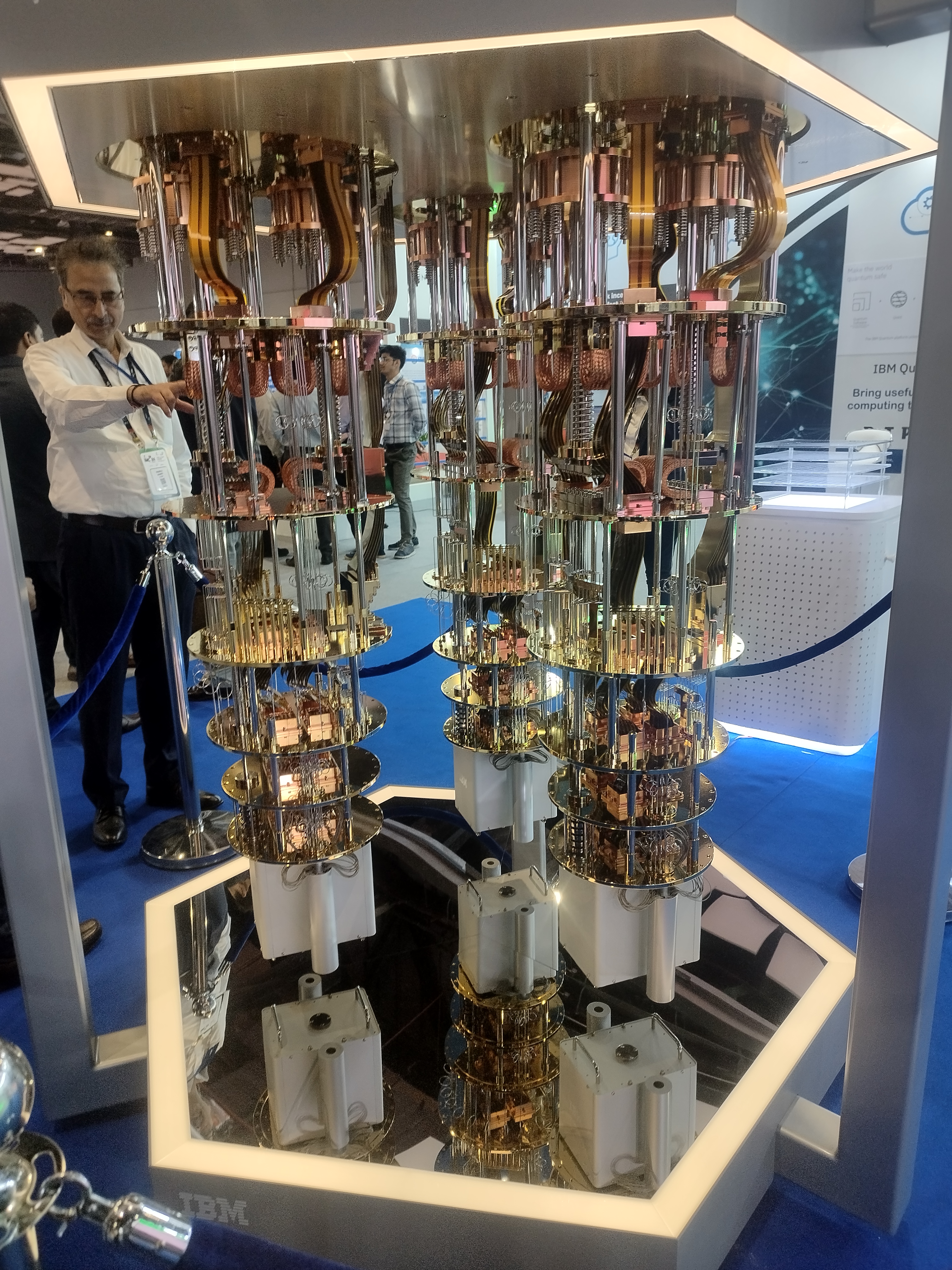
In 1982, Richard Feynman identified a fundamental computational bottleneck in the simulation of quantum mechanical systems using classical hardware. He argued that because the state space of a quantum system grows exponentially with the number of particles, a classical, local, and deterministic machine requires an exponential amount of time and memory to track the system's evolution. To resolve this inefficiency, Feynman proposed the construction of a computer made of quantum mechanical elements that could emulate the behavior of nature directly, effectively initiating the field of quantum computing.
The Exponential Explosion of Classical State
Feynman’s primary observation was the structural mismatch between classical logic and quantum reality. A classical computer representing quantum particles must manage complex amplitudes to describe the system's state. As increases linearly, the computational resources required for an exact simulation increase exponentially, rendering the analysis of even modest molecular or subatomic systems impossible on classical Turing machines. This finding demonstrated that the limitation of classical physics simulation is not a lack of raw processing power, but a fundamental incompatibility with the non-local and probabilistic nature of quantum mechanics.
Reversible Computation and Information Conservation
Before addressing the quantum problem, Feynman explored the constraints of classical computation, specifically the issue of energy dissipation. He utilized the work of Charles Bennett on reversible computation to prove that information processing does not inherently require the consumption of energy. By utilizing reversible gates such as the Fredkin or Toffoli gates - which can be executed in both forward and backward directions - a machine can avoid the loss of information that leads to heat production. This realization was a prerequisite for quantum computing, as quantum operations are inherently unitary and therefore must be reversible to preserve the integrity of the wave function.
Probabilistic Amplitudes and Negative Probability
Feynman investigated whether stochastic classical methods could simulate quantum phenomena. He demonstrated that while standard probabilistic systems utilize positive probabilities that sum to one, quantum mechanics involves complex amplitudes that can interfere destructively, behaving as if they were "negative probabilities." A classical probabilistic machine cannot replicate these interference patterns without sampling an exponential number of states. This methodological choice established that the "quantum-ness" of nature is characterized by interference rather than simple randomness, requiring a new class of logic gates that can manipulate these amplitudes directly.
The Universal Quantum Simulator
To resolve the exponential complexity, Feynman proposed the universal quantum simulator - a machine composed of quantum components that obey the same physical laws as the system being studied. By mapping the state of a simulated system onto the state of the simulator's own hardware, the machine bypasses the need for an abstract classical representation. He argued that the simulator should be a "quantum-mechanical device" where the time evolution is governed by a local Hamiltonian. This shift moved the field from software-based simulation to hardware-based emulation, establishing that the most efficient way to compute the properties of nature is to utilize the physics of nature itself.
Fermi-Dirac and Bose-Einstein Statistics
A critical technical challenge identified in the research is the requirement for simulators to account for the specific statistics of particles. Feynman noted that while Bosons (which allow multiple particles to occupy the same state) are relatively straightforward to simulate, Fermions present a significant difficulty due to the Pauli Exclusion Principle. Simulating Fermions requires the management of anti-symmetric wavefunctions, where the exchange of two particles results in a negative sign in the amplitude. He suggested that a quantum simulator would need internal symmetry properties that match the statistics of the target particles, proving that the architecture of the machine must be deeply integrated with the fundamental symmetries of physics.
Physics as a Computational Primitive
The achievement of Feynman’s lecture demonstrated that the laws of physics can be viewed as a set of computational rules. The decision to model computers as physical systems revealed that the boundaries of what is computable are determined by the underlying properties of the universe. This principle remains the central theme of quantum information science, providing the roadmap for the development of hardware capable of solving problems in chemistry, materials science, and cryptography that are fundamentally unreachable for classical systems. It leaves open the question of whether a perfect simulation of a physical system is mathematically indistinguishable from the system itself.
Dive Deeper
Simulating Physics with Computers (Official DOI)
Springer • docs
Explore ResourceFeynman's Talk at MIT (Transcript)
MIT • docs
Explore ResourceRichard Feynman's MIT Lecture (Video)
YouTube • video
Explore Resource
Discussion
0Join the discussion
Sign in to share your thoughts and technical insights.
Loading insights...
Recommended Readings
The author of this article utilized generative AI (Google Gemini 3.1 Pro) to assist in part of the drafting and editing process.