
Homomorphic Encryption over Integers: Securing Computation on Encrypted Data
Marten van Dijk, Craig Gentry, Shai Halevi, & Vinod Vaikuntanathan (2010)
van Dijk, M., Gentry, C., Halevi, S., & Vaikuntanathan, V. (2010). Fully homomorphic encryption over the integers. In Annual International Conference on the Theory and Applications of Cryptographic Techniques (pp. 24-43). Springer.
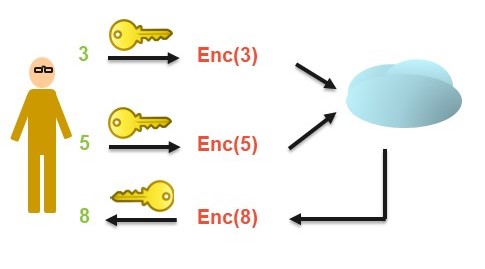
In 2010, researchers introduced a framework for Fully Homomorphic Encryption (FHE) that utilizes basic integer arithmetic rather than the complex algebraic geometry of ideal lattices. While earlier proofs established that universal computation on encrypted data was possible, their reliance on high-dimensional manifolds made the concepts difficult to understand and implement. This research addresses the implementation bottleneck by basing the system's security on the Approximate Greatest Common Divisor (AGCD) problem. The researchers demonstrated that the fundamental operations of homomorphic addition and multiplication can be achieved through the management of noisy integers, established a more accessible roadmap for the practical deployment of secure multi-party protocols.
The Approximate GCD Problem and Noise Shielding
The security of the integer-based FHE scheme is rooted in the mathematical difficulty of identifying the common factor between numbers that have been intentionally perturbed with small random errors. Given a set of values of the form , where is a large secret prime and is a small noise term, it is computationally hard to recover without knowing the secret grid. In this framework, a bit of information is encrypted by adding it to a multiple of the secret and an even-valued noise term. This finding revealed that the "parity" of an integer can be used as a robust carrier for information, provided that the underlying secret acts as a permanent mathematical shield against direct observation.
Homomorphic Addition and Multiplication of Integers
The primary technical contribution of the paper is the demonstration that standard integer operations directly support homomorphic evaluation. Adding two ciphertexts results in an integer whose parity matches the sum of the original bits, while multiplying them results in an integer whose parity matches the product. Although these operations significantly increase the noise level - with multiplication causing the noise term to grow quadratically - the mathematical structure of the encryption is preserved as long as the total noise remains below half of the secret . This methodological choice proved that the properties of modular arithmetic - the same principles that power RSA - can be extended to support full homomorphic logic if the stochastic growth of error can be managed.
Simplification of the Bootstrapping Process
A critical achievement of the DGHV (van Dijk, Gentry, Halevi, Vaikuntanathan) scheme was the simplification of the "bootstrapping" technique required for infinite computation. To reduce the noise of a ciphertext, the system must evaluate its own decryption function homomorphically. The researchers showed that by "squashing" the decryption circuit and representing it as a relatively simple sparse subset sum problem, the bootstrapping operation could be implemented using only basic integer arithmetic. This abstraction made the "recursive" nature of FHE more transparent to the cryptographic community, revealing that the bottleneck in private computation was the complexity of the verification circuit rather than the nature of the data representation.
Practical Constraints and Public-Key Construction
While providing a clearer conceptual framework, the researchers identified that the integer-based approach requires significantly larger public keys than lattice-based methods to maintain a comparable level of security. A public key in the DGHV scheme consists of a large set of "encryptions of zero" - noisy multiples of that can be used to mask new inputs. To encrypt a bit, a user takes a random subset of these public values and adds them together. This finding established that the scalability of integer-based encryption is a function of the memory required to store these public masks, suggesting that the most efficient way to achieve privacy is to balance the simplicity of the math with the storage overhead of the cryptographic artifacts.
The Legacy of Conceptual Clarity
The success of FHE over the integers demonstrated that the most profound advancements in cryptography are often those that reduce complex theories to their most familiar components. The decision to prioritize the "integer" as a universal container for value and privacy revealed that the primary constraint on secure computation was the perceived requirement for specialized algebraic structures. This principle remains the central theme in the search for practical "privacy-enhancing technologies," influencing the development of hybrid schemes that combine the simplicity of integer math with the efficiency of modern ring-based constructions. It leaves open the question of whether these simplified methods can eventually rival the speed of non-private computation as hardware accelerators are optimized for large-integer arithmetic.
Dive Deeper
FHE over Integers (Official Paper)
IACR • docs
Explore ResourceHomomorphic Encryption Overview (Wikipedia)
Wikipedia • article
Explore ResourceDGHV Scheme Explanation (Video)
Helib • video
Explore ResourceLattice-Based Cryptography Diagram
Wikipedia • article
Explore Resource
Discussion
0Join the discussion
Sign in to share your thoughts and technical insights.
Loading insights...
Recommended Readings
The author of this article utilized generative AI (Google Gemini 3.1 Pro) to assist in part of the drafting and editing process.