
Karp's 21 NP-Complete Problems: Reducibility Among Combinatorial Problems
Richard Karp (1972)
Karp, R. M. (1972). Reducibility among combinatorial problems. In Complexity of Computer Computations (pp. 85-103). Springer, Boston, MA.
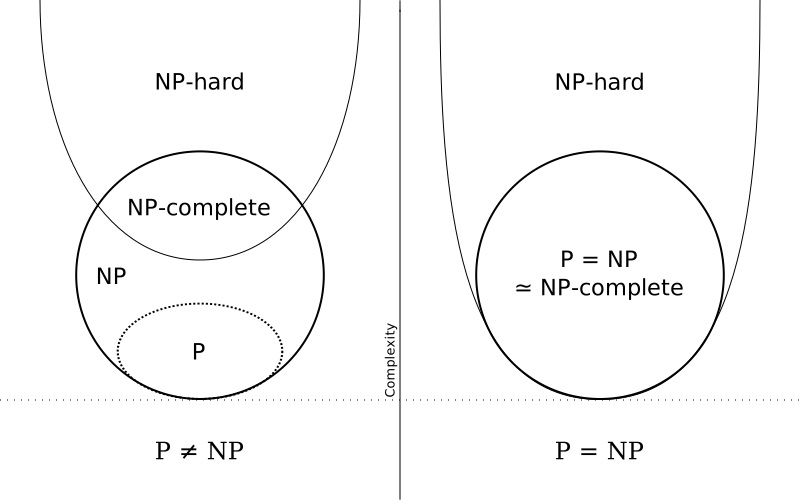
In 1972, Richard Karp demonstrated that the property of NP-completeness is a ubiquitous characteristic of computational problems across diverse scientific domains. Following Stephen Cook's proof that the Boolean satisfiability problem (SAT) is universal for the class of non-deterministic polynomial-time problems, Karp identified 21 distinct combinatorial challenges - including the clique problem, the traveling salesperson problem, and integer programming - that are all equivalent in their computational difficulty. This work established a practical methodology for classifying problem complexity through the use of polynomial-time reductions, transforming theoretical complexity into a central constraint of algorithm design.
Polynomial-Time Many-One Reductions
The primary technical contribution of the paper is the formalization of many-one reductions as a tool for comparing the relative hardness of computational tasks. Karp demonstrated that if a problem can be transformed into an instance of problem by a polynomial-time function, then any efficient solution for would inherently provide an efficient solution for . This finding established a rigorous framework for mapping the landscape of computational difficulty, allowing researchers to link the intractability of disparate problems through a chain of logical transformations. It proved that if any single problem in this interconnected web can be solved in polynomial time, then every problem in the class NP must also be solvable efficiently.
The Logic of Modular Gadget Construction
Karp utilized modular architectural components, termed gadgets, to execute complexity reductions between seemingly unrelated problems. A gadget is a local subgraph or set of constraints that simulates a specific logical operation within the target problem’s environment. For instance, in reducing SAT to the chromatic number problem, specific vertex configurations are constructed to ensure that a graph is colorable if and only if the original Boolean formula is satisfiable. This methodological choice revealed that the difficulty of NP-complete problems is not a monolithic property but an emergent feature of the complex ways these simple, local constraints can be interconnected.
The Interconnectedness of Combinatorial Intractability
The identification of 21 NP-complete problems proved that the phenomenon of computational hardness is widespread and structurally consistent. By constructing a series of reductions starting from SAT, Karp showed that foundational tasks in optimization, logic, and set theory all share the same mathematical bottleneck. This finding suggested that the difficulty encountered in practical engineering - ranging from project scheduling to network optimization - is often a different manifestation of the same underlying logical barrier. It effectively established the NP-complete class as a universal threshold for computational feasibility.
Algorithmic Strategy and Approximation
The realization that hundreds of practical problems are NP-complete necessitated a paradigm shift in the development of computational tools. Since finding exact solutions to these problems in polynomial time is likely impossible, the research focused on the creation of approximation algorithms and heuristics. This engineering shift allowed for the development of high-performance tools that provide provably near-optimal results for tasks such as the knapsack problem or the set cover problem within seconds. Karp’s work proved that the most effective way to approach a complex optimization task is to first determine its position within the global hierarchy of computational limits.
The Classification of Computational Complexity
The paper provided the first comprehensive map of the P vs NP landscape, identifying a massive category of problems that appear to be fundamentally intractable for deterministic machines. By proving the equivalence of diverse combinatorial challenges, Karp established a roadmap for the systematic classification of computational difficulty. This principle remains the guiding rule for modern computer science, requiring that every new algorithmic problem be evaluated against the established benchmarks of NP-completeness. This leaves open the question of whether there exist natural problems that reside in the gap between P and NP-complete, and how the boundaries of this hierarchy shift under non-classical models of computation.
Dive Deeper
Reducibility Among Combinatorial Problems (Official DOI)
Springer • docs
Explore ResourceKarp's Original Paper (UMD PDF)
UMD • docs
Explore ResourceNP-Completeness and the 21 Problems (Scott Aaronson)
Scott Aaronson • article
Explore Resource
Discussion
0Join the discussion
Sign in to share your thoughts and technical insights.
Loading insights...
Recommended Readings
The author of this article utilized generative AI (Google Gemini 3.1 Pro) to assist in part of the drafting and editing process.