
Cook's Theorem: The Complexity of Theorem-Proving Procedures and NP-Completeness
Stephen Cook (1971)
Cook, S. A. (1971). The complexity of theorem-proving procedures. In Proceedings of the third annual ACM symposium on Theory of computing (pp. 151-158).
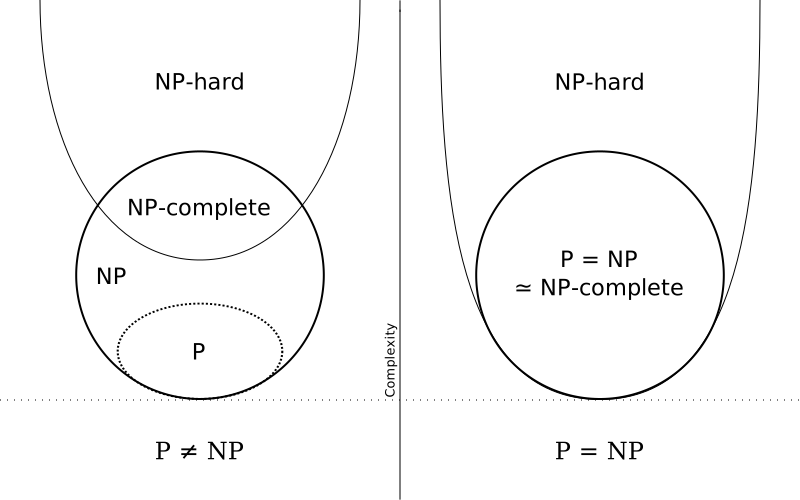
In 1971, Stephen Cook introduced a formal framework for analyzing the computational resources required to solve mathematical problems, establishing the foundational constraints of complexity theory. The paper identified a class of problems that are recognizable in polynomial time by a non-deterministic machine, effectively shifting the research focus from what is computable to the specific time-efficiency of the computation. By proving that the Boolean satisfiability problem (SAT) possesses a universal property within this class, Cook established the concept of NP-completeness, providing a method for identifying the theoretical limits of deterministic algorithms.
Non-Deterministic Polynomial Time and Verification
The research defined the class NP as the set of languages accepted by a non-deterministic Turing machine within a number of steps bounded by a polynomial function of the input size. This definition transitioned the study of complexity from the difficulty of identifying a solution to the efficiency of verifying a proposed certificate. In this framework, a problem belongs to NP if a candidate solution can be checked for correctness in polynomial time by a deterministic machine. This finding established the gap between search and verification as the fundamental metric of computational difficulty, revealing that confirming the validity of an answer is a structurally simpler task than its initial discovery.
The Universality of the Boolean Satisfiability Problem
The primary technical contribution of the paper was the proof that SAT is NP-complete. Cook demonstrated this by showing that the entire execution history of any non-deterministic polynomial-time machine can be encoded as a single Boolean formula in conjunctive normal form. This encoding captures the machine's state, head position, and memory transitions over time as a coordinated set of logical constraints. The formula is satisfiable if and only if there exists a sequence of non-deterministic choices that leads the machine to an accepting state. Because this transformation can be executed in polynomial time, it proved that a polynomial-time solution for SAT would imply a polynomial-time solution for every problem in the NP class.
Polynomial-Time Reducibility and the Complexity Hierarchy
Cook introduced the concept of polynomial-time subrecursive reducibility to evaluate the relative hardness of different computational tasks. He argued that if a problem can be resolved by a polynomial-time algorithm using an oracle for problem , then is no more difficult than . This technical mechanism enabled the hierarchical ordering of mathematical problems based on their intrinsic structural complexity rather than their specific domain. It established the concept of NP-hardness, effectively digitalizing the study of logic and algebra by demonstrating that diverse problems across mathematics share a common underlying architecture of computational difficulty.
Structural Constraints on Theorem Proving
The analysis extended to more restricted versions of the satisfiability problem, proving that even simplified logical systems such as 3-SAT - where each clause contains exactly three literals - maintain the property of NP-completeness. This was achieved through a polynomial-time mapping from any general SAT formula to a 3-SAT instance while preserving its satisfiability. This modular approach to complexity suggested that NP-completeness is a ubiquitous feature of any system involving a search over an exponential number of configurations. It demonstrated that even highly constrained logical frameworks can possess the same computational power as a universal non-deterministic machine.
The P vs NP Problem and Algorithmic Limits
The success of Cook's Theorem established the P vs NP question as the primary open problem in theoretical computer science. It asks whether every problem whose solution can be verified efficiently can also be identified efficiently. The discovery of NP-completeness proved that if a single NP-complete problem can be solved in polynomial time, then . Conversely, the existence of such a class suggests a fundamental and potentially irreversible gap between the power of deterministic and non-deterministic computation. This realization remains the primary driver for research into algorithm design and cryptography, raising the question of whether the creative act of finding a mathematical proof can ever be fully reduced to a deterministic procedure.
Dive Deeper
The Complexity of Theorem-Proving Procedures (Official DOI)
ACM • docs
Explore ResourceCook's Original Paper (UofT PDF)
University of Toronto • docs
Explore ResourceP vs NP and the Cook-Levin Theorem (MIT)
MIT News • article
Explore Resource
Discussion
0Join the discussion
Sign in to share your thoughts and technical insights.
Loading insights...
Recommended Readings
The author of this article utilized generative AI (Google Gemini 3.1 Pro) to assist in part of the drafting and editing process.