
The Surprising Power of Machines with No Memory
Michael Rabin & Dana Scott (1959)
Rabin, M. O., & Scott, D. (1959). Finite automata and their decision problems. IBM journal of research and development, 3(2), 114-125.
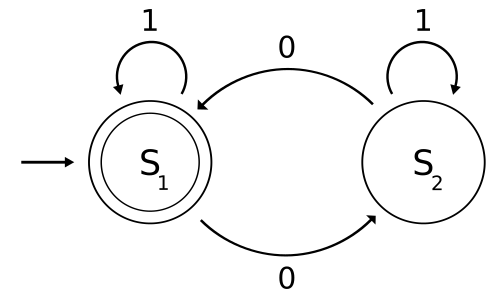
In 1959, Michael Rabin and Dana Scott introduced a formal mathematical framework for finite-state machines, establishing the foundational constraints of automata theory. The paper provided the definitive proof that deterministic and non-deterministic finite automata are equivalent in their computational capacity, despite differences in their structural descriptions. This work transitioned the study of state-based computation from isolated engineering examples to a rigorous theory of formal language recognition, defining the limits of what can be computed by systems with restricted memory.
Non-Determinism and the Power Set Construction
A central technical contribution of the research is the formalization of non-deterministic finite automata (NFA) and the proof of their equivalence to deterministic finite automata (DFA). Rabin and Scott demonstrated that any NFA can be transformed into an equivalent DFA through a methodological process known as the power set construction. This technique defines each state of the resulting deterministic machine as a subset of the states of the original non-deterministic machine. By tracking all possible states the NFA could simultaneously inhabit, the DFA effectively simulates every potential execution path in parallel. This finding proved that the introduction of non-deterministic choices does not expand the fundamental recognition power of finite-state systems.
Algebraic Closure and Formal Regular Languages
The researchers established the algebraic properties of the languages recognized by finite automata, termed regular languages. They proved that these languages are closed under operations such as union, intersection, and complementation, allowing for the construction of complex machine behaviors from simpler components. This finding enabled a systematic approach to machine design, where the recognition requirements of a system can be decomposed into well-defined logical operations. Furthermore, the paper established the decidability of the emptiness and finiteness problems, proving that basic questions regarding a machine's behavior can be resolved through repeatable algorithmic procedures.
Impact on Compiler Architecture and Lexical Analysis
The technical significance of the Rabin-Scott framework is most evident in the development of modern compiler architecture. The principles of finite automata provide the primary mechanism for lexical analysis, where input source code is decomposed into a series of tokens based on formal state transitions. By mapping programming language grammars into state machines, developers can ensure that the parsing process remains efficient and mathematically sound. This application proved that the most robust method for processing structured data streams is to represent them as transitions within a formal state space whose properties are pre-verified.
Theoretical Constraints on Finite Memory
The work of Rabin and Scott defined the theoretical boundaries of computation for systems constrained by finite memory. By proving that certain languages cannot be recognized by any finite automaton - such as those requiring a potentially infinite stack of symbols - the researchers established a hierarchy of computational complexity. This realization remains a cornerstone of computer science, providing a benchmark for evaluating the necessity of more powerful machine models like Turing machines. It leaves open the question of how these deterministic state-management techniques can be adapted to handle the non-discrete and continuous states encountered in modern neuromorphic and quantum computing systems.
Dive Deeper
Finite Automata and Their Decision Problems (Official DOI)
IBM • docs
Explore ResourceRabin & Scott Original Paper (PDF)
Otterbein • docs
Explore ResourceTheory of Computation (MIT OCW)
MIT • article
Explore Resource
Discussion
0Join the discussion
Sign in to share your thoughts and technical insights.
Loading insights...
Recommended Readings
The author of this article utilized generative AI (Google Gemini 3.1 Pro) to assist in part of the drafting and editing process.