
KMP Algorithm: Fast Pattern Matching in Strings
Knuth, Morris, Pratt (1977)
Knuth, D. E., Morris, Jr, J. H., & Pratt, V. R. (1977). Fast pattern matching in strings. SIAM journal on computing, 6(2), 323-350.
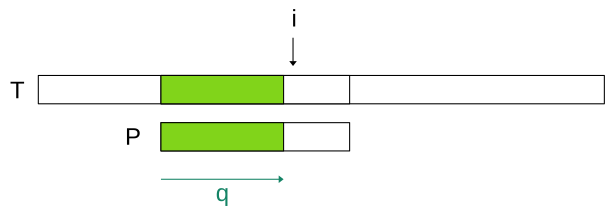
In 1977, Donald Knuth, James Morris, and Vaughan Pratt published a method for identifying the occurrence of a pattern within a text string with linear time complexity. Prior to this research, standard matching techniques required a brute-force approach that frequently involved backtracking through previously examined characters, resulting in a worst-case performance of . The researchers demonstrated that by analyzing the internal symmetry of a pattern before the search phase, it is possible to avoid redundant work and ensure that the pointer in the text never moves backward.
The Prefix Function and Structural Memory
The core technical mechanism of the KMP algorithm is the precomputation of a prefix function, often denoted as . This function analyzes the pattern to identify the longest proper prefix that is also a suffix for every possible sub-segment of the pattern. This precomputation allows the algorithm to determine exactly how many characters of the pattern have already been matched against the text following a mismatch. By building a mathematical memory of the pattern’s own structural self-similarities, the algorithm effectively treats the pattern as a blueprint for its own search, enabling the system to jump forward in the text rather than restarting from the next character.
Linear-Time Complexity and the Text Pointer
The primary advantage of the KMP algorithm is its achievement of time complexity, where is the length of the text and is the length of the pattern. Unlike brute-force methods, the KMP algorithm guarantees that each character in the text is inspected a constant number of times. By utilizing the precomputed prefix function to adjust the pattern's position relative to the text, the algorithm ensures that the text pointer always advances or remains stationary. This methodological choice proved that the time required to search through data can be a linear function of the input size, independent of the complexity or repetitiveness of the target pattern.
State Machine Abstraction and State Transitions
Mathematically, the KMP algorithm can be modeled as a deterministic finite automaton (DFA) where each character in the pattern represents a unique state. The prefix function defines the fallback transitions for each state when a character mismatch occurs. This abstraction treats string matching as a problem of efficient state management rather than simple character comparison. By mapping the search process into a formal state space, the researchers demonstrated that any mismatch contains latent information about the next potential match point, effectively transforming the search into a directed information-aware process.
Optimality in Streaming Information
The elimination of the need to backtrack through the text makes the KMP algorithm particularly valuable for processing streaming information where data cannot be stored or re-accessed. By proving that the text pointer never moves backward, the researchers established a theoretical limit for string matching efficiency. This realization remains central to modern computational tasks such as real-time text filtering, biological sequence alignment, and the development of efficient tools for scanning digital data streams. The algorithm proved that a small initial investment in analyzing the structure of the search target can yield massive computational savings during the execution phase.
The Transformation of Pattern Search
The KMP algorithm provided the foundational logic for subsequent multi-pattern matching systems and more advanced data processing tools. It established that an understanding of structural information is the primary requirement for scaling digital systems to handle large volumes of data. By providing a universal method for avoiding redundant calculations, the work demonstrated that the "search" is a process of systematic state refinement rather than exhaustive trial. This leaves open the question of how these deterministic state-machine methods can be integrated with the high-dimensional, probabilistic matching required in modern machine learning environments.
Dive Deeper
Fast Pattern Matching in Strings (Official DOI)
SIAM • docs
Explore ResourceKMP Original Paper (PDF)
JHU • docs
Explore ResourceKMP Algorithm Visualization
PyPup • article
Explore Resource
Discussion
0Join the discussion
Sign in to share your thoughts and technical insights.
Loading insights...
Recommended Readings
The author of this article utilized generative AI (Google Gemini 3.1 Pro) to assist in part of the drafting and editing process.