
Aho-Corasick Algorithm: Searching for Thousands of Patterns at Once
Alfred Aho & Margaret Corasick (1975)
Aho, A. V., & Corasick, M. J. (1975). Efficient string matching: an aid to bibliographic search. Communications of the ACM, 18(6), 333-340.
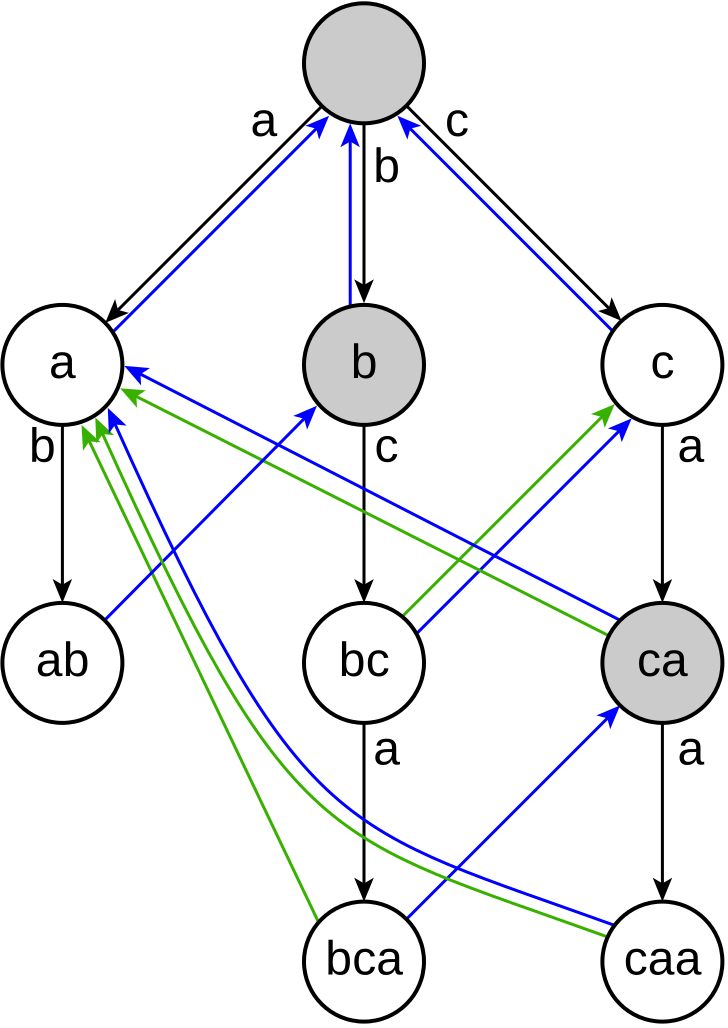
In 1975, Alfred Aho and Margaret Corasick introduced a method for identifying all occurrences of a set of keywords within an input text in a single linear pass. This algorithm addresses the inefficiency of repeated individual string searches by consolidating a library of patterns into a single deterministic finite automaton (DFA). This approach ensures that the time complexity of the search phase remains independent of the number of keywords, establishing a fundamental logic for high-performance string processing in lexical analysis, intrusion detection, and genomics.
The Construction of the Pattern Automaton
The Aho-Corasick algorithm operates by first constructing a prefix tree, or trie, representing the target keywords. The critical technical innovation is the addition of failure links that map each node in the trie to the longest proper suffix of the current prefix that is also a prefix of another keyword. These links enable the automaton to transition directly to a new potential match upon encountering a mismatch, eliminating the need to backtrack through the input text. This mechanism effectively encodes the memory of the search into a static graph, allowing the system to maintain multiple parallel search states simultaneously.
DFA Optimization and State Transitions
The construction process involves a multi-stage pipeline where the trie is transformed into a robust state machine. After the initial trie is populated, a breadth-first search (BFS) is utilized to compute the failure links, resulting in a non-deterministic machine where a single character can trigger either a successful transition or a failure jump. To optimize for performance, this machine is often flattened into a full transition table, where every pair of (state, character) results in a precomputed next state. This optimization front-loads the computational cost into a compilation phase, enabling the search phase to operate at the maximum throughput of the system's memory.
Simultaneous Matching and Output Links
To ensure that every keyword is identified even when patterns overlap, the algorithm utilizes output links. These links connect a node to all keywords that end at the current character position in the text. This finding demonstrated that the computational cost of searching for a collection of patterns is not a cumulative sum of individual searches, but a function of the input length and the total number of matches detected. By integrating dictionary-matching into the automaton's transitions, the algorithm provides a method for constant-time-per-character processing regardless of the dictionary size.
Applications in Real-Time Systems
The efficiency of the Aho-Corasick automaton makes it the primary engine for high-throughput filtering systems, such as network intrusion detection systems (NIDS). In these environments, thousands of malicious signatures must be cross-referenced against incoming traffic in real-time. By compiling these signatures into a unified DFA, systems can monitor data streams with constant time-per-byte complexity. This application proved that the scalability of security and filtering tools depends on the front-loading of structural pattern information into an efficient state-management framework.
Motif Search in Genomic Data
Beyond text processing, the algorithm is foundational to bioinformatics for the identification of specific biological motifs across massive genomic datasets. When researchers must locate instances of a predefined set of regulatory sequences or protein domains, Aho-Corasick provides a more efficient alternative to iterative scanning. By treating the four-letter genetic alphabet as the input stream, the automaton identifies complex, overlapping biological patterns with optimal efficiency. This suggests that the principles of bibliographic search are directly applicable to the decoding of biological sequences.
Finite-State Management as a Search Strategy
The success of this work demonstrated that multi-pattern matching is fundamentally a problem of efficient state management. The choice to map a dictionary of patterns into a formal state space revealed that the most effective way to process information streams is to ensure that every input character contributes to the simultaneous refinement of all possible matches. This principle remains central to the design of lexical analyzers and database search engines. It leaves open the question of how these static automata can be adapted to massive, evolving dictionaries where the cost of recompiling the state machine becomes a bottleneck.
Dive Deeper
Efficient String Matching (Official DOI)
ACM • docs
Explore ResourceAho-Corasick (Wikipedia)
Wikipedia • article
Explore ResourceAho-Corasick Multi-Pattern Matching (Video)
YouTube • video
Explore Resource
Discussion
0Join the discussion
Sign in to share your thoughts and technical insights.
Loading insights...
Recommended Readings
The author of this article utilized generative AI (Google Gemini 3.1 Pro) to assist in part of the drafting and editing process.