The Art of Exploring Complex Networks
Robert Tarjan (1972)
Tarjan, R. (1972). Depth-first search and linear graph algorithms. SIAM journal on computing, 1(2), 146-160.
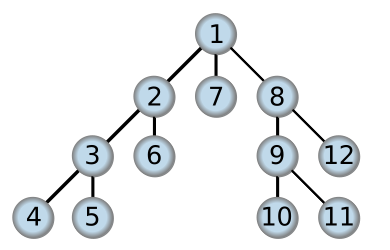
In 1972, Robert Tarjan introduced a set of algorithms that demonstrate how diverse graph problems can be resolved with optimal linear efficiency using a single depth-first search (DFS) traversal. Prior to this research, identifying structural properties such as strongly connected components required multiple passes or quadratic time complexity. Tarjan proved that by maintaining a structured history of the traversal - specifically through the use of stacks and low-link values - global properties of both directed and undirected graphs can be identified in a single pass of complexity.
Edge Classification and the DFS Forest
The mechanism of Tarjan’s algorithms relies on the systematic classification of edges encountered during a DFS traversal. Each edge is categorized as a tree edge, back edge, forward edge, or cross edge based on its role in the resulting DFS forest. This taxonomy provides the mathematical engine for detecting cycles and evaluating reachability. Back edges, which connect a node to an ancestor in the search tree, are particularly critical as they indicate the presence of cycles and enable the calculation of low-link values. This classification demonstrated that the structural information of a graph is inherently encoded in the sequence and depth of its traversal.
Strongly Connected Components and Low-Link Values
Tarjan’s primary technical contribution was an algorithm to identify strongly connected components (SCCs) in directed graphs. The process involves maintaining a stack of visited nodes and tracking two specific integers for each vertex: its discovery time and its low-link value. The low-link value represents the smallest discovery time reachable from a node through back-edges. A strongly connected component is identified when a node’s discovery time matches its low-link value, marking it as the root of the component. At this point, all members of the component are popped from the stack, isolating a maximal subgraph where every vertex is mutually reachable.
Linear-Time Identification of Articulation Points and Bridges
The same DFS-based logic was applied to undirected graphs to identify articulation points and bridges. An articulation point is a vertex whose removal increases the number of connected components, while a bridge is an edge with an equivalent structural significance. Tarjan demonstrated that these points of failure can be identified by comparing the low-link values of a node’s descendants with the node’s own discovery time. If a descendant has no path back to an ancestor of the node, the node or its connecting edge is identified as a critical structural bottleneck. This provided a formal methodology for evaluating the resilience of physical and digital infrastructures without exhaustive testing.
Algorithmic Efficiency and Computational Lower Bounds
The technical significance of Tarjan’s work lies in achieving complexity, which represents the theoretical lower bound for any algorithm that must inspect all vertices and edges. By consolidating multiple structural checks into a single traversal, these algorithms proved that the key to efficient graph processing is the identification of appropriate invariants during the search. This realization remains central to modern computational tasks, including the optimization of control-flow graphs in compilers and the analysis of massive connectivity datasets in network science. This leaves open the question of how these linear-time methods can be scaled to dynamic graphs where edges are frequently added or removed.
Dive Deeper
Depth-First Search and Linear Graph Algorithms (DOI)
SIAM • docs
Explore ResourceTarjan's Original Paper (PDF)
CMU • docs
Explore ResourceStrongly Connected Components (Wikipedia)
Wikipedia • article
Explore Resource
Discussion
0Join the discussion
Sign in to share your thoughts and technical insights.
Loading insights...
Recommended Readings
The author of this article utilized generative AI (Google Gemini 3.1 Pro) to assist in part of the drafting and editing process.