
Magentic-One: Multi-Agent Orchestration via Nested Ledgers
Fourney et al. (2024)
Fourney, A., et al. (2024). Magentic-One: A Generalist Multi-Agent System for Solving Complex Tasks. arXiv preprint arXiv:2411.04468.
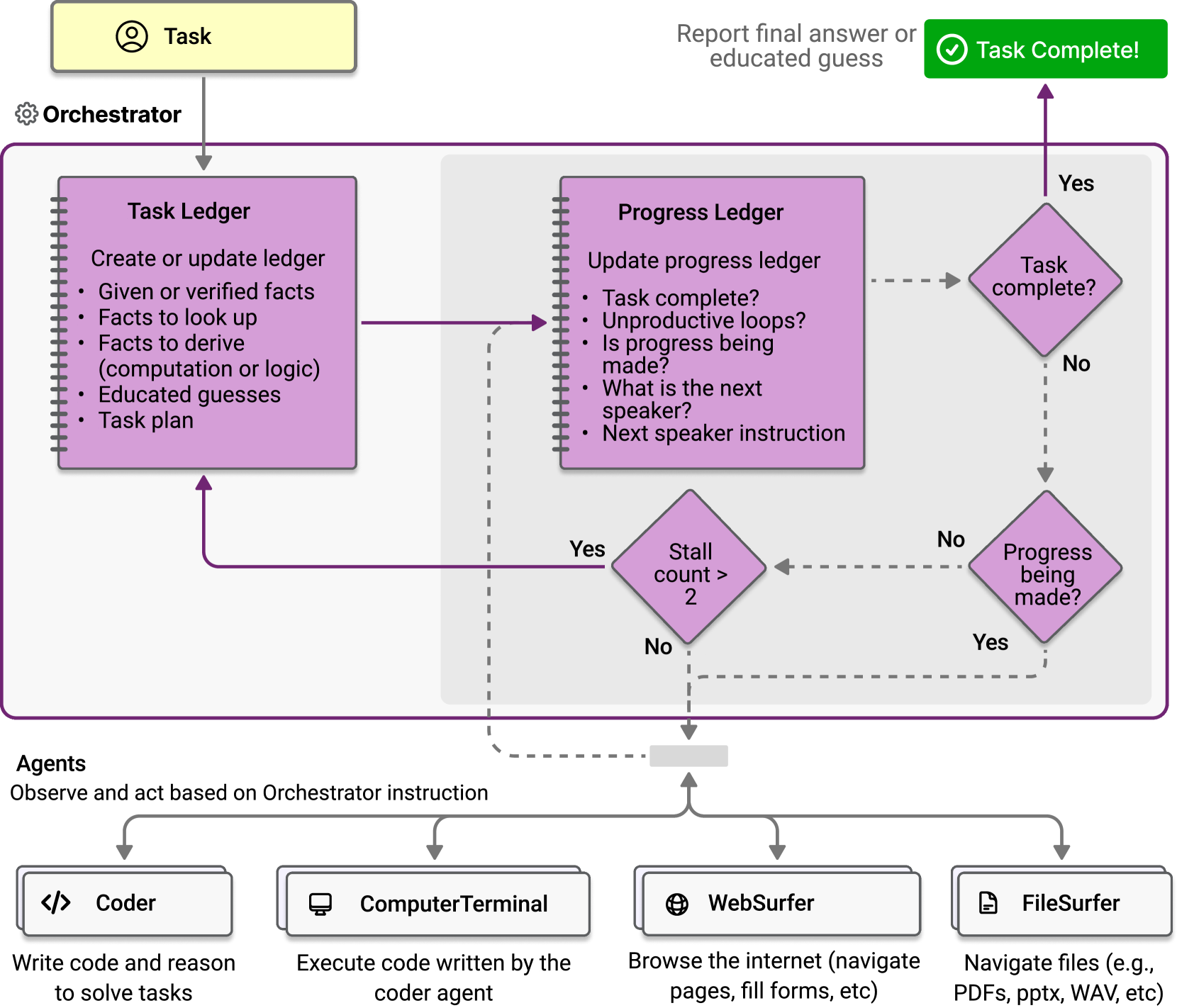

Magentic-One multi-agent team completing a complex task from the GAIA benchmark.
Magentic-One, released by Microsoft Research in late 2024, introduces a high-performance architectural pattern for generalist multi-agent systems. Built on the AutoGen 0.4 framework, it addresses the "context drift" and "planning fragility" common in single-agent systems by centralizing intelligence in a lead Orchestrator that manages task lifecycles through a dual-loop state machine and persistent, structured memory ledgers.
The Ledger-Based Control Loop

The system's execution logic is governed by two distinct control loops:
- Outer Loop (Task Ledger): The Orchestrator maintains a "Task Ledger" that acts as the system's global state. It tracks Verified Facts, Information Gaps (to be searched), and Reasoning Nodes (to be derived). Crucially, the ledger includes a section for "Educated Guesses" - memorized closed-book information used to mitigate stalls when external tool-use fails.
- Inner Loop (Progress Ledger): For every sub-task, the Orchestrator initiates an Inner Loop. It asks five diagnostic questions: Is the task complete? Is the team looping? Is progress being made? Which agent is next? What is the specific instruction? This ledger prevents the common agentic failure of "vague delegation," where a lead agent sends broad, unconstrained commands to sub-agents.
This nested architecture allows Magentic-One to be model-agnostic. While the Orchestrator typically uses a reasoning-heavy model like GPT-4o, sub-agents like WebSurfer or FileSurfer can be powered by smaller, specialized models. The ledgers act as a standardized interface, ensuring that the system's "intent" remains coherent even as execution is passed between heterogeneous models.
The WebSurfer and Accessibility Tree Mapping
The WebSurfer agent is the most technically complex component of the Magentic-One team. Unlike simple scraper bots, it manages a full Chromium-based browser and interacts with websites via an Accessibility Tree (AXTree) mapping.
- Perception: The agent extracts the AXTree from the browser, which provides a semantic representation of the UI (e.g., distinguishing between a decorative image and a functional button).
- Set-of-Marks (SoM) Prompting: It overlays numerical labels on the visual screenshot. The Orchestrator then receives a multimodal input: the raw pixels, the annotated screenshot, and the linearized AXTree text.
- Action Execution: The agent translates LLM commands into precise Playwright/Selenium events (e.g.,
page.click('[data-testid="search"]')).
By providing the model with both visual tags and semantic metadata, Magentic-One solves the "dynamic content" problem. If a button's visual position shifts due to a loading ad, the agent can still target it reliably via its AXTree ID.
The Stall Counter and Error Recovery
A critical implementation nuance is the Stall Counter. If the Progress Ledger detects that the same action is being repeated without state change, or if a sub-agent returns a non-informative error, the counter increments. Once the counter exceeds a predefined threshold (typically ), the system forces a "break-to-outer" transition. The Orchestrator then performs a global reflection, updates the Task Ledger with a "lesson learned" from the failure, and re-plans the trajectory.
This deterministic handling of agentic failure is a departure from simple "self-reflection" prompts. It treats recovery as a state transition rather than a reasoning prompt, ensuring the system doesn't enter an infinite recursion of apologies. For researchers, this highlights a fundamental law of deployment: reliable agency requires a deterministic state machine to govern the probabilistic reasoning of the LLM.
Dive Deeper
Magentic-One Paper on arXiv
arXiv • article
Explore ResourceMagentic-One Project Page
Microsoft • docs
Explore ResourceMagentic-One on GitHub
GitHub • code
Explore Resource
Discussion
0Join the discussion
Sign in to share your thoughts and technical insights.
Loading insights...
Recommended Readings
The author of this article utilized generative AI (Google Gemini 3.1 Pro) to assist in part of the drafting and editing process.