
Quantum Supremacy: How Google's Sycamore Processor Beat Classical Computers
Frank Arute et al. (Google Research, 2019)
Arute, F., et al. (2019). Quantum supremacy using a programmable superconducting processor. Nature, 574(7779), 505-510.
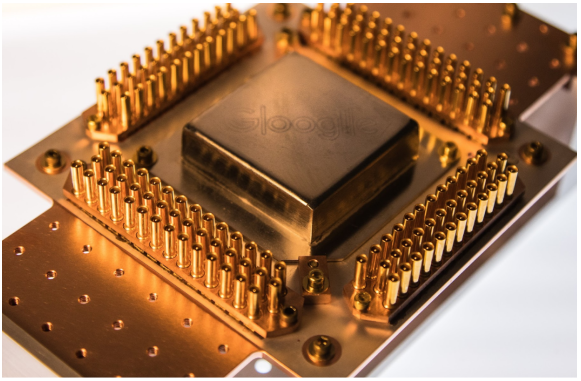
In 2019, researchers at Google Research demonstrated the first instance of quantum supremacy by executing a specific computational task on a programmable superconducting processor that is beyond the reach of any classical supercomputer. The experiment utilized the 54-qubit Sycamore architecture to sample from the output distribution of a random quantum circuit, a task that required 200 seconds on the quantum hardware. The researchers demonstrated that the same calculation would require approximately 10,000 years on the world's most powerful classical supercomputer, establishing the first empirical evidence for the exponential scaling of quantum state spaces.
The Sycamore Architecture and Tunable Coupling
The technical foundation of the experiment is the Sycamore processor, characterized by a two-dimensional grid of transmon qubits connected via adjustable couplers. These couplers allow for the dynamic tuning of qubit interaction strengths, enabling the execution of high-fidelity entangling gates while minimizing the parasitic crosstalk that limits earlier superconducting designs. The processor utilizes a flip-chip integration scheme to manage the complex vertical routing of control and readout lines, preventing the wiring bottlenecks associated with purely planar layouts. This methodological choice proved that the stability of a large-scale quantum processor is determined by the precision of its local control and the efficiency of its physical interconnects.
Random Circuit Sampling and Complexity Theory
The task used to demonstrate supremacy was Random Circuit Sampling (RCS), where the processor executes a sequence of randomly selected single-qubit gates followed by structured patterns of entangling operations. This process creates a complex multi-qubit state where quantum interference causes certain bitstrings to be significantly more likely than others - a pattern known as speckle. The computational hardness of this task is a direct consequence of the exponential growth of the Hilbert space; for a 53-qubit system, a classical machine must track complex amplitudes, a task that exceeds the memory and processing limits of existing silicon technology. This finding established a definitive benchmark for evaluating the crossover point where quantum mechanics offers a fundamentally different class of computational leverage.
Linear Cross-Entropy Benchmarking
Verification of the result was achieved through Linear Cross-Entropy Benchmarking (XEB), a statistical method for inferring the fidelity of the quantum state from its output bitstrings. XEB compares the experimentally collected samples against the ideal probabilities calculated by classical simulators for smaller, more manageable versions of the circuit. The researchers proved that the total system fidelity could be accurately predicted by multiplying the fidelities of the individual gates and readout operations. This finding demonstrated that there are no unforeseen many-body decoherence effects as quantum systems scale, validating the foundational assumptions of quantum complexity theory and the Extended Church-Turing Thesis.
Impact on the Future of Computation
The practical significance of the Google experiment is its transition of quantum advantage from a theoretical promise to an experimental reality. While the RCS task does not possess immediate industrial utility, the demonstration established the rigorous engineering framework required for the development of error-corrected quantum computers. This application proved that the scalability of quantum hardware is a manageable variable, shifting the field from the study of isolated qubits to the design of integrated systems capable of outperforming classical logic. It established a theoretical deadline for the era of purely classical high-performance computing, requiring the development of new paradigms for information processing that natively exploit the properties of superposition and interference.
Dive Deeper
Quantum Supremacy (Official Nature)
Nature • article
Explore ResourceSycamore Original Paper (arXiv)
arXiv • docs
Explore ResourceGoogle AI Blog: Quantum Supremacy
Google • article
Explore ResourceQuantum Supremacy Explained (Video)
Google • video
Explore Resource
Discussion
0Join the discussion
Sign in to share your thoughts and technical insights.
Loading insights...
Recommended Readings
The author of this article utilized generative AI (Google Gemini 3.1 Pro) to assist in part of the drafting and editing process.