
ReAct: Synergizing Reasoning and Acting in Language Models
Yao et al. (2022)
Yao, S., Zhao, J., Yu, D., Du, N., Shafran, I., Narasimhan, K., & Cao, Y. (2022). ReAct: Synergizing reasoning and acting in language models. arXiv preprint arXiv:2210.03629.
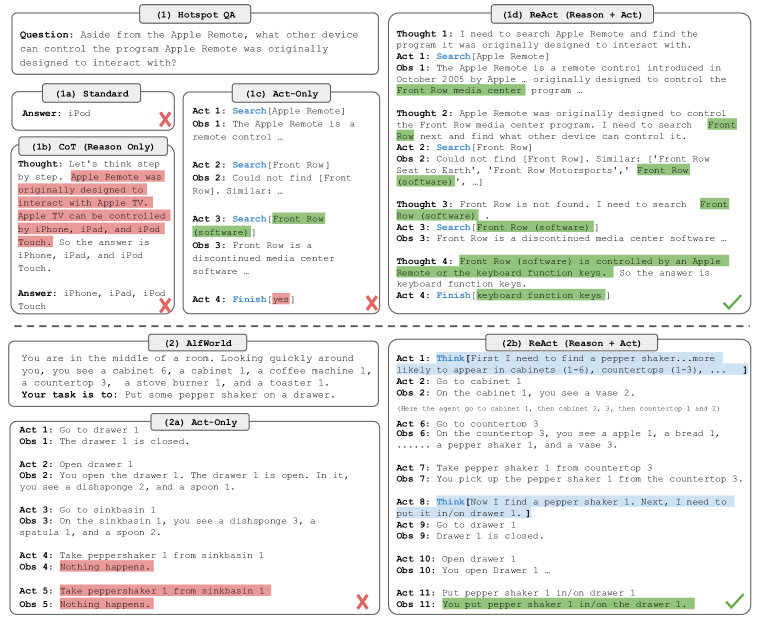
The 2022 ReAct framework introduced a prompting method that allows large language models to interleave reasoning traces with task-specific actions. While previous approaches often treated internal reasoning and external acting as separate functions, researchers from Princeton and Google DeepMind demonstrated that combining them creates a synergistic effect. The model uses thoughts to plan and actions to ground its reasoning in external data, moving away from a static black-box response model toward a dynamic system capable of multi-step interaction with its environment.
The ReAct loop formalizes a cycle of thoughts, actions, and observations. The model first produces a textual trace that decomposes a complex goal into manageable steps. It then executes a specific action, such as a search query, and incorporates the resulting observation back into its context window. This continuous updating of the internal state allows the model to refine its reasoning based on real-world feedback. This grounded interaction reduces the frequency of hallucinations by ensuring that the model's claims are supported by external evidence.
Hallucination remains a significant failure mode for models relying solely on internal, static weights. In fact-heavy tasks like HotpotQA, traditional reasoning models often generate incorrect information. ReAct mitigates this by requiring the model to retrieve and verify specific data before making a claim. A manual study indicated that over half of the errors in standard reasoning chains were caused by hallucination, a figure that ReAct significantly lowered. This confirms that accuracy is not only a function of model parameters but also of the ability to verify internal states against external truth.
The framework employs dynamic reasoning-driven retrieval, which differs from static retrieval-augmented generation. Instead of fetching a fixed set of documents at the start, ReAct identifies what information is missing after each observation and formulates new, specific queries. This enables multi-hop reasoning, where the answer to one query informs the next. The value of the model lies in its ability to navigate a database strategically rather than simply memorizing its contents.
In text-based planning environments like ALFWorld, ReAct improved success rates by 34% over non-reasoning baselines. By using sparse thoughts to apply commonsense reasoning to actions, the model maintains a coherent plan while reacting to unexpected feedback. This suggests that intelligence in an agentic context is the ability to balance long-term planning with immediate flexibility. Whether this approach scales to physical environments with higher latency or more complex state spaces remains a subject of ongoing research.
Dive Deeper
ReAct Paper on arXiv
arXiv • article
Explore ResourceGoogle AI Blog: ReAct
Google AI • article
Explore ResourceGitHub Implementation
GitHub • code
Explore Resource
Discussion
0Join the discussion
Sign in to share your thoughts and technical insights.
Loading insights...
Recommended Readings
The author of this article utilized generative AI (Google Gemini 3.1 Pro) to assist in part of the drafting and editing process.