Reingold's Algorithm: Undirected Graph Connectivity in Log-Space
Omer Reingold (2005)
Reingold, O. (2008). Undirected connectivity in log-space. Journal of the ACM (JACM), 55(4), 1-24.
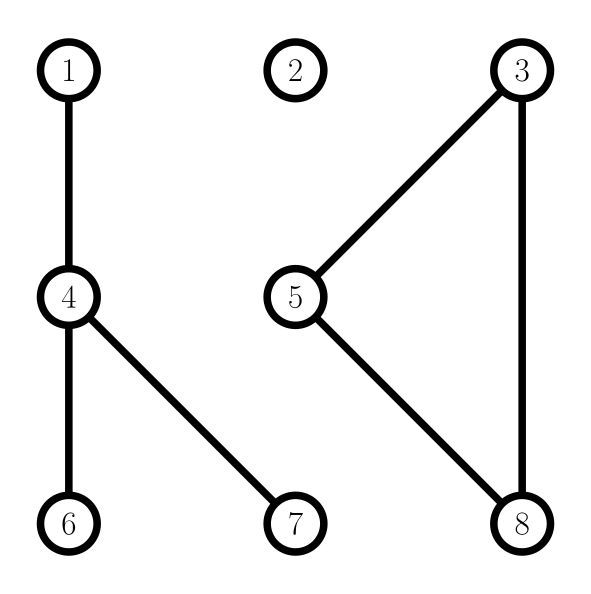
In 2005, Omer Reingold resolved a long-standing open problem in computational complexity by demonstrating that identifying a path between two nodes in an undirected graph can be achieved using only logarithmic space. This result proved that SL = L (Symmetric Log-space equals Log-space), showing that the apparent necessity for randomized or linear-space search techniques was a limitation of earlier algorithmic frameworks rather than a fundamental property of the problem. Reingold’s method introduced a deterministic way to increase the connectivity of a graph until its global structure can be explored through a simple, memory-efficient local walk.
Expander Graphs and Iterative Diameter Reduction
The primary technical contribution of the research is a method for transforming any connected undirected graph into an expander graph without exceeding logarithmic space constraints. An expander graph is characterized by a large spectral gap in its adjacency matrix, ensuring that a short walk from any vertex quickly reaches a significant portion of the total nodes. Traditional search algorithms like breadth-first search require storing a list of visited nodes, which consumes linear space (). Reingold bypassed this requirement by iteratively reducing the graph’s diameter through a sequence of deterministic graph operations, effectively condensing the system’s global connectivity into a state where it can be verified with memory.
The Zig-Zag Product and Graph Powering
The algorithmic mechanism for this transformation utilizes the zig-zag product, a graph-theoretic operation that combines a large graph with a small expander. The process follows an iterative cycle: a powering step is applied to reduce the graph's diameter, followed by a zig-zag product to restore the degree of the vertices to a constant value. This specific sequence ensures that the graph’s expansion properties improve at each step while the space required to store the current position and traversal history remains logarithmic. This methodological choice proved that global connectivity can be established through a series of coordinated local refinements, treating the graph as a topological object that can be "smoothed" into a highly connected state.
Derandomization and the Power of L-Space
The proof that represents a significant milestone in the field of derandomization. Prior to this research, the most space-efficient algorithm for undirected connectivity was the randomized walk, which operates in Randomized Log-space (RL). Reingold demonstrated that any task achievable by a randomized walk on an undirected graph can be executed deterministically within the same memory bounds. This finding provided critical evidence for the broader conjecture that , suggesting that randomness is an artifact of incomplete algorithmic design rather than an essential component of computational power. It proved that structured expansion can replace stochastic sampling as a tool for navigating information.
Universal Traversal Sequences and Deterministic Search
A primary consequence of Reingold’s theorem is the construction of deterministic universal traversal sequences. These are fixed sequences of instructions - such as a specific order of edge selections - that are guaranteed to visit every node in any connected regular graph of a specific size. While the existence of such sequences was previously established through probabilistic arguments, Reingold provided the first log-space construction of a related primitive. This finding established that a machine can explore an unknown environment using a rigid, pre-determined script without the need to remember its previous path, effectively digitalizing the logic of spatial exploration.
Memory Efficiency in Large-Scale Network Analysis
The success of this work demonstrated that the complexity of computational systems is deeply linked to the structural invariants maintained during a search. The technical significance of achieving log-space connectivity lies in its application to the analysis of massive datasets that are too large to fit in physical memory. Reingold’s insights into iterative expansion provide a rigorous framework for identifying connected components and structural bottlenecks using minimal computational resources. This principle remains central to the design of high-performance tools for web crawling, social network analysis, and the study of large-scale digital infrastructures where memory capacity is the primary constraint.
Dive Deeper
Undirected Connectivity in Log-Space (Official DOI)
ACM • docs
Explore ResourceAuthor's Weizmann Institute Page (PDF)
Weizmann • docs
Explore ResourceExpander Graphs and their Applications (AMS)
AMS • article
Explore Resource
Discussion
0Join the discussion
Sign in to share your thoughts and technical insights.
Loading insights...
Recommended Readings
The author of this article utilized generative AI (Google Gemini 3.1 Pro) to assist in part of the drafting and editing process.