
The First Crack in the ACC Barrier
Ryan Williams (2011)
Williams, R. (2014). Nonuniform ACC circuit lower bounds. Journal of the ACM (JACM), 61(1), 1-32.
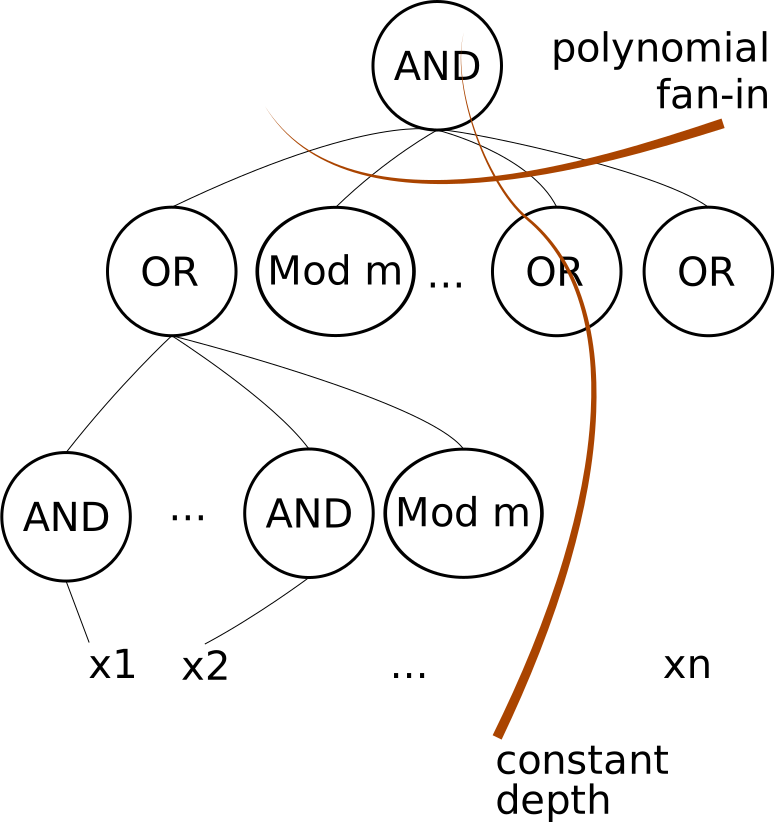
In 2011, Ryan Williams proved that the complexity class NEXP (nondeterministic exponential time) cannot be represented by polynomial-size ACC0 circuits. This result resolved a long-standing impasse in circuit complexity, identifying the first non-trivial lower bound for a class of circuits that include modular gates. The research introduced a methodological inversion known as the algorithmic method, which demonstrates that the existence of slightly-faster-than-brute-force algorithms for the satisfiability problem (SAT) is logically sufficient to prove structural lower bounds against specific circuit families.
The Algorithmic Method for Circuit Lower Bounds
The primary technical contribution of the paper is the formalization of the link between algorithm design and complexity barriers. Williams demonstrated that if a circuit class could represent every problem in NEXP, then one could utilize that representation to construct an algorithm for -SAT that runs marginally faster than . This construction would lead to a contradiction of the Nondeterministic Time Hierarchy Theorem, which establishes rigid limits on how much can be computed within a given time bound. This finding revealed that every improvement in the efficiency of logic-solving algorithms acts as a potential proof of a computational limit, effectively unifying the upper-bound and lower-bound branches of theoretical computer science.
Bypassing the Natural Proofs Barrier
The significance of this result lies in its ability to bypass the natural proofs barrier identified by Razborov and Rudich. Traditional attempts to prove circuit lower bounds relied on identifying "large" and "constructive" combinatorial properties of functions, a strategy proven to be self-defeating if strong pseudorandom generators exist. Williams’ proof avoids this limitation by utilizing high-level diagonal arguments and the specific algorithmic properties of the satisfiability problem. By focusing on ACC0 circuits - which extend standard AC0 gates with modular counting capabilities - the research provided a new roadmap for establishing hardness against increasingly complex architectural models without triggering the limitations of statistical analysis.
The Relationship Between SAT and Circuit Size
Circuit complexity serves as the primary metric for evaluating the P vs NP problem, as proving that a function in P requires a super-polynomial circuit size would resolve the question. Williams’ breakthrough was the first significant advancement in the circuit hierarchy since the late 1980s, moving the boundary of proven hardness from AC0 to ACC0. This result demonstrated that the difficulty of representing a logic function is inversely proportional to the efficiency with which that function can be solved. It suggested that the path to a definitive separation of complexity classes requires the development of increasingly sophisticated SAT algorithms that can exploit the underlying structure of the target circuit family.
Exponential Time and Information Limits
The research is deeply integrated with the Exponential Time Hypothesis (ETH), which postulates that 3-SAT cannot be solved in sub-exponential time. While Williams’ result is a lower bound on circuit size, it is derived from the limits of algorithmic acceleration. This convergence suggests that the barrier encountered in many combinatorial searches is not merely an artifact of current software design but a fundamental structural property of information. By linking the "easiness" of solving a problem to the "hardness" of its circuit representation, the work established a unified framework for understanding the physical limits of deterministic and non-deterministic computation.
Formal Logic as a Structural Constraint
The success of the algorithmic method established that the complexity of computational systems is most accurately understood through the performance limits of their best possible solvers. The choice to link SAT efficiency to circuit capacity revealed that the architecture of a system determines the maximum speed at which its logical state can be evaluated. This principle remains the central theme of modern circuit complexity research, providing a rigorous methodology for probing the boundaries of the P vs NP problem. It leaves open the question of how these algorithmic techniques can be scaled to prove lower bounds against even more powerful circuit classes, such as TC0 or those involving threshold logic.
Dive Deeper
Non-Uniform ACC Circuit Lower Bounds (Official DOI)
ACM • docs
Explore ResourceWilliams' Original Paper (arXiv)
arXiv • docs
Explore ResourceACC0 Complexity (Wikipedia)
Wikipedia • article
Explore Resource
Discussion
0Join the discussion
Sign in to share your thoughts and technical insights.
Loading insights...
Recommended Readings
The author of this article utilized generative AI (Google Gemini 3.1 Pro) to assist in part of the drafting and editing process.