
VQE: A Variational Eigenvalue Solver for Simulating Molecules on Quantum Hardware
Alberto Peruzzo et al. (University of Bristol, 2013)
Peruzzo, A., McClean, J., Shadbolt, P., Yung, M. H., Zhou, X. Q., Love, P. J., ... & O'Brien, J. L. (2014). A variational eigenvalue solver on a photonic quantum processor. Nature Communications, 5(1), 4213.
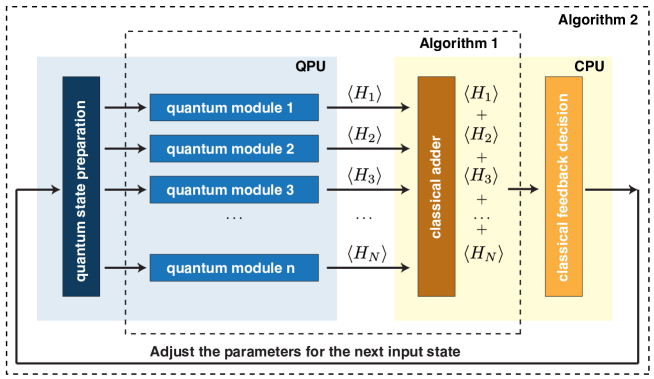
In 2013, researchers at the University of Bristol introduced the Variational Quantum Eigensolver (VQE), a hybrid quantum-classical algorithm designed to find the ground state energy of molecular Hamiltonians. This approach addresses the decoherence constraints of Noisy Intermediate-Scale Quantum (NISQ) hardware, where the coherence times are insufficient for deep coherent algorithms such as Quantum Phase Estimation. The researchers demonstrated that by offloading the optimization of trial states to a classical computer, the quantum processor can function as a specialized co-processor for calculating expectation values, establishing a practical framework for quantum chemistry on imperfect hardware.
The Hybrid Variational Loop and Parameterized Ansatz
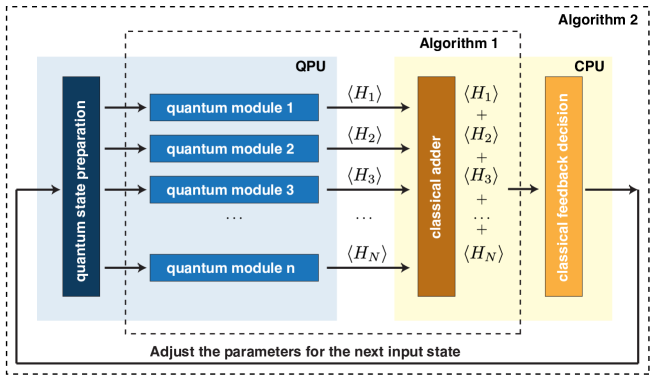
The core technical mechanism of VQE is a feedback loop between a quantum register and a classical optimizer. The process begins with the preparation of a trial state, or ansatz, defined by a set of adjustable parameters that control the rotations and entangling gates within the quantum circuit. This ansatz acts as a high-dimensional "guess" for the true wavefunction of the system. The quantum hardware is utilized to measure the expectation value of the Hamiltonian . This measured energy is then passed to a classical algorithm, which iteratively updates the parameters to minimize the value. This methodological choice proved that the stability of a quantum calculation can be maintained by anchoring the process to the robustness of classical iterative refinement.
Pauli Decomposition and Statistical Sampling
To evaluate the Hamiltonian on quantum hardware, the operator is decomposed into a sum of Pauli strings - linear combinations of , , and matrices. Each string represents a specific observable that can be measured independently on the qubits. The total energy is reconstructed classically as a weighted sum of these measurements. This finding revealed that the Act of observing a complex quantum system can be discretized into a series of statistically independent samples, allowing for the parallelization of the measurement phase across multiple processors or time-steps. This approach established the principle that the accuracy of a variational result is a function of the total number of samples collected rather than the depth of a single coherent gate sequence.
The Variational Principle and Error Robustness
The stability of the VQE is derived from the variational principle of quantum mechanics, which guarantees that the measured expectation value for any trial state is an upper bound on the true ground state energy. This mathematical property makes the algorithm inherently robust to certain types of systematic hardware errors; a slight mis-calibration of a rotation gate simply results in a different trial state within the Hilbert space, which the classical optimizer can often compensate for in subsequent rounds. This finding transformed the noise of the NISQ era from an absolute barrier into a structural constraint that can be managed through the choice of an appropriate ansatz.
Applications in Quantum Chemistry and Materials Science
The practical significance of VQE was demonstrated through the calculation of the electronic structure of small molecules like and on early photonic and superconducting devices. By providing a method for mapping the Fermionic constraints of electron orbitals into the qubit space - typically through transformations like Jordan-Wigner or Bravyi-Kitaev - VQE enabled the simulation of chemical bonding and reaction coordinates. This application established quantum hardware as a foundational tool for materials science, suggesting that the most efficient way to understand the fundamental properties of matter is to utilize a simulator built from the same quantum primitives as the system under study.
Optimization as a Scaling Bottleneck
The success of the VQE demonstrated that near-term quantum advantage is tied to the efficiency of the hybrid interface. The decision to utilize classical optimization revealed that the primary constraint on variational intelligence is the topology of the energy landscape. As the number of parameters increases, the optimizer may encounter "barren plateaus" - regions where the gradients vanish and the search for the ground state stalls. This principle remains the central theme in the study of variational quantum algorithms, influencing the design of more efficient ansatz structures and the development of quantum-aware optimizers. It leaves open the question of whether these hybrid methods can eventually surpass the precision of classical benchmarks for industrially relevant molecules.
Dive Deeper
A Variational Eigenvalue Solver (Official Paper)
arXiv • article
Explore ResourceVariational Quantum Algorithms Survey (arXiv)
arXiv • article
Explore ResourceVQE on Qiskit (IBM)
IBM • docs
Explore ResourceQuantum Chemistry Tutorial (Pennylane)
Xanadu • docs
Explore Resource
Discussion
0Join the discussion
Sign in to share your thoughts and technical insights.
Loading insights...
Recommended Readings
The author of this article utilized generative AI (Google Gemini 3.1 Pro) to assist in part of the drafting and editing process.