
Zero-Knowledge Proofs: How to Prove a Secret Without Revealing It
Shafi Goldwasser, Silvio Micali, & Charles Rackoff (1985)
Goldwasser, S., Micali, S., & Rackoff, C. (1989). The knowledge complexity of interactive proof systems. SIAM Journal on Computing, 18(1), 186-208.
In 1985, Shafi Goldwasser, Silvio Micali, and Charles Rackoff introduced zero-knowledge proofs (ZKP), a cryptographic protocol that allows a prover to convince a verifier of a statement's truth without revealing any information beyond that truth itself. Prior to this research, proofs were viewed as a static transfer of information that necessarily exposed the underlying evidence or secret. The researchers proved that through a randomized interactive challenge-response sequence, a system can achieve high-confidence verification while maintaining absolute data confidentiality. This work established the foundational primitive for modern private identity and decentralized protocols, effectively digitalizing the Act of "proving" without disclosure.
The Interactive Proof Paradigm and Conversational Evidence
The ZKP protocol is based on the Interactive Proof System, where the prover and the verifier engage in a series of back-and-forth exchanges. Instead of a static mathematical argument, the proof is a structured conversation. The verifier asks a series of random questions that can only be answered correctly if the prover possesses the secret information. If the prover answers a sufficient number of these challenges, the verifier becomes mathematically certain of the prover's honesty. This shift from "absolute truth" to "probabilistic certainty" allowed for a more flexible approach to security, revealing that the "certainty" of a result is a function of the number of successful trials rather than the explicit sharing of facts.
Completeness, Soundness, and the Zero-Knowledge Criterion
For an interactive proof to be considered "zero-knowledge," it must satisfy three rigorous criteria. Completeness ensures that if a statement is true and both parties follow the protocol, the verifier will always be convinced. Soundness ensures that if the statement is false, a cheating prover has a vanishingly small probability of deceiving the verifier. The most significant criterion is "Zero-Knowledge," which requires that the verifier learns nothing beyond the fact that the statement is true. To prove this property, the authors used a simulation argument, demonstrating that a verifier could have generated the entire interaction by themselves, proving that the actual exchange contained no new informational content for the observer.
The Ali Baba Cave and Algorithmic Probabilities
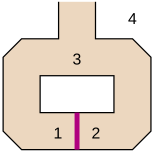
The logic of ZKP is often visualized through the Ali Baba Cave metaphor, where a prover demonstrates knowledge of a secret password to open a hidden door within a circular cave. By entering one path and exiting from the path requested by the verifier, the prover can establish knowledge through a 50% probability of success in any single trial. By repeating this process times, the probability of a forgery decreases to . This findng established that the most robust way to authenticate is to treat the secret as a hidden variable that is never directly sampled but is instead inferred through its consistent influence on the results of randomized challenges.
Evolution toward zk-SNARKs and Non-Interactive Proofs
While the original ZKP protocols were purely theoretical and computationally expensive, the field has evolved into highly efficient systems like zk-SNARKs (Zero-Knowledge Succinct Non-Interactive Arguments of Knowledge). These modern versions allow for the proof to be non-interactive, where the prover generates a single, short string of data that can be verified at any time without further communication. This technology is now the cornerstone of privacy-focused blockchains and "Rollups," where it is used to verify the integrity of thousands of transactions without revealing the details of individual trades. This application established ZKP as a universal tool for decoupling the verification of a transaction from the disclosure of its contents.
The Logic of Privacy by Design
The success of Goldwasser, Micali, and Rackoff demonstrated that the boundaries of information exchange are not a law of physics but a function of the protocol design. The decision to model proofs as interactive systems revealed that the primary constraint on digital privacy was the reliance on static data sharing. This principle remains the central theme in the development of modern digital identity systems, where individuals can prove properties - such as being over 18 - without revealing their specific birthdate. It leaves open the question of how these "zero-knowledge" techniques can be scaled to support real-time reasoning on massive, encrypted datasets without the computational "tax" of current proof generation.
Dive Deeper
The Knowledge Complexity of Interactive Proof Systems (Official Paper)
MIT • docs
Explore ResourceZero-Knowledge Proofs (Video)
Computerphile • video
Explore ResourceOfficial Journal Record (DOI)
SIAM • docs
Explore ResourceZero Knowledge Proofs (Interactive Animation)
ZK Hack • interactive
Explore Resource
Discussion
0Join the discussion
Sign in to share your thoughts and technical insights.
Loading insights...
Recommended Readings
The author of this article utilized generative AI (Google Gemini 3.1 Pro) to assist in part of the drafting and editing process.