
The Optimizer Behind Every Modern AI
Diederik Kingma & Jimmy Ba (2014)
Kingma, D. P., & Ba, J. (2014). Adam: A method for stochastic optimization. arXiv preprint arXiv:1412.6980.
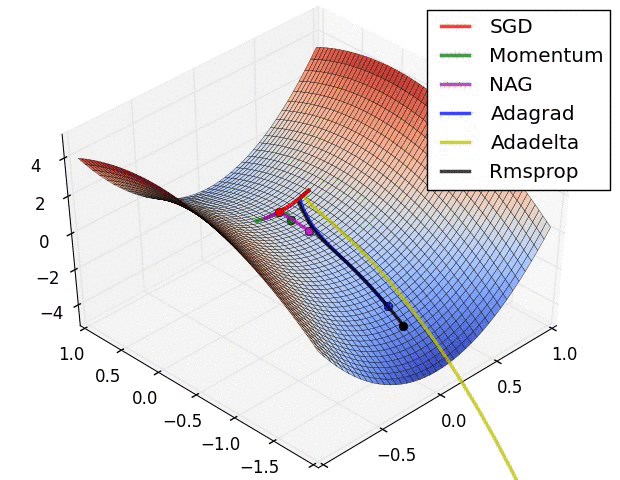
In 2014, Diederik Kingma and Jimmy Ba introduced Adam, an algorithm for first-order gradient-based optimization that utilizes adaptive estimates of lower-order moments. Prior to this research, training deep neural networks required the manual tuning of a global learning rate, which often failed to account for the varying curvatures and sparse gradients encountered in high-dimensional loss landscapes. The researchers demonstrated that by maintaining individual adaptive learning rates for every parameter based on estimates of the gradient's mean and variance, the optimization process becomes significantly more stable and computationally efficient across diverse architectures.
Adaptive Moment Estimation and Signal Stability
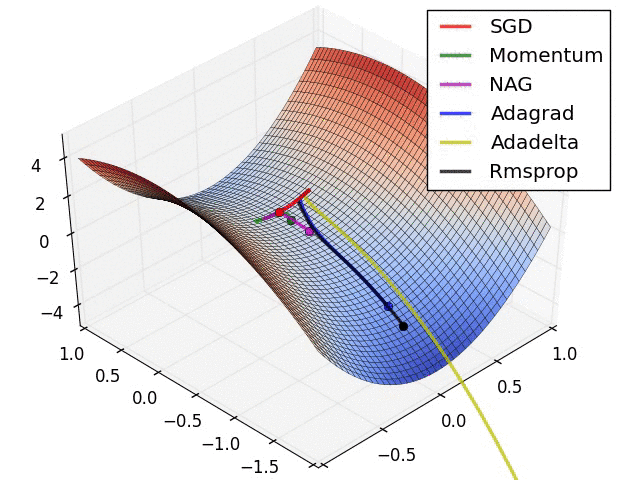
The core technical mechanism of Adam is the simultaneous tracking of two exponentially moving averages: the first moment (the mean of the gradients) and the second raw moment (the uncentered variance). The algorithm utilizes the first moment to provide momentum, smoothing out the noise inherent in stochastic mini-batch updates, while the second moment scales the update size inversely proportional to the gradient's magnitude. This methodological choice ensures that parameters with large, consistent gradients receive smaller, more controlled updates, while those with sparse or small gradients are amplified. This finding proved that the most effective way to navigate a complex loss landscape is to treat the learning rate as a dynamic property of the local gradient statistics rather than a static hyperparameter.
Bias Correction and the Initialization Problem
A critical technical detail in the Adam framework is the implementation of bias correction to account for the initialization of moving averages at zero. Without correction, the estimates of the first and second moments are biased toward the origin during the initial training steps, leading to excessively small updates. Kingma and Ba introduced a mathematical scaling factor that counteracts this bias, where represents the decay rate and is the current time step. This engineering choice demonstrated that the stability of a complex optimization system is determined by its ability to manage the transition from an uninitialized state to a data-informed regime. It established that a robust optimizer must possess the internal mechanisms to correct for its own initial uncertainty.
Computational Efficiency and Hyperparameter Robustness
The success of Adam is attributed to its low memory requirements and its relative insensitivity to the choice of hyperparameters. By performing only first-order calculations and basic arithmetic on moving averages, the algorithm achieves high performance with minimal computational overhead compared to standard stochastic gradient descent. The researchers proved that the default decay rates (typically and ) are effective across a wide range of tasks, including vision, language, and reinforcement learning. This application revealed that many disparate machine learning problems share a common underlying statistical structure, allowing for the adoption of a universal optimization primitive that replaces the need for exhaustive manual search.
Impact on Large-Scale Model Scaling
The practical significance of Adam is evidenced by its immediate adoption as the standard optimizer for foundation models and deep architectures. By providing a method that is both fast and unconditionally reliable in a diverse range of settings, the technology facilitated the rapid scaling of the Transformer and other massive neural systems. The success of this method proved that the scalability of artificial intelligence is determined by the adoption of optimization frameworks that prioritize local adaptability over global pre-scheduling. This work digitalized the act of steering a model's weights, replacing the intuition of the researcher with an automated, differentiable feedback loop that responds to the data in real-time.
The Limits of Local First-Order Information
The achievement of Adam demonstrated that many foundational problems in optimization are more easily resolved through the management of gradient statistics than through complex higher-order calculations. The decision to accept the limitations of first-order information revealed that the primary constraint on deep learning was the volatility of the gradient signal. This principle remains the central theme of modern research into optimizer variants, including AdamW for improved weight decay and Adafactor for reduced memory footprint. It leaves open the question of whether there exists a fundamental threshold where second-order or curvature-aware methods become necessary for further progress, or if adaptive moment estimation represents the mathematical limit of what can be known from local gradients alone.
Dive Deeper
Adam: A Method for Stochastic Optimization (Official arXiv)
arXiv • article
Explore ResourceOptimizer Comparison (Blog)
Sebastian Ruder • article
Explore ResourceGitHub: Adam Reference Implementation
Keras • code
Explore Resource
Discussion
0Join the discussion
Sign in to share your thoughts and technical insights.
Loading insights...
Recommended Readings
The author of this article utilized generative AI (Google Gemini 3.1 Pro) to assist in part of the drafting and editing process.