
Batch Normalization: Accelerating Deep Network Training by Reducing Internal Covariate Shift
Sergey Ioffe & Christian Szegedy (2015)
Ioffe, S., & Szegedy, C. (2015). Batch normalization: Accelerating deep network training by reducing internal covariate shift. In International conference on machine learning (pp. 448-456). PMLR.
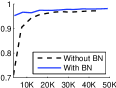
In 2015, Sergey Ioffe and Christian Szegedy addressed a primary bottleneck in deep neural network training by introducing Batch Normalization, a method for standardizing the inputs to each layer within a model. Prior to this research, training deep architectures required precise parameter initialization and small learning rates to prevent the vanishing or exploding of gradients as they propagated through the network. The researchers demonstrated that by standardizing the mean and variance of layer activations for each mini-batch, the training process becomes significantly more robust and efficient, enabling the use of higher learning rates and accelerating the convergence of state-of-the-art architectures.
Internal Covariate Shift and Gradient Stability
The technical justification for Batch Normalization is the reduction of internal covariate shift, defined as the continuous change in the distribution of a layer's inputs during training. As the parameters of a network are updated, the input distribution for each subsequent layer shifts, forcing those layers to constantly adapt to a non-stationary signal. This instability restricts the speed of learning and increases sensitivity to the scale of initialization. By fixing the first and second moments of the input distribution, Batch Normalization ensures that the signal reaching each activation function remains within a stable, non-saturating regime. This finding revealed that the difficulty of training deep networks is fundamentally a problem of stochastic stability rather than model capacity.
The Normalization Transform and Learnable Parameters
The core technical mechanism involves a differentiable transformation applied to each scalar feature independently. For a mini-batch of activations, the algorithm calculates the batch mean and variance to normalize the signal to zero-mean and unit-variance. To ensure that the transformation does not restrict the representational power of the network, the researchers introduced two learnable parameters, (scale) and (shift). These parameters allow the network to autonomously identify the optimal distribution for each layer, including the ability to reconstruct the original activations if the identity transform is required. This methodological choice established a structural mechanism for maintaining signal integrity across the entire computational graph.
Stochastic Regularization and Mini-Batch Dependencies
A secondary effect identified in the research is the role of Batch Normalization as a form of stochastic regularization. Because the normalization of a specific training example depends on the other samples present in its mini-batch, a small amount of noise is introduced into the activation values. This noise acts as a regularizer, reducing the model's reliance on specific parameter configurations and improving generalization on unseen data. However, this dependency also implies that the effectiveness of the normalization is tied to the size and diversity of the mini-batch, suggesting that the stability of the training process remains partially a function of the data sampling strategy.
Impact on Scaling Deep Architectures
The practical significance of Batch Normalization is evidenced by its integration into almost every major deep learning architecture since its introduction. By enabling the training of models that were previously considered too deep to optimize efficiently, the technology facilitated the rapid scaling of convolutional and feed-forward networks. The success of this method proved that the most effective way to accelerate intelligence is to front-load the structural stability of the signal within the model's architecture. This application digitalized the act of initialization, replacing manual tuning with an automated, differentiable process that adapts to the data in real-time.
The Logic of Signal Standardization
The achievement of Batch Normalization demonstrated that the efficiency of a learning system is determined by the consistency of the information flow between its components. The decision to fix internal distributions revealed that the primary constraint on deep learning was the mathematical volatility of the update process. This principle remains central to modern research into normalization techniques, including Layer Normalization and Group Normalization, which seek to achieve similar stability in recurrent and small-batch environments. It leaves open the question of whether there exists a purely deterministic method for signal stabilization that does not rely on the statistical properties of the mini-batch.
Dive Deeper
Batch Normalization (Official PMLR)
PMLR • docs
Explore ResourceBatch Normalization (arXiv Preprint)
arXiv • article
Explore ResourceA Visual Guide to Batch Norm
Towards Data Science • article
Explore Resource
Discussion
0Join the discussion
Sign in to share your thoughts and technical insights.
Loading insights...
Recommended Readings
The author of this article utilized generative AI (Google Gemini 3.1 Pro) to assist in part of the drafting and editing process.